Department of Environmental and Occupational Health, Antibiotic Resistance Action Center, George Washington University, Washington, DC, USA.
Milken Institute School of Public Health, George Washington University, Washington, DC, USA.
Microbiol Spectr. 2024 Jul 2;12(7):e0341523. doi: 10.1128/spectrum.03415-23. Epub 2024 Jun 12.
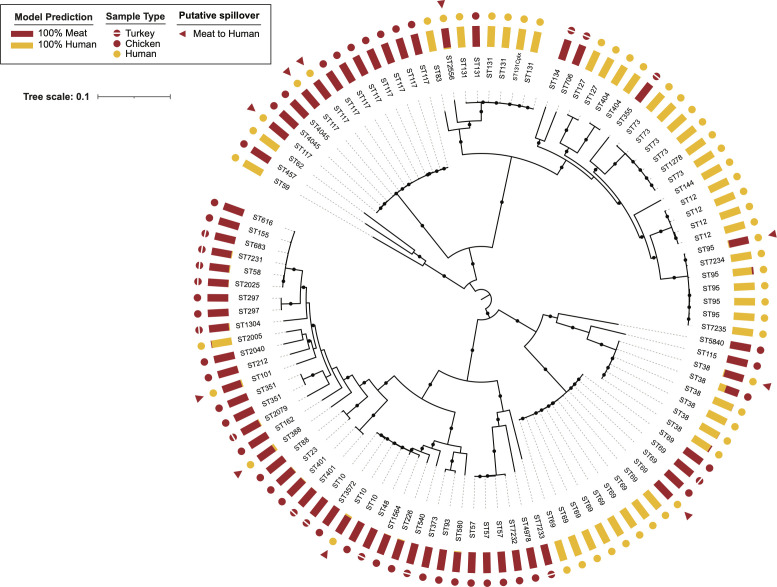
is the leading cause of urinary tract infections (UTIs) in children and adults. The gastrointestinal tract is the primary reservoir of uropathogenic , which can be acquired from a variety of environmental exposures, including retail meat. In the current study, we used a novel statistical-genomic approach to estimate the proportion of pediatric UTIs caused by foodborne zoonotic strains. urine isolates were collected from DC residents aged 2 months to 17 years from the Children's National Medical Center Laboratory, 2013-2014. During the same period, isolates were collected from retail poultry products purchased from 15 sites throughout DC. A total of 52 urine and 56 poultry isolates underwent whole-genome sequencing, core genome phylogenetic analysis, and host-origin prediction by a Bayesian latent class model that incorporated data on the presence of mobile genetic elements (MGEs) among isolates from multiple vertebrate hosts. A total of 56 multilocus sequence types were identified among the isolates. Five sequence types-ST10, ST38, ST69, ST117, and ST131-were observed among both urine and poultry isolates. Using the Bayesian latent class model, we estimated that 19% (10/52) of the clinical isolates in our population were foodborne zoonotic strains. These data suggest that a substantial portion of pediatric UTIs in the Washington DC region may be caused by strains originating in food animals and likely transmitted via contaminated poultry meat.IMPORTANCE UTIs are a heavy public health burden and can have long-term negative health consequences for pediatric patients. has an extremely broad host range, including humans, chickens, turkeys, pigs, and cattle. derived from food animals is a frequent contaminant of retail meat products, but little is known about the risk these strains pose to pediatric populations. Quantifying the proportion of pediatric UTIs caused by food-animal-derived , characterizing the highest-risk strains, and identifying their primary reservoir species could inform novel intervention strategies to reduce UTI burden in this vulnerable population. Our results suggest that retail poultry meat may be an important vehicle for pediatric exposure to zoonotic strains capable of causing UTIs. Vaccinating poultry against the highest-risk strains could potentially reduce poultry colonization, poultry meat contamination, and downstream pediatric infections.
是儿童和成人尿路感染(UTI)的主要原因。胃肠道是尿路致病性的主要储库,它可以通过各种环境暴露获得,包括零售肉类。在目前的研究中,我们使用了一种新的统计基因组方法来估计食源性病原体引起的儿科 UTI 的比例。2013-2014 年,从儿童国家医学中心实验室收集了来自华盛顿特区居民的 2 个月至 17 岁的儿童尿液分离株,同期从特区 15 个地点购买的零售家禽产品中收集了 分离株。总共对 52 份尿液和 56 份家禽分离株进行了全基因组测序、核心基因组系统发育分析和通过贝叶斯潜在类别模型进行的宿主起源预测,该模型整合了来自多种脊椎动物宿主的 分离株中移动遗传元件(MGE)存在的数据。分离株中鉴定出 52 个多位点序列类型。在尿液和家禽分离株中均观察到 5 个序列类型-ST10、ST38、ST69、ST117 和 ST131。使用贝叶斯潜在类别模型,我们估计我们人群中 19%(10/52)的临床 分离株是食源性病原体。这些数据表明,华盛顿特区地区相当一部分儿科 UTI 可能是由源自食用动物的 菌株引起的,并且可能通过受污染的家禽肉传播。重要性 UTI 是一个沉重的公共卫生负担,对儿科患者有长期的负面健康后果。具有极其广泛的宿主范围,包括人类、鸡、火鸡、猪和牛。源自食用动物的 是零售肉类产品的常见污染物,但对这些菌株对儿科人群构成的风险知之甚少。量化由食源性病原体引起的儿科 UTI 的比例、描述风险最高的菌株、并确定其主要储存物种,可以为减少该脆弱人群的 UTI 负担提供新的干预策略。我们的结果表明,零售家禽肉可能是儿童接触能够引起 UTI 的食源性病原体的重要媒介。对家禽进行针对最高风险菌株的疫苗接种可能会减少家禽定植、家禽肉污染和下游儿科感染。