Haverroth Eduardo J, Da-Silva Cristiane J, Taggart Matthew, Oliveira Leonardo A, Cardoso Amanda A
Department of Crop and Soil Sciences, North Carolina State University, Raleigh, NC 27695, USA.
Department of Horticultural Science, North Carolina State University, Raleigh, NC 27695, USA.
Plant Physiol. 2024 Dec 23;197(1). doi: 10.1093/plphys/kiae336.
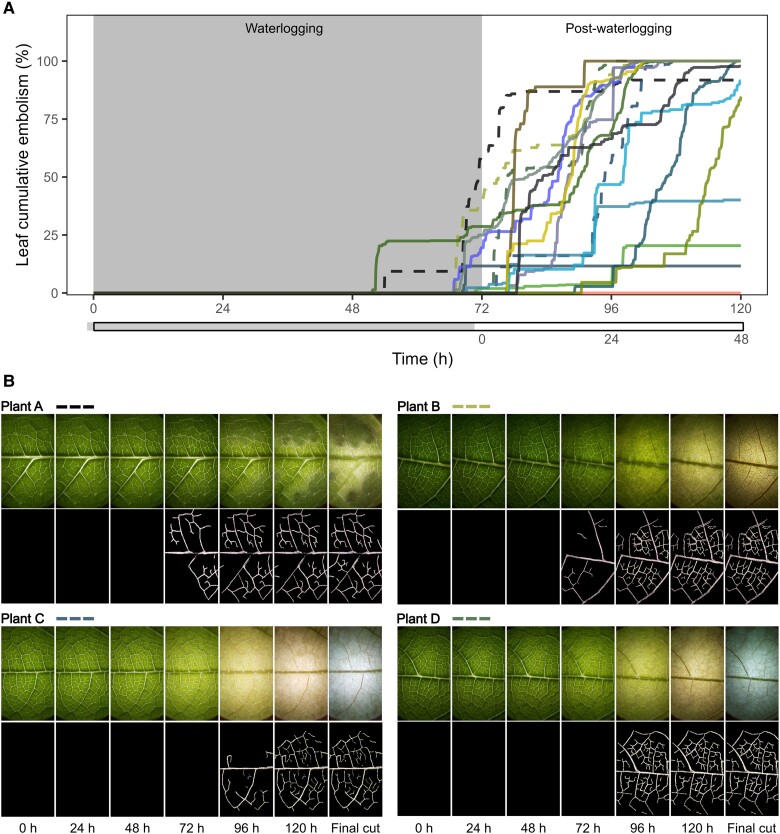
Soil waterlogging and drought correspond to contrasting water extremes resulting in plant dehydration. Dehydration in response to waterlogging occurs due to impairments to root water transport, but no previous study has addressed whether limitations to water transport occur beyond this organ or whether dehydration alone can explain shoot impairments. Using common bean (Phaseolus vulgaris) as a model species, we report that waterlogging also impairs water transport in leaves and stems. During the very first hours of waterlogging, leaves transiently dehydrated to water potentials close to the turgor loss point, possibly driving rapid stomatal closure and partially explaining the decline in leaf hydraulic conductance. The initial decline in leaf hydraulic conductance (occurring within 24 h), however, surpassed the levels predicted to occur based solely on dehydration. Constraints to leaf water transport resulted in a hydraulic disconnection between leaves and stems, furthering leaf dehydration during waterlogging and after soil drainage. As leaves dehydrated later during waterlogging, leaf embolism initiated and extensive embolism levels amplified leaf damage. The hydraulic disconnection between leaves and stems prevented stem water potentials from declining below the threshold for critical embolism levels in response to waterlogging. This allowed plants to survive waterlogging and soil drainage. In summary, leaf and stem dehydration are central in defining plant impairments in response to waterlogging, thus creating similarities between waterlogging and drought. Yet, our findings point to the existence of additional players (likely chemicals) partially controlling the early declines in leaf hydraulic conductance and contributing to leaf damage during waterlogging.
土壤渍水和干旱对应着截然不同的水分极端情况,都会导致植物脱水。因渍水导致的脱水是由于根系水分运输受损引起的,但此前尚无研究探讨水分运输的限制是否超出该器官范围,或者脱水本身是否能够解释地上部分的损伤。以菜豆(Phaseolus vulgaris)作为模式物种,我们发现渍水还会损害叶片和茎中的水分运输。在渍水的最初几个小时内,叶片会短暂脱水至接近膨压丧失点的水势,这可能促使气孔迅速关闭,部分解释了叶片水力导度的下降。然而,叶片水力导度的初始下降(在24小时内发生)超过了仅基于脱水预测的水平。叶片水分运输的限制导致叶片与茎之间出现水力脱节,在渍水期间和土壤排水后加剧了叶片脱水。随着渍水后期叶片脱水,叶片栓塞开始形成,大量的栓塞程度加剧了叶片损伤。叶片与茎之间的水力脱节使茎水势在渍水时不会降至临界栓塞水平的阈值以下。这使得植物能够在渍水和土壤排水后存活下来。总之,叶片和茎的脱水是界定植物对渍水反应损伤的核心因素,从而造成了渍水与干旱之间的相似性。然而,我们的研究结果表明存在其他因素(可能是化学物质)部分控制叶片水力导度的早期下降,并在渍水期间导致叶片损伤。