De Ollas Carlos, González-Guzmán Miguel, Pitarch Zara, Matus José Tomás, Candela Héctor, Rambla José Luis, Granell Antonio, Gómez-Cadenas Aurelio, Arbona Vicent
Departament de Ciències Agràries i del Medi Natural, Universitat Jaume I, Castelló de la Plana, Spain.
Institute for Integrative Systems Biology, Universitat de València - Consejo Superior de Investigaciones Científicas, Paterna, Spain.
Front Plant Sci. 2021 Mar 5;12:613059. doi: 10.3389/fpls.2021.613059. eCollection 2021.
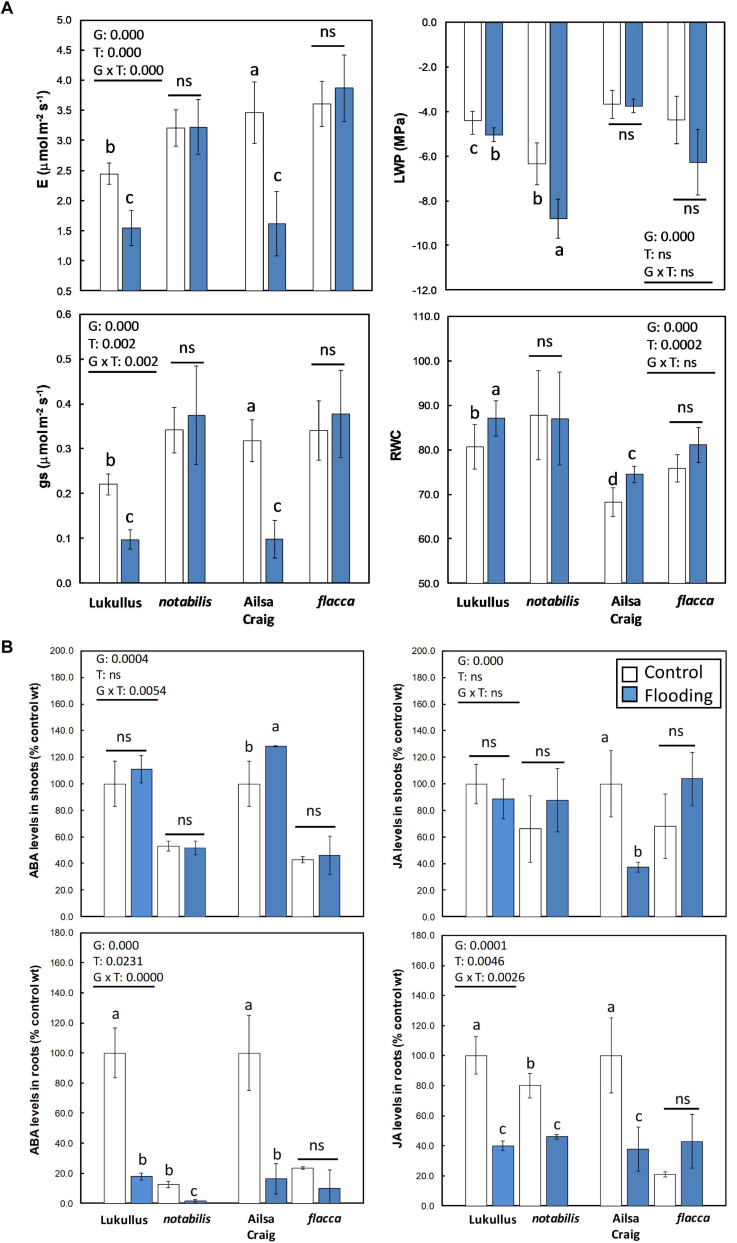
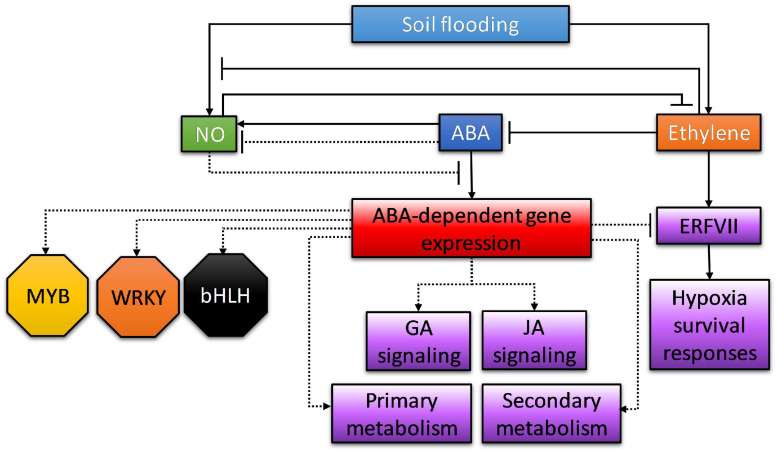
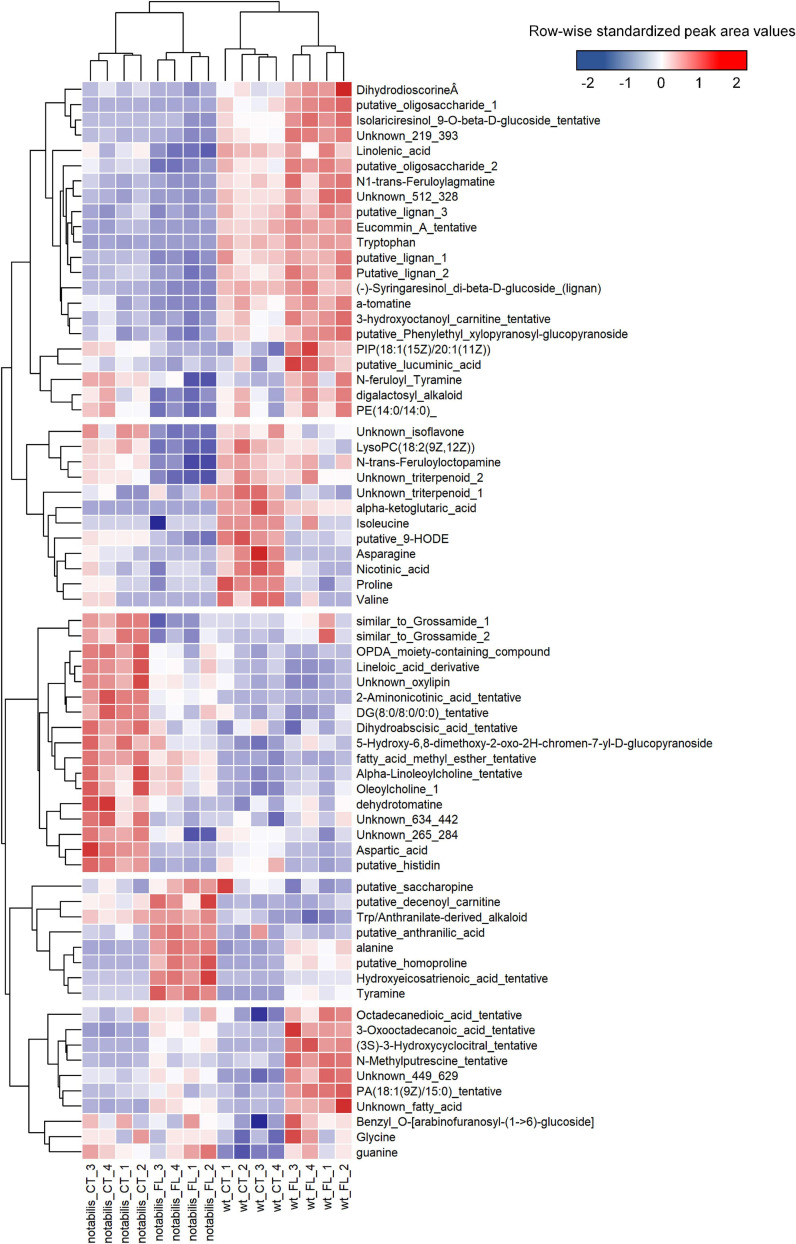
Soil flooding is a compound abiotic stress that alters soil properties and limits atmospheric gas diffusion (O and CO) to the roots. The involvement of abscisic acid (ABA) in the regulation of soil flooding-specific genetic and metabolic responses has been scarcely studied despite its key importance as regulator in other abiotic stress conditions. To attain this objective, wild type and ABA-deficient tomatoes were subjected to short-term (24 h) soil waterlogging. After this period, gas exchange parameters were reduced in the wild type but not in ABA-deficient plants that always had higher and . Transcript and metabolite alterations were more intense in waterlogged tissues, with genotype-specific variations. Waterlogging reduced the ABA levels in the roots while inducing PYR/PYL/RCAR ABA receptors and ABA-dependent transcription factor transcripts, of which induction was less pronounced in the ABA-deficient genotype. Ethylene/O-dependent genetic responses (ERFVIIs, plant anoxia survival responses, and genes involved in the N-degron pathway) were induced in hypoxic tissues independently of the genotype. Interestingly, genes encoding a nitrate reductase and a phytoglobin involved in NO biosynthesis and scavenging and ERFVII stability were induced in waterlogged tissues, but to a lower extent in ABA-deficient tomato. At the metabolic level, flooding-induced accumulation of Ala was enhanced in ABA-deficient lines following a differential accumulation of Glu and Asp in both hypoxic and aerated tissues, supporting their involvement as sources of oxalacetate to feed the tricarboxylic acid cycle in waterlogged tissues and constituting a potential advantage upon long periods of soil waterlogging. The promoter analysis of upregulated genes indicated that the production of oxalacetate from Asp Asp oxidase, energy processes such as acetyl-CoA, ATP, and starch biosynthesis, and the lignification process were likely subjected to ABA regulation. Taken together, these data indicate that ABA depletion in waterlogged tissues acts as a positive signal, inducing several specific genetic and metabolic responses to soil flooding.
土壤淹水是一种复合非生物胁迫,它会改变土壤性质,并限制大气气体(氧气和二氧化碳)向根系的扩散。尽管脱落酸(ABA)作为其他非生物胁迫条件下的关键调节因子具有重要作用,但关于其参与调节土壤淹水特异性遗传和代谢反应的研究却很少。为了实现这一目标,对野生型和ABA缺陷型番茄进行了短期(24小时)土壤渍水处理。在此之后,野生型植株的气体交换参数降低,而ABA缺陷型植株的气体交换参数未降低,且后者的氧气和二氧化碳水平一直较高。转录本和代谢物的变化在渍水组织中更为强烈,且存在基因型特异性差异。渍水降低了根系中的ABA水平,同时诱导了PYR/PYL/RCAR ABA受体和ABA依赖的转录因子转录本,其中ABA缺陷型基因型中的诱导作用不太明显。乙烯/氧气依赖的遗传反应(ERFVIIs、植物缺氧存活反应以及参与N-降解途径的基因)在缺氧组织中被诱导,且与基因型无关。有趣的是,编码参与一氧化氮生物合成和清除以及ERFVII稳定性的硝酸还原酶和植物血红蛋白的基因在渍水组织中被诱导,但在ABA缺陷型番茄中的诱导程度较低。在代谢水平上,在缺氧和通气组织中谷氨酸和天冬氨酸存在差异积累之后,ABA缺陷型品系中淹水诱导的丙氨酸积累增强,这支持了它们作为草酰乙酸来源为渍水组织中的三羧酸循环提供原料,并构成长期土壤渍水时的潜在优势。上调基因的启动子分析表明,天冬氨酸从天冬氨酸氧化酶生成草酰乙酸、乙酰辅酶A等能量过程、ATP和淀粉生物合成以及木质化过程可能受到ABA的调节。综上所述,这些数据表明渍水组织中ABA的消耗作为一个积极信号,诱导了对土壤淹水的几种特异性遗传和代谢反应。