Department of Renewable Resources, University of Alberta, Edmonton T6G 2G7, Canada.
Centre for Prions and Protein Folding Diseases, University of Alberta, Edmonton T6G 2M8, Canada.
Environ Sci Technol. 2024 Jun 25;58(25):10932-10940. doi: 10.1021/acs.est.4c04633. Epub 2024 Jun 12.
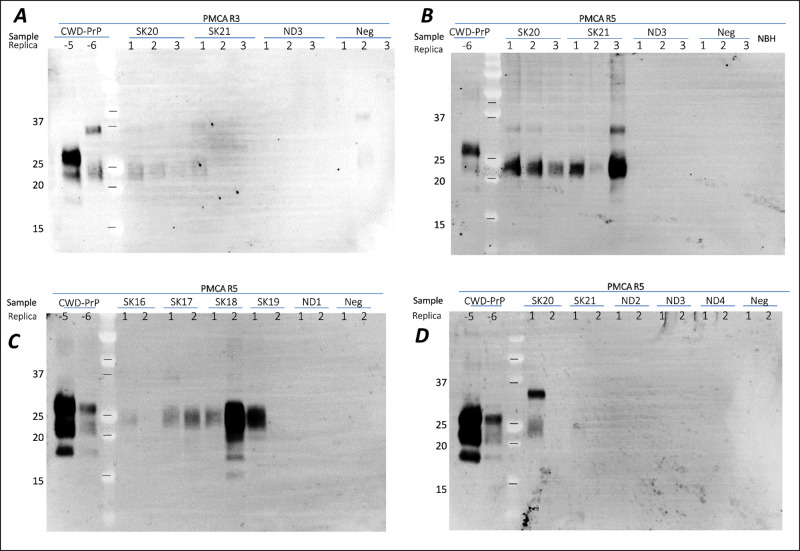
Chronic wasting disease (CWD) is a contagious prion disease that affects cervids in North America, Northern Europe, and South Korea. CWD is spread through direct and indirect horizontal transmission, with both clinical and preclinical animals shedding CWD prions in saliva, urine, and feces. CWD particles can persist in the environment for years, and soils may pose a risk for transmission to susceptible animals. Our study presents a sensitive method for detecting prions in the environmental samples of prairie soils. Soils were collected from CWD-endemic regions with high (Saskatchewan, Canada) and low (North Dakota, USA) CWD prevalence. Heat extraction with SDS-buffer, a serial protein misfolding cyclic amplification assay coupled with a real-time quaking-induced conversion assay was used to detect the presence of CWD prions in soils. In the prairie area of South Saskatchewan where the CWD prevalence rate in male mule deer is greater than 70%, 75% of the soil samples tested were positive, while in the low-prevalence prairie region of North Dakota (11% prevalence in male mule deer), none of the soils contained prion seeding activity. Soil-bound CWD prion detection has the potential to improve our understanding of the environmental spread of CWD, benefiting both surveillance and mitigation approaches.
慢性消耗病(CWD)是一种传染性朊病毒病,影响北美洲、北欧和韩国的鹿科动物。CWD 通过直接和间接水平传播传播,临床和临床前动物的唾液、尿液和粪便中都有 CWD 朊病毒脱落。CWD 颗粒在环境中可以持续存在多年,土壤可能对易感动物的传播构成风险。我们的研究提出了一种检测草原土壤环境样本中朊病毒的敏感方法。从 CWD 流行地区(加拿大萨斯喀彻温省,高流行率;美国北达科他州,低流行率)采集土壤样本。用 SDS-缓冲液进行热提取,结合实时晃动诱导转换分析的系列蛋白质错误折叠循环扩增分析,用于检测土壤中 CWD 朊病毒的存在。在 CWD 流行率大于 70%的南萨斯喀彻温草原地区,75%的土壤样本检测呈阳性,而在北达科他州低流行率的草原地区(雄性骡鹿的流行率为 11%),没有土壤含有朊病毒播种活性。土壤结合的 CWD 朊病毒检测有可能提高我们对 CWD 环境传播的理解,有利于监测和缓解措施。