Pourreza Ghoushchi Vahid, Mompeán Juan, Prieto Pedro M, Artal Pablo
Laboratorio de Óptica, Instituto Universitario de Investigación en Óptica y Nanofísica, Universidad de Murcia, Campus de Espinardo (Edificio 34), E-30100 Murcia, Spain.
Biomed Opt Express. 2024 May 20;15(6):3848-3858. doi: 10.1364/BOE.521340. eCollection 2024 Jun 1.
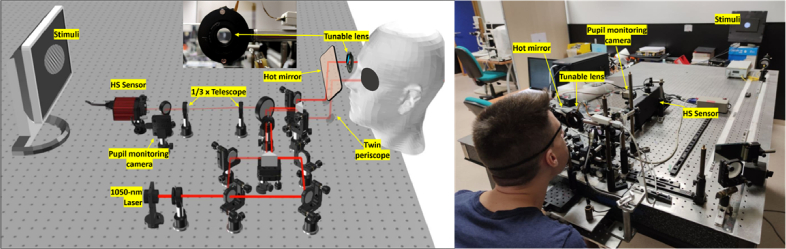
This study investigates the potential effects of periodic defocus oscillations on contrast sensitivity. Sinusoidal fluctuations at 5, 15, and 25 Hz, with defocus peak-to-valley values ranging from 0.15 to 3 D, were induced by means of a focus-tunable lens after calibrating its dynamic behavior. Monocular contrast sensitivity was measured on five young emmetropic subjects. The experimental data shows that contrast sensitivity loss due to defocus fluctuations is low for a wide range of frequencies and amplitudes. Only for the more severe case studied (25 Hz, ± 1.5 D) contrast threshold showed a clear increase in most subjects. Qualitative comparison of the empirical data with a simulation of modulation loss due to time integration of defocused retinal point spread functions, suggests a short integration time by the eye for defocus blur, around or even below a hundredth of a second.
本研究调查了周期性散焦振荡对对比度敏感度的潜在影响。在校准其动态行为后,通过一个可调节焦距的透镜产生了频率为5、15和25Hz的正弦波动,散焦峰谷值范围为0.15至3D。对五名年轻正视眼受试者的单眼对比度敏感度进行了测量。实验数据表明,在很宽的频率和幅度范围内,由散焦波动导致的对比度敏感度损失较低。仅在所研究的更严重的情况(25Hz,±1.5D)下,大多数受试者的对比度阈值出现了明显增加。将实验数据与散焦视网膜点扩散函数时间积分导致的调制损失模拟进行定性比较,表明眼睛对散焦模糊的积分时间较短,约为甚至低于百分之一秒。