Kuemmerli Christoph, Linke Katja, Daume Diana, Germann Nicolas, Peterli Ralph, Müller-Stich Beat, Klasen Jennifer M
Department of Visceral Surgery, Clarunis University Digestive Health Care Center Basel, Spitalstrasse 21, Basel, 4031, Switzerland.
Department of General Surgery, Lucerne Cantonal Hospital, Lucerne, Switzerland.
Langenbecks Arch Surg. 2024 Jun 13;409(1):186. doi: 10.1007/s00423-024-03375-z.
The purpose of this study was to assess the effect of training with a personal, portable laparoscopic endo-trainer (PLET) on residents' laparoscopic skills.
The study took place at a tertiary-care academic university hospital in Switzerland. All participants were randomized to either a home- or hospital-based PLET training group, and surgical skill performance was assessed using five laparoscopic exercises. 24 surgical residents, 13 females and 11 males, were enrolled at any training stage. Nine residents completed the assessments. Endpoints consisted of subjective and objective assessment ratings as well as exercise time and qualitative data up to 12 weeks. The primary outcome was the difference in exercise time and secondary outcomes included performance scores as well as qualitative data.
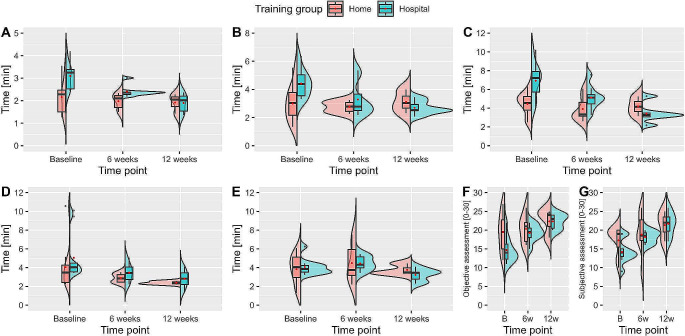
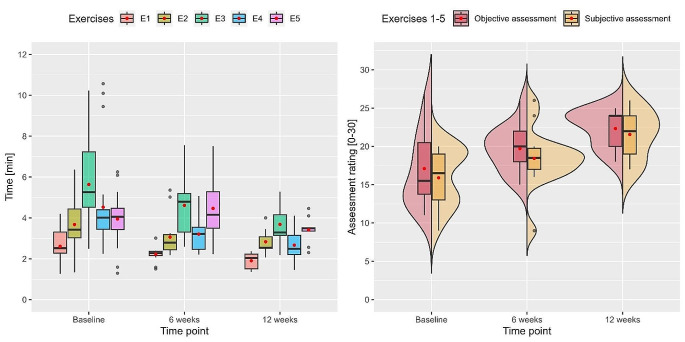
The hospital-based training group performed exercises number 1, 3 and 4 faster at 12 weeks than at baseline (p = .003, < 0.001 and 0.024). Surgical skill performance was not statistically significantly different in any of the endpoints between the hospital- and home-based training groups at 12 weeks. Both the subjective and objective assessment ratings significantly improved in the hospital-based training group between baseline and 12 weeks (p = .006 and 0.003, respectively). There was no statistically significant improvement in exercise time as well as subjective and objective assessment ratings over time in the home-based training group. The qualitative data suggested that participants who were randomized to the hospital-based training group wished to have the PLET at home and vice versa. Several participants across groups lacked motivation because of their workload or time constraints, though most believed the COVID-19 pandemic had no influence on their motivation or the time they had for training.
The PLET enhances laparoscopic surgical skills over time in a hospital-based training setting. In order to understand and optimize motivational factors, further research is needed.
This trial was retrospectively registered on clinicaltrials.gov (NCT06301230).
本研究旨在评估使用个人便携式腹腔镜内镜训练器(PLET)进行培训对住院医师腹腔镜技能的影响。
该研究在瑞士一家三级医疗学术大学医院进行。所有参与者被随机分为家庭或医院为基础的PLET训练组,并使用五项腹腔镜练习评估手术技能表现。24名外科住院医师(13名女性和11名男性)在任何训练阶段入组。9名住院医师完成了评估。观察指标包括主观和客观评估评分、练习时间以及长达12周的定性数据。主要结局是练习时间的差异,次要结局包括表现评分以及定性数据。
以医院为基础的训练组在12周时完成第1、3和4项练习的速度比基线时更快(p = 0.003、<0.001和0.024)。在12周时,以医院和家庭为基础的训练组在任何观察指标上的手术技能表现均无统计学显著差异。以医院为基础的训练组在基线和12周之间主观和客观评估评分均显著改善(分别为p = 0.006和0.003)。以家庭为基础的训练组在练习时间以及主观和客观评估评分方面随时间没有统计学显著改善。定性数据表明,被随机分配到以医院为基础的训练组的参与者希望在家中使用PLET,反之亦然。尽管大多数人认为新冠疫情对他们的积极性或训练时间没有影响,但各组中有几名参与者由于工作量或时间限制而缺乏动力。
在以医院为基础的训练环境中,随着时间的推移,PLET可提高腹腔镜手术技能。为了理解和优化激励因素,需要进一步研究。
本试验在clinicaltrials.gov上进行了回顾性注册(NCT06301230)。