Margalit Ili, Yahav Dafna, Hoffman Tomer, Tabah Alexis, Ruckly Stéphane, Barbier François, Singer Pierre, Timsit Jean-François, Prendki Virginie, Buetti Niccolò
Infectious Diseases Unit, Sheba Medical Center, Ramat-Gan, Israel.
Faculty of Medical & Health Sciences, Tel Aviv University, Ramat Aviv, Tel Aviv, Israel.
Infection. 2024 Dec;52(6):2435-2443. doi: 10.1007/s15010-024-02304-y. Epub 2024 Jun 13.
Older adults admitted to the intensive care unit (ICU) usually have fair baseline functional capacity, yet their age and frailty may compromise their management. We compared the characteristics and management of older (≥ 75 years) versus younger adults hospitalized in ICU with hospital-acquired bloodstream infection (HA-BSI).
Nested cohort study within the EUROBACT-2 database, a multinational prospective cohort study including adults (≥ 18 years) hospitalized in the ICU during 2019-2021. We compared older versus younger adults in terms of infection characteristics (clinical signs and symptoms, source, and microbiological data), management (imaging, source control, antimicrobial therapy), and outcomes (28-day mortality and hospital discharge).
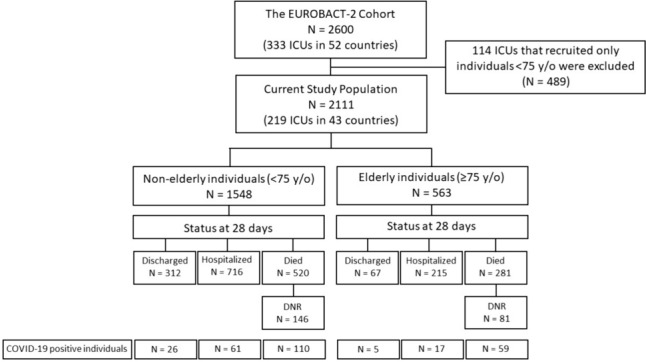
Among 2111 individuals hospitalized in 219 ICUs with HA-BSI, 563 (27%) were ≥ 75 years old. Compared to younger patients, these individuals had higher comorbidity score and lower functional capacity; presented more often with a pulmonary, urinary, or unknown HA-BSI source; and had lower heart rate, blood pressure and temperature at presentation. Pathogens and resistance rates were similar in both groups. Differences in management included mainly lower rates of effective source control achievement among aged individuals. Older adults also had significantly higher day-28 mortality (50% versus 34%, p < 0.001), and lower rates of discharge from hospital (12% versus 20%, p < 0.001) by this time.
Older adults with HA-BSI hospitalized in ICU have different baseline characteristics and source of infection compared to younger patients. Management of older adults differs mainly by lower probability to achieve source control. This should be targeted to improve outcomes among older ICU patients.
入住重症监护病房(ICU)的老年人通常基线功能能力尚可,但其年龄和虚弱状况可能会影响对他们的治疗管理。我们比较了因医院获得性血流感染(HA-BSI)入住ICU的老年人(≥75岁)与年轻人的特征及治疗管理情况。
在EUROBACT-2数据库内进行巢式队列研究,这是一项多国前瞻性队列研究,纳入了2019年至2021年期间入住ICU的成年人(≥18岁)。我们比较了老年人与年轻人在感染特征(临床症状和体征、感染源及微生物学数据)、治疗管理(影像学检查、感染源控制、抗菌治疗)及结局(28天死亡率和出院情况)方面的差异。
在219个ICU中因HA-BSI住院的2111名患者中,563名(27%)年龄≥75岁。与年轻患者相比,这些患者合并症评分更高、功能能力更低;肺部、泌尿系统或感染源不明的HA-BSI更为常见;就诊时心率、血压和体温更低。两组的病原体及耐药率相似。治疗管理方面的差异主要包括老年患者有效感染源控制达成率较低。到此时,老年人28天死亡率也显著更高(50%对34%,p<0.001),出院率更低(12%对20%,p<0.001)。
与年轻患者相比,因HA-BSI入住ICU的老年患者具有不同的基线特征和感染源。老年患者的治疗管理主要差异在于感染源控制达成概率较低。应针对这一点改善老年ICU患者的结局。