Boot Iris W A, Planken R Nils, den Hartog Alexander W, Vrijhoef Hubertus J M
Panaxea B.V., Den Bosch, The Netherlands.
Department of Radiology and Nuclear Medicine, Amsterdam University Medical Centers, Location AMC, Amsterdam, The Netherlands.
PLoS One. 2024 Jun 13;19(6):e0305189. doi: 10.1371/journal.pone.0305189. eCollection 2024.
The aim of this early-stage Health Technology Assessment (HTA) was to assess the difference in healthcare costs and effects of fractional flow reserve derived from coronary computed tomography (FFRct) compared to standard diagnostics in patients with stable chest pain in The Netherlands.
A decision-tree model was developed to assess the difference in total costs from the hospital perspective, probability of correct diagnoses, and risk of major adverse cardiovascular events at one year follow-up. One-way sensitivity analyses were conducted to determine the main drivers of the cost difference between the strategies. A threshold analysis on the added price of FFRct analysis (computational analysis only) was conducted.
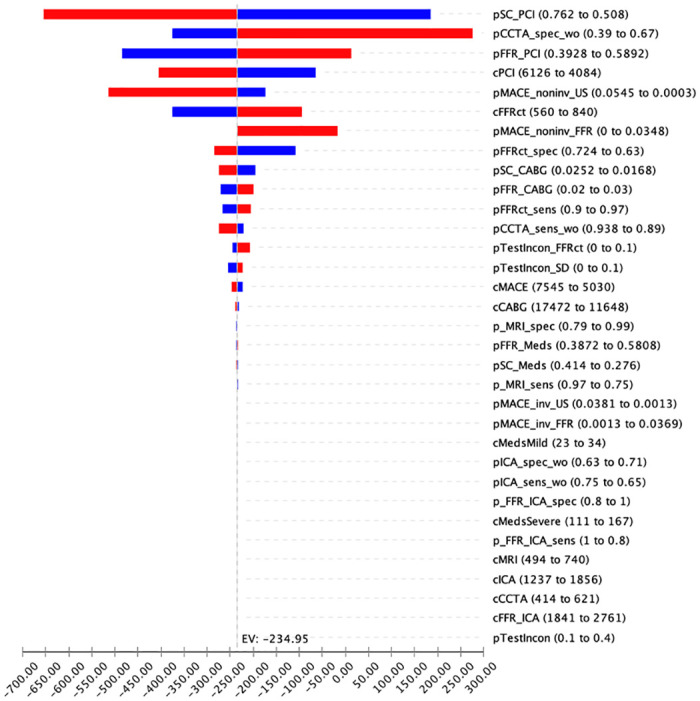
The mean one-year costs were €2,680 per patient for FFRct and €2,915 per patient for standard diagnostics. The one-year probability of correct diagnoses was 0.78 and 0.61, and the probability of major adverse cardiovascular events was 1.92x10⁻⁵ and 0.01, respectively. The probability and costs of revascularization and the specificity of coronary computed tomography angiography had the greatest effect on the difference in costs between the strategies. The added price of FFRct analysis should be below €935 per patient to be considered the least costly option.
The early-stage HTA findings suggest that FFRct may reduce total healthcare spending, probability of incorrect diagnoses, and major adverse cardiovascular events compared to current diagnostics for patients with stable chest pain in the Dutch healthcare setting over one year. Future cost-effectiveness studies should determine a value-based pricing for FFRct and quantify the economic value of the anticipated therapeutic impact.
这项早期卫生技术评估(HTA)的目的是评估在荷兰,对于稳定型胸痛患者,与标准诊断方法相比,基于冠状动脉计算机断层扫描的血流储备分数(FFRct)在医疗成本和效果方面的差异。
开发了一个决策树模型,从医院角度评估总成本差异、正确诊断的概率以及一年随访时主要不良心血管事件的风险。进行单向敏感性分析以确定不同策略间成本差异的主要驱动因素。对FFRct分析的附加价格(仅计算分析)进行阈值分析。
FFRct组患者的平均一年成本为每人2680欧元,标准诊断组为每人2915欧元。一年正确诊断的概率分别为0.78和0.61,主要不良心血管事件的概率分别为1.92×10⁻⁵和0.01。血运重建的概率和成本以及冠状动脉计算机断层扫描血管造影的特异性对不同策略间的成本差异影响最大。FFRct分析的附加价格应低于每人935欧元,才能被视为成本最低的选择。
早期HTA结果表明,在荷兰医疗环境中,对于稳定型胸痛患者,与当前诊断方法相比,FFRct在一年中可能会降低总医疗支出、错误诊断的概率以及主要不良心血管事件。未来的成本效益研究应确定FFRct基于价值的定价,并量化预期治疗效果的经济价值。