Yilak Gizachew, Tilahun Befikad Derese, Abate Biruk Beletew, Zemariam Alemu Birara, Lake Eyob Shitie, Ayele Mulat, Belay Alemayehu Sayih
Department of Nursing, College of Health Sciences, Woldia University, Woldia, Ethiopia.
Department of Midwifery, College of Health Sciences, Woldia University, Woldia, Ethiopia.
PLoS One. 2024 Jun 13;19(6):e0303749. doi: 10.1371/journal.pone.0303749. eCollection 2024.
Poor attachment, suckling, and positioning contribute to ineffective breastfeeding techniques. Poor weight gain, stunting, and decreased immunity are caused by insufficient breast milk intake owing to ineffective breastfeeding techniques. Numerous primary studies conducted in Ethiopia have revealed negative effects of ineffective breastfeeding techniques. However, inconsistencies have been observed among these studies, and no review has been conducted to report the amalgamated magnitude and associated factors. Therefore, this review aimed to estimate the national prevalence and factors associated with ineffective breastfeeding techniques in Ethiopia.
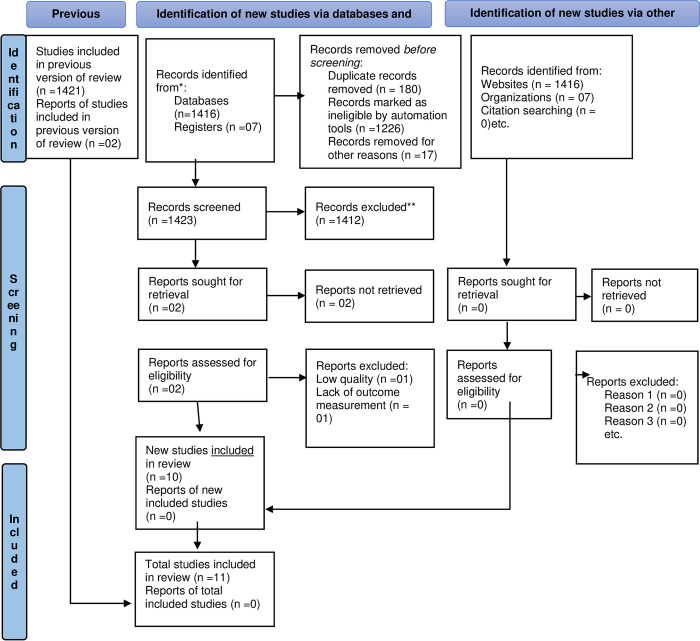
Using PRISMA standards, we systematically reviewed and meta-analyzed articles from PubMed, Cochrane Library, and Google Scholar to investigate the prevalence and associated factors of ineffective breastfeeding techniques. Q and I2 tests were used to assess heterogeneity across studies. To evaluate the national prevalence and effect size of the linked covariates, a weighted inverse variance random-effects model was used. Subgroup analysis was performed based on the region, sample size, and year of publication. Funnel plots and Egger's regression tests were used to examine publication bias. A sensitivity analysis was also performed to determine the impact of the studies.
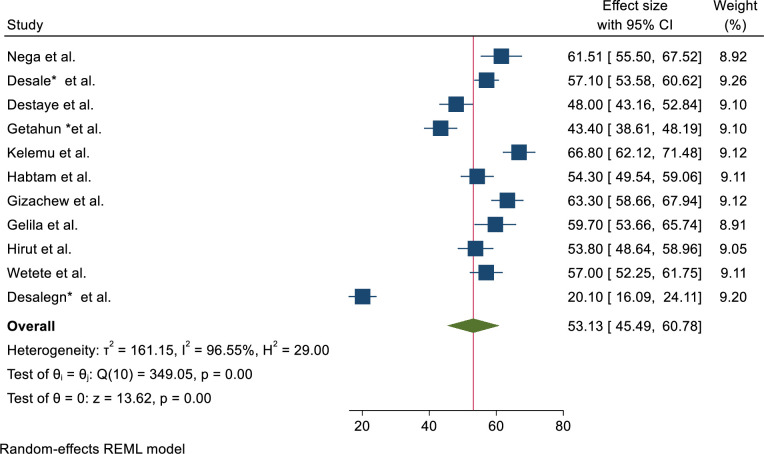
The analysis included a total of eleven studies with 4,470 participants used in the analysis. The pooled prevalence of ineffective breastfeeding techniques in Ethiopia was 53.13% (45.49, 60.78) no formal education (AOR = 3.42; 95% CI:1.67-5.18; I2 = 72.2%; P = 0.0132), primipara (AOR = 2.72;95% CI:1.81-3.64; I2 = 46.7%; P = 0.131), postnatal care (PNC) (AOR = 1.84; 95% CI:1.35-2.32; I2 = 0%; P = 0.53), breastfeeding counseling (AOR = 1.93; 95% CI:1.23-2.63; I2 = 0%;P = 0.35), home delivery and having breast problem (AOR = 3.11; 95% CI:1.09-5.16; I2 = 0%;P = 0.877) and (AOR = 2.22; 95% CI:1.28-3.16; I2 = 0%;P = 0.80) respectively were significantly associated with ineffective breastfeeding techniques.
The prevalence of ineffective breastfeeding techniques in Ethiopia remains high. Policymakers and program officials should focus on empowering women, increasing institutional delivery, and providing counseling on breastfeeding throughout the maternal continuum of care. These measures will improve breastfeeding techniques and lead to better health of both infants and women.
不良的依恋、吸吮和姿势会导致母乳喂养技术无效。由于母乳喂养技术无效导致母乳摄入量不足,进而引起体重增加不佳、发育迟缓以及免疫力下降。在埃塞俄比亚进行的众多初步研究揭示了无效母乳喂养技术的负面影响。然而,这些研究之间存在不一致之处,并且尚未进行综述来报告综合影响程度及相关因素。因此,本综述旨在估计埃塞俄比亚无效母乳喂养技术的全国患病率及其相关因素。
我们采用PRISMA标准,系统地回顾和荟萃分析了来自PubMed、Cochrane图书馆和谷歌学术的文章,以调查无效母乳喂养技术的患病率及其相关因素。使用Q检验和I²检验评估各研究之间的异质性。为了评估相关协变量的全国患病率和效应大小,我们使用了加权逆方差随机效应模型。根据地区、样本量和发表年份进行亚组分析。使用漏斗图和Egger回归检验来检查发表偏倚。还进行了敏感性分析以确定各项研究的影响。
该分析共纳入了11项研究,总计4470名参与者。埃塞俄比亚无效母乳喂养技术综合患病率为53.13%(45.49,60.78)。未接受过正规教育(比值比[AOR]=3.42;95%置信区间[CI]:1.67 - 5.18;I²=۷۲٫۲%;P=0.0132)、初产妇(AOR=2.72;95%CI:1.81 - 3.64;I²=46.7%;P=0.131)、产后护理(PNC)(AOR=1.84;95%CI:1.35 - 2.32;I²=0%;P=0.53)、母乳喂养咨询(AOR=1.93;95%CI:1.23 - 2.63;I²=0%;P=0.35)、在家分娩以及有乳房问题(AOR=3.11;95%CI:1.09 - 5.16;I²=۰%;P=0.877)和(AOR=2.22;95%CI:1.28 - 3.16;I²=0%;P=0.80)分别与无效母乳喂养技术显著相关。
埃塞俄比亚无效母乳喂养技术的患病率仍然很高。政策制定者和项目官员应专注于增强妇女权能、增加机构分娩,并在孕产妇连续护理过程中提供母乳喂养咨询。这些措施将改善母乳喂养技术,并使婴儿和妇女的健康状况更佳。