Research Institute of Medical Sciences, Chonnam National University Medical School, Hwasun, Jeonnam 58128, Republic of Korea.
Department of Obstetrics and Gynecology, Chosun University College of Medicine, Gwangju 61452, Republic of Korea.
Oncol Rep. 2024 Jul;52(1). doi: 10.3892/or.2024.8756. Epub 2024 Jun 14.
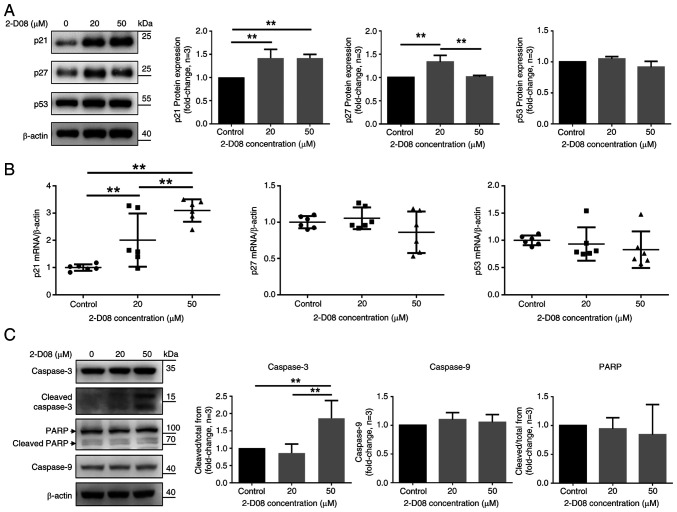
2',3',4'‑trihydroxyflavone (2‑D08), a SUMO E2 inhibitor, has several biological functions, including anticancer activity, but its effects on uterine leiomyosarcoma (Ut‑LMS) are unknown. The anticancer activity of 2‑D08 was explored in an model using SK‑LMS‑1 and SK‑UT‑1B cells (human Ut‑LMS cells). Treatment with 2‑D08 inhibited cell viability in a dose‑ and time‑dependent manner and significantly inhibited the colony‑forming ability of Ut‑LMS cells. In SK‑UT‑1B cells treated with 2‑D08, flow cytometric analysis revealed a slight increase in apoptotic rates, while cell cycle progression remained unaffected. Western blotting revealed elevated levels of RIP1, indicating induction of necrosis, but LC3B levels remained unchanged, suggesting no effect on autophagy. A lactate dehydrogenase (LDH) assay confirmed increased LDH release, further supporting the induction of apoptosis and necrosis by 2‑D08 in SK‑UT‑1B cells. 2‑D08‑induced production of reactive oxygen species and apoptosis progression were observed in SK‑LMS‑1 cells. Using Ki67 staining and bromodeoxyuridine assays, it was found that 2‑D08 suppressed proliferation in SK‑LMS‑1 cells, while treatment for 48 h led to cell‑cycle arrest. 2‑D08 upregulated p21 protein expression in SK‑LMS‑1 cells and promoted apoptosis through caspase‑3. Evaluation of α‑SM‑actin, calponin 1 and TAGLN expression indicated that 2‑D08 did not directly initiate smooth muscle phenotypic switching in SK‑LMS‑1 cells. Transcriptome analysis on 2‑D08‑treated SK‑LMS‑1 cells identified significant differences in gene expression and suggested that 2‑D08 modulates cell‑cycle‑ and apoptosis‑related pathways. The analysis identified several differentially expressed genes and significant enrichment for biological processes related to DNA replication and molecular functions associated with the apoptotic process. It was concluded that 2‑D08 exerts antitumor effects in Ut‑LMS cells by modulating multiple signaling pathways and that 2‑D08 may be a promising candidate for the treatment of human Ut‑LMS. The present study expanded and developed knowledge regarding Ut‑LMS management and indicated that 2‑D08 represents a notable finding in the exploration of fresh treatment options for such cancerous tumors.
2',3',4'‑三羟基黄酮(2‑D08),一种 SUMO E2 抑制剂,具有多种生物学功能,包括抗癌活性,但它对子宫平滑肌肉瘤(Ut‑LMS)的影响尚不清楚。在 SK‑LMS‑1 和 SK‑UT‑1B 细胞(人 Ut‑LMS 细胞)模型中探索了 2‑D08 的抗癌活性。用 2‑D08 处理以剂量和时间依赖的方式抑制细胞活力,并显著抑制 Ut‑LMS 细胞的集落形成能力。在用 2‑D08 处理的 SK‑UT‑1B 细胞中,流式细胞术分析显示凋亡率略有增加,而细胞周期进程不受影响。Western blot 显示 RIP1 水平升高,表明诱导坏死,但 LC3B 水平保持不变,表明对自噬没有影响。乳酸脱氢酶(LDH)测定证实 LDH 释放增加,进一步支持 2‑D08 在 SK‑UT‑1B 细胞中诱导凋亡和坏死。在 SK‑LMS‑1 细胞中观察到 2‑D08 诱导的活性氧产生和凋亡进展。通过 Ki67 染色和溴脱氧尿苷测定发现,2‑D08 抑制 SK‑LMS‑1 细胞的增殖,而处理 48 小时导致细胞周期停滞。2‑D08 在 SK‑LMS‑1 细胞中上调 p21 蛋白表达,并通过 caspase‑3 促进凋亡。α‑SM‑肌动蛋白、钙调蛋白 1 和 TAGLN 表达的评估表明,2‑D08 不会直接在 SK‑LMS‑1 细胞中引发平滑肌表型转换。对 2‑D08 处理的 SK‑LMS‑1 细胞进行转录组分析发现基因表达存在显著差异,并表明 2‑D08 调节细胞周期和凋亡相关途径。分析确定了几个差异表达的基因,并对与 DNA 复制相关的生物学过程和与凋亡过程相关的分子功能进行了显著富集。研究得出结论,2‑D08 通过调节多种信号通路对 Ut‑LMS 细胞发挥抗肿瘤作用,2‑D08 可能是治疗人类 Ut‑LMS 的有前途的候选药物。本研究扩展和发展了 Ut‑LMS 管理的知识,并表明 2‑D08 代表了对这些癌症肿瘤新治疗方案探索的重要发现。