Université de La Réunion, Unité Mixte de Recherche Processus Infectieux en Milieu Insulaire Tropical (UMR PIMIT), CNRS 9192, INSERM 1187, IRD 249, Plateforme Technologique CYROI, Sainte Clotilde, La Réunion, France.
Evolutionary Anthropology, Duke University, Durham, North Carolina, United States of America.
PLoS Negl Trop Dis. 2024 Jun 14;18(6):e0012263. doi: 10.1371/journal.pntd.0012263. eCollection 2024 Jun.
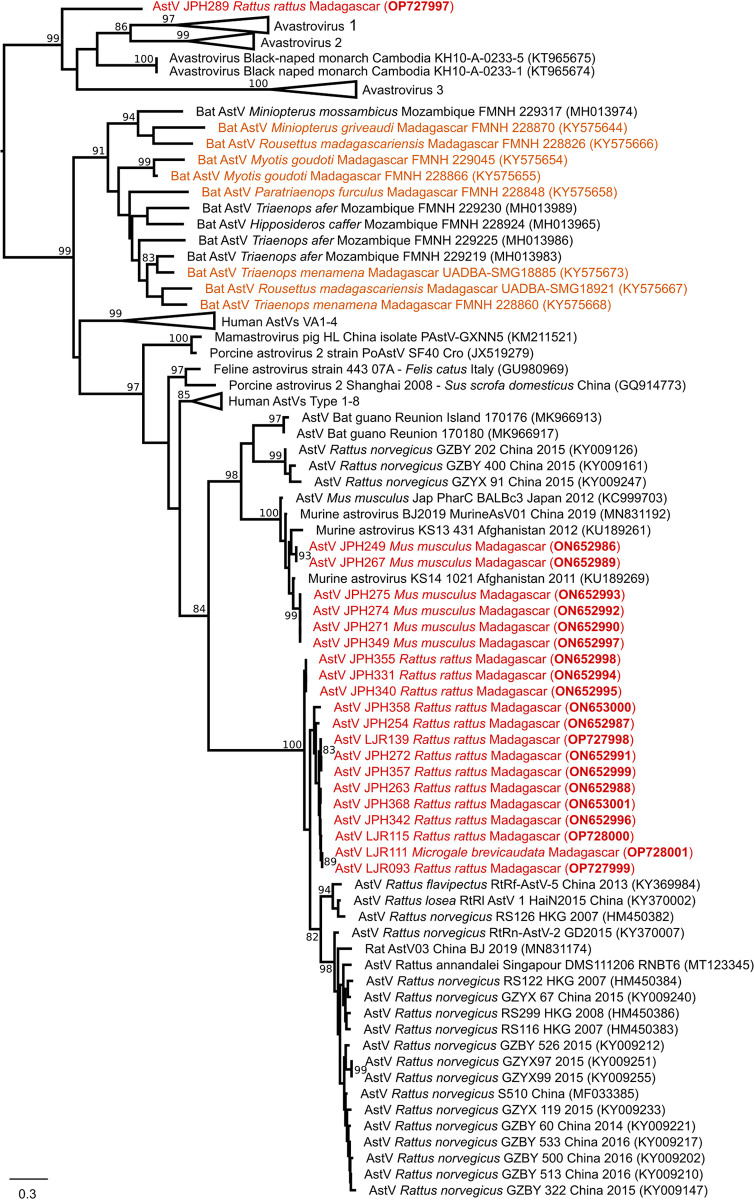
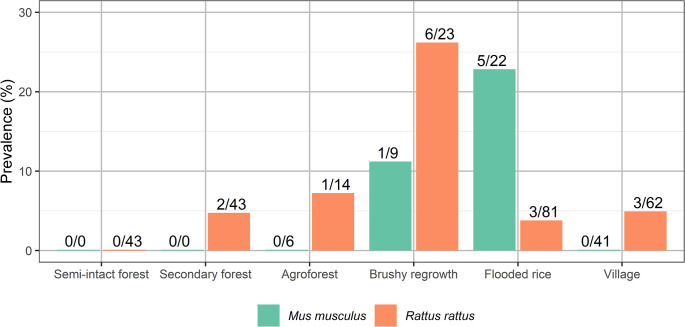
Small terrestrial mammals are major hosts of infectious agents responsible for zoonotic diseases. Astroviruses (AstVs)-the cause of non-bacterial gastroenteritis mainly affecting young children-have been detected in a wide array of mammalian and avian host species. However, understanding the factors that influence AstV infection within and across hosts is limited. Here, we investigated the impact of land use changes on AstVs in terrestrial small mammals in rural northeastern Madagascar. We sampled 515 small mammals, representing seven endemic and four introduced species. Twenty-two positive samples were identified, all but one of which were found in the introduced species Mus musculus and Rattus rattus (family Muridae), with a positivity rate of 7.7% (6/78) and 5.6% (15/266), respectively. The non-introduced rodent case was from an endemic shrew-tenrec (family Tenrecidae). We found the highest positivity rate of AstVs infection in brushy regrowth (17.5%, 7/40) as compared to flooded rice fields (4.60%, 8/174), secondary forest (4.1%, 3/74), agroforest (3.6%, 1/28), village (2.61%, 3/115), and semi-intact forest (0%, 0/84). A phylogenetic analysis revealed an association between AstVs and their rodent host species. None of the viruses were phylogenetically related to AstVs previously described in Malagasy bats. This study supports AstV circulation in synanthropic animals in agricultural habitats of Madagascar and highlights the need to assess the spillover risk to human populations in rural areas.
陆生小型哺乳动物是引发人畜共患病的传染性病原体的主要宿主。星状病毒(AstVs)是导致主要影响婴幼儿的非细菌性肠胃炎的病原体,已在多种哺乳动物和禽类宿主中被检测到。然而,对于宿主内部和之间影响 AstV 感染的因素了解有限。在这里,我们研究了土地利用变化对马达加斯加农村陆生小型哺乳动物中 AstVs 的影响。我们对 515 只小型哺乳动物进行了采样,这些动物代表了七个特有种和四个引入种。鉴定出 22 个阳性样本,除了一个之外,都在引入种小家鼠和褐家鼠(鼠科)中发现,阳性率分别为 7.7%(6/78)和 5.6%(15/266)。非引入种啮齿动物是一种特有鼩鼱(鼩鼱科)。我们发现,AstVs 感染的阳性率在灌木丛再生地最高(17.5%,7/40),而水淹稻田(4.60%,8/174)、次生林(4.1%,3/74)、农林复合地(3.6%,1/28)、村庄(2.61%,3/115)和半完整森林(0%,0/84)中较低。系统进化分析显示 AstVs 与它们的啮齿动物宿主之间存在关联。这些病毒与之前在马达加斯加蝙蝠中描述的 AstVs 均无系统进化关系。本研究支持 AstV 在马达加斯加农业生境中适应人类环境的动物中循环,并强调需要评估向农村人口溢出的风险。