Barry Barbara, Zhu Xuan, Behnken Emma, Inselman Jonathan, Schaepe Karen, McCoy Rozalina, Rushlow David, Noseworthy Peter, Richardson Jordan, Curtis Susan, Sharp Richard, Misra Artika, Akfaly Abdulla, Molling Paul, Bernard Matthew, Yao Xiaoxi
Division of Health Care Delivery Research, Mayo Clinic, Rochester, MN, United States.
Robert D. and Patricia E. Kern Center for the Science of Health Care Delivery, Mayo Clinic, Rochester, MN, United States.
JMIR AI. 2022 Oct 14;1(1):e41940. doi: 10.2196/41940.
The promise of artificial intelligence (AI) to transform health care is threatened by a tangle of challenges that emerge as new AI tools are introduced into clinical practice. AI tools with high accuracy, especially those that detect asymptomatic cases, may be hindered by barriers to adoption. Understanding provider needs and concerns is critical to inform implementation strategies that improve provider buy-in and adoption of AI tools in medicine.
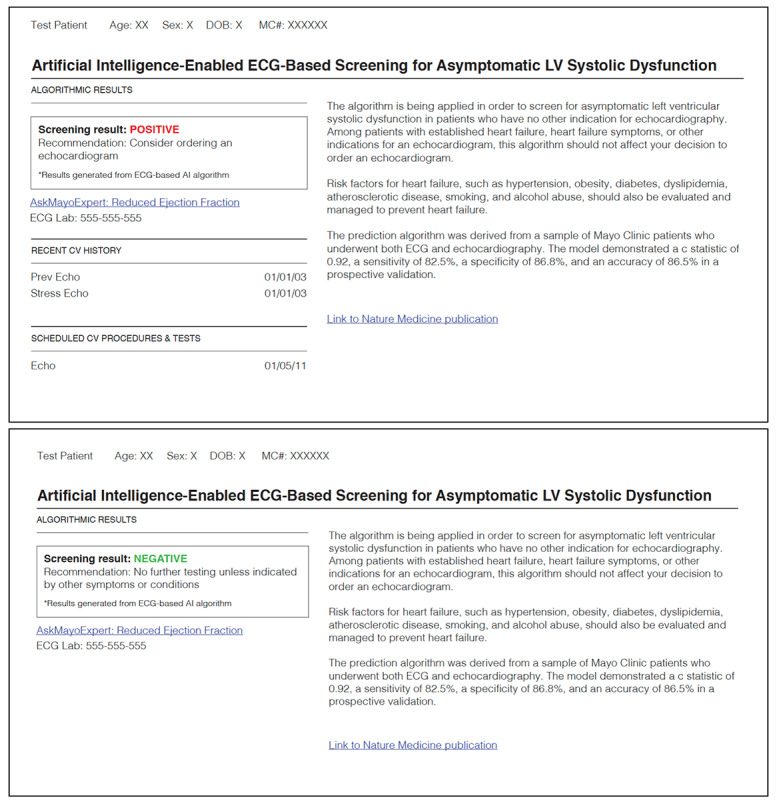
This study aimed to describe provider perspectives on the adoption of an AI-enabled screening tool in primary care to inform effective integration and sustained use.
A qualitative study was conducted between December 2019 and February 2020 as part of a pragmatic randomized controlled trial at a large academic medical center in the United States. In all, 29 primary care providers were purposively sampled using a positive deviance approach for participation in semistructured focus groups after their use of the AI tool in the randomized controlled trial was complete. Focus group data were analyzed using a grounded theory approach; iterative analysis was conducted to identify codes and themes, which were synthesized into findings.
Our findings revealed that providers understood the purpose and functionality of the AI tool and saw potential value for more accurate and faster diagnoses. However, successful adoption into routine patient care requires the smooth integration of the tool with clinical decision-making and existing workflow to address provider needs and preferences during implementation. To fulfill the AI tool's promise of clinical value, providers identified areas for improvement including integration with clinical decision-making, cost-effectiveness and resource allocation, provider training, workflow integration, care pathway coordination, and provider-patient communication.
The implementation of AI-enabled tools in medicine can benefit from sensitivity to the nuanced context of care and provider needs to enable the useful adoption of AI tools at the point of care.
ClinicalTrials.gov NCT04000087; https://clinicaltrials.gov/ct2/show/NCT04000087.
随着新的人工智能(AI)工具被引入临床实践,一系列棘手的挑战威胁着AI改变医疗保健的前景。具有高精度的AI工具,尤其是那些能够检测无症状病例的工具,可能会受到采用障碍的阻碍。了解医疗服务提供者的需求和担忧对于制定改善医疗服务提供者对AI工具的接受度和在医学中采用AI工具的实施策略至关重要。
本研究旨在描述医疗服务提供者对在初级保健中采用人工智能筛查工具的看法,以为有效整合和持续使用提供参考。
2019年12月至2020年2月进行了一项定性研究,该研究是美国一家大型学术医疗中心进行的一项实用随机对照试验的一部分。在美国一家大型学术医疗中心进行的一项实用随机对照试验中,在29名初级保健提供者在随机对照试验中使用AI工具完成后,采用积极偏差方法对他们进行了有目的的抽样,以参与半结构化焦点小组。焦点小组数据采用扎根理论方法进行分析;进行迭代分析以识别代码和主题,并将其综合为研究结果。
我们的研究结果表明,医疗服务提供者理解AI工具的目的和功能,并看到了其在更准确、快速诊断方面的潜在价值。然而,要成功将其应用于日常患者护理,需要该工具与临床决策和现有工作流程顺利整合,以在实施过程中满足医疗服务提供者的需求和偏好。为了实现AI工具的临床价值承诺,医疗服务提供者确定了需要改进的领域,包括与临床决策的整合、成本效益和资源分配、医疗服务提供者培训、工作流程整合、护理路径协调以及医疗服务提供者与患者的沟通。
在医学中实施人工智能工具时,若能敏锐地关注护理的细微背景和医疗服务提供者的需求,将有助于在护理点有效采用人工智能工具。
ClinicalTrials.gov NCT04000087;https://clinicaltrials.gov/ct2/show/NCT04000087