Evtushenko Anna, Kleinberg Jon
Department of Information Science, Cornell University, Ithaca, NY, USA.
Department of Computer Science, Cornell University, Ithaca, NY, USA.
Sci Rep. 2024 Jun 14;14(1):13730. doi: 10.1038/s41598-024-63167-9.
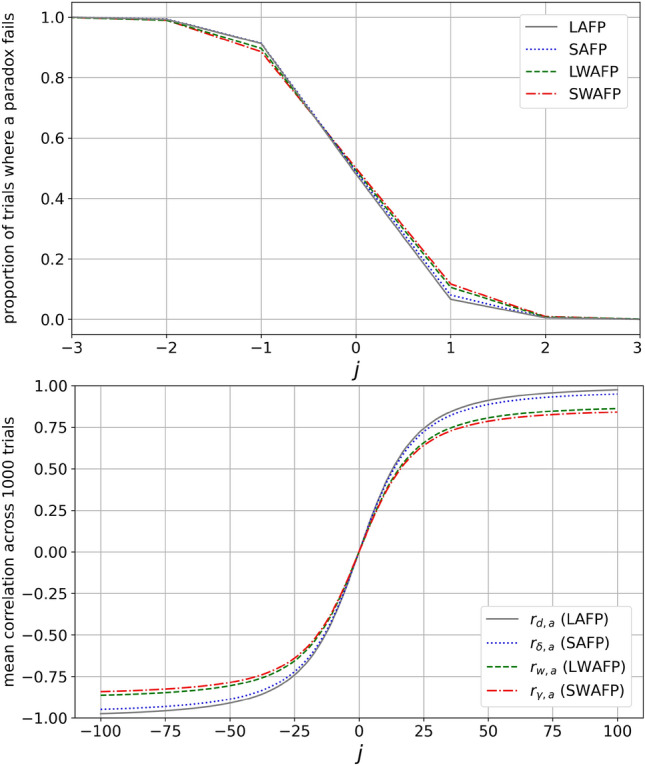
The Friendship Paradox is a simple and powerful statement about node degrees in a graph. However, it only applies to undirected graphs with no edge weights, and the only node characteristic it concerns is degree. Since many social networks are more complex than that, it is useful to generalize this phenomenon, if possible, and a number of papers have proposed different generalizations. Here, we unify these generalizations in a common framework, retaining the focus on undirected graphs and allowing for weighted edges and for numeric node attributes other than degree to be considered, since this extension allows for a clean characterization and links to the original concepts most naturally. While the original Friendship Paradox and the Weighted Friendship Paradox hold for all graphs, considering non-degree attributes actually makes the extensions fail around 50% of the time, given random attribute assignment. We provide simple correlation-based rules to see whether an attribute-based version of the paradox holds. In addition to theory, our simulation and data results show how all the concepts can be applied to synthetic and real networks. Where applicable, we draw connections to prior work to make this an accessible and comprehensive paper that lets one understand the math behind the Friendship Paradox and its basic extensions.
友谊悖论是关于图中节点度的一个简单而有力的表述。然而,它仅适用于没有边权重的无向图,且它所关注的唯一节点特征是度。由于许多社交网络比这更复杂,若有可能对这一现象进行推广将很有用,并且已有多篇论文提出了不同的推广方式。在此,我们将这些推广统一在一个通用框架中,保持对无向图的关注,并允许考虑加权边以及除度之外的数值型节点属性,因为这种扩展能最自然地对其进行清晰的刻画并与原始概念建立联系。虽然原始友谊悖论和加权友谊悖论对所有图都成立,但考虑非度属性时,在随机属性分配的情况下,实际上约50%的扩展会不成立。我们提供基于简单相关性的规则来判断基于属性的悖论版本是否成立。除了理论内容,我们的模拟和数据结果展示了所有这些概念如何应用于合成网络和真实网络。在适用的地方,我们将与先前的工作建立联系,以使本文易于理解且全面,让读者理解友谊悖论及其基本扩展背后的数学原理。