Lewis James D, Gibble Theresa Hunter, Shan Mingyang, Zhou Xian, Naegeli April N, Dawwas Ghadeer K
Center for Clinical Epidemiology and Biostatistics, University of Pennsylvania, 7th Floor, Blockley Hall, 423 Guardian Drive, Philadelphia, PA, 19104-6021, USA.
Eli Lilly and Company, Indianapolis, USA.
Drugs Real World Outcomes. 2024 Sep;11(3):403-412. doi: 10.1007/s40801-024-00434-1. Epub 2024 Jun 15.
Bowel urgency is a highly burdensome symptom among patients with inflammatory bowel disease (IBD).
To assess changes in severity of bowel urgency and identify predictors of worsening or improvement among patients with Crohn's disease (CD) and ulcerative colitis (UC) at 6 months from their enrollment visit.
Data from patients in the Study of a Prospective Adult Research Cohort with IBD were analyzed. Enrolled patients with CD or UC with 6-month visits were included. Changes and predictors of bowel urgency severity over 6 months in patients with CD or UC were examined using two separate analyses: (a) "worsening" versus "no change" excluding those with moderate-to-severe bowel urgency at enrollment, and (b) "improvement" versus "no change" excluding those with no bowel urgency at enrollment. The enrollment characteristics were compared within these groups.
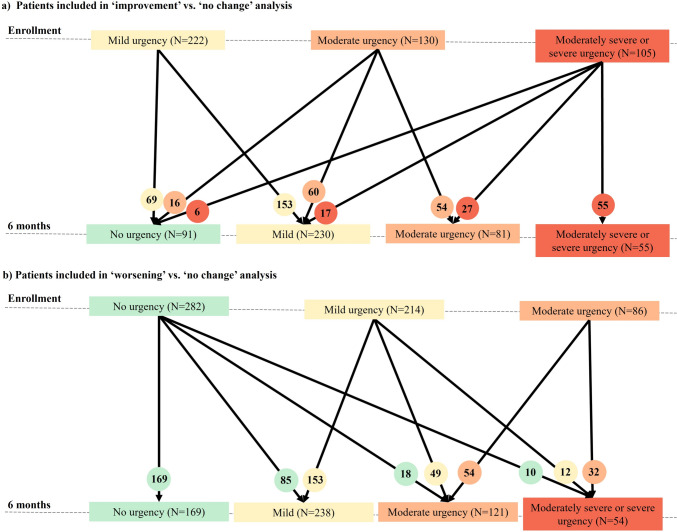
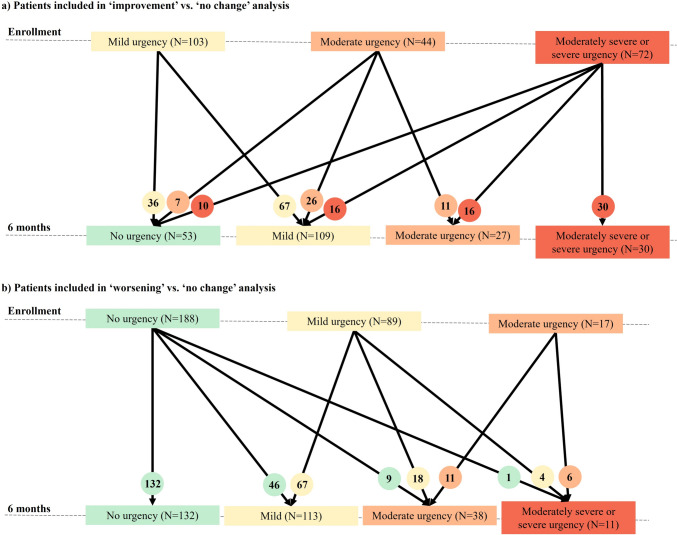
At baseline, in both CD and UC, use of biologics and/or immunomodulators at enrollment was similar across cohorts. Among patients with CD, 206 of 582 (35.4%) reported worsening, and 195 of 457 (42.7%) reported improvement in bowel urgency. Younger age (P = 0.013) and moderate-to-severe bowel urgency (P < 0.001) were associated with improvement. Moderate bowel urgency (P = 0.026) and bowel incontinence while awake (P = 0.022) were associated with worsening. Among patients with UC, 84 of 294 (28.6%) reported worsening, and 111 of 219 (50.7%) reported improvement in bowel urgency. Higher symptomatic disease severity (P = 0.011) and more severe bowel urgency (P < 0.001) were associated with improvement.
Bowel urgency is an unpredictable and unstable symptom among patients with IBD. Over 50% of patients with CD or UC experienced either worsening or improvement at 6 months postenrollment.
肠道急迫感是炎症性肠病(IBD)患者中一种负担极重的症状。
评估肠道急迫感严重程度的变化,并确定克罗恩病(CD)和溃疡性结肠炎(UC)患者在入组就诊6个月时病情恶化或改善的预测因素。
对来自IBD成人前瞻性研究队列的数据进行分析。纳入有6个月随访的CD或UC患者。通过两项单独分析检查CD或UC患者6个月内肠道急迫感严重程度的变化及预测因素:(a)“恶化”与“无变化”,排除入组时患有中度至重度肠道急迫感的患者;(b)“改善”与“无变化”,排除入组时无肠道急迫感的患者。在这些组内比较入组特征。
基线时,CD和UC患者中,入组时生物制剂和/或免疫调节剂的使用在各队列间相似。在CD患者中,582例中有206例(35.4%)报告肠道急迫感恶化,457例中有195例(42.7%)报告改善。年龄较小(P = 0.013)和中度至重度肠道急迫感(P < 0.001)与改善相关。中度肠道急迫感(P = 0.026)和清醒时大便失禁(P = 0.022)与恶化相关。在UC患者中,294例中有84例(28.6%)报告肠道急迫感恶化,219例中有111例(50.7%)报告改善。较高的症状性疾病严重程度(P = 0.011)和更严重的肠道急迫感(P < 0.001)与改善相关。
肠道急迫感在IBD患者中是一种不可预测且不稳定的症状。超过50%的CD或UC患者在入组6个月时病情出现恶化或改善。