Atreya Raja, Redondo Isabel, Streit Petra, Protic Marijana, Hartz Susanne, Gurses Gamze, Knight Hannah, Barlow Sophie, Harvey Niamh, Hunter Gibble Theresa
Medical Department 1, University Hospital Erlangen, Friedrich Alexander University Erlangen-Nürnberg, Erlangen, Germany.
Medical Affairs, Eli Lilly and Company, Lisbon, Portugal.
Crohns Colitis 360. 2024 Aug 10;6(3):otae047. doi: 10.1093/crocol/otae047. eCollection 2024 Jul.
Bowel urgency is a highly disruptive and bothersome symptom experienced by patients with inflammatory bowel diseases (IBD), (ulcerative colitis [UC], and Crohn's disease [CD]). However, the burden of bowel urgency among patients with varying experiences in targeted treatment has not been consistently assessed. This real-world study explored the clinical and health-related quality of life burden of bowel urgency among patients with IBD with differing treatment experiences.
This cross-sectional survey included gastroenterologists and their patients with IBD across France, Germany, Italy, Spain, the United Kingdom, and the United States treated for over 3 months. Physicians provided patient demographics, clinical characteristics, and treatment history. Patients reported their health-related quality of life and work productivity. Patients with UC and CD were analyzed separately and stratified into 3 groups: Targeted therapy naïve, those receiving their first-line targeted therapy, and targeted therapy experienced.
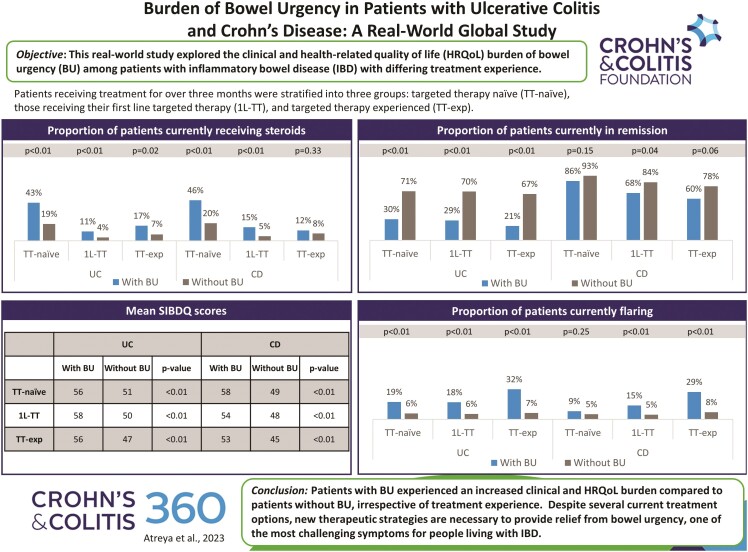
This study found that 17%-26% of UC and 13%-17% of CD patients experienced persistent bowel urgency, irrespective of receiving conventional or targeted therapy. Moreover, patients with bowel urgency experienced an increased clinical and health-related quality of life burden compared to patients without bowel urgency, which physicians most commonly regarded as one of the most difficult symptoms to treat, with the burden remaining substantial irrespective of their treatment experience.
Despite several current treatment options, new therapeutic strategies are necessary to provide relief from bowel urgency, one of the most challenging symptoms for people living with IBD.
肠道急迫感是炎症性肠病(IBD,包括溃疡性结肠炎[UC]和克罗恩病[CD])患者经历的一种极具干扰性且令人困扰的症状。然而,针对不同靶向治疗经历的患者,肠道急迫感的负担尚未得到一致评估。这项真实世界研究探讨了不同治疗经历的IBD患者肠道急迫感的临床负担以及与健康相关的生活质量负担。
这项横断面调查纳入了法国、德国、意大利、西班牙、英国和美国接受治疗超过3个月的胃肠病学家及其IBD患者。医生提供患者的人口统计学信息、临床特征和治疗史。患者报告他们与健康相关的生活质量和工作生产力。UC和CD患者分别进行分析,并分为3组:未接受过靶向治疗的、正在接受一线靶向治疗的以及有靶向治疗经历的。
本研究发现,17%-26%的UC患者和13%-17%的CD患者经历持续性肠道急迫感,无论接受的是传统治疗还是靶向治疗。此外,与无肠道急迫感的患者相比,有肠道急迫感的患者临床负担以及与健康相关的生活质量负担增加,医生最常将其视为最难治疗的症状之一,无论治疗经历如何,负担都依然很大。
尽管目前有多种治疗选择,但仍需要新的治疗策略来缓解肠道急迫感,这是IBD患者面临的最具挑战性的症状之一。