Department of Cell Physiology and Metabolism, University of Geneva Medical Center, Geneva, Switzerland.
Department of Cell Physiology and Metabolism, University of Geneva Medical Center, Geneva, Switzerland.
J Biol Chem. 2024 Jul;300(7):107473. doi: 10.1016/j.jbc.2024.107473. Epub 2024 Jun 13.
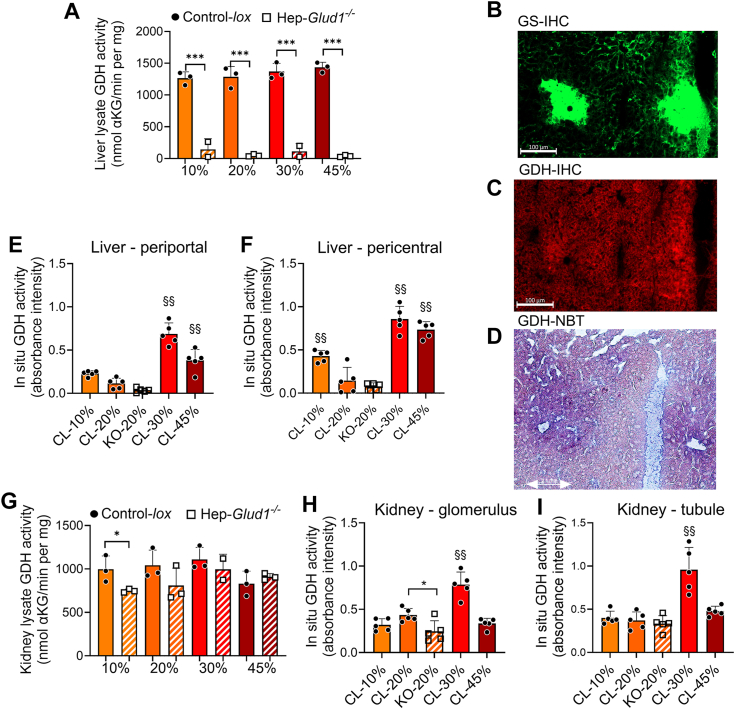
Provision of amino acids to the liver is instrumental for gluconeogenesis while it requires safe disposal of the amino group. The mitochondrial enzyme glutamate dehydrogenase (GDH) is central for hepatic ammonia detoxification by deaminating excessive amino acids toward ureagenesis and preventing hyperammonemia. The present study investigated the early adaptive responses to changes in dietary protein intake in control mice and liver-specific GDH KO mice (Hep-Glud1). Mice were fed chow diets with a wide coverage of protein contents; i.e., suboptimal 10%, standard 20%, over optimal 30%, and high 45% protein diets; switched every 4 days. Metabolic adaptations of the mice were assessed in calorimetric chambers before tissue collection and analyses. Hep-Glud1 mice exhibited impaired alanine induced gluconeogenesis and constitutive hyperammonemia. The expression and activity of GDH in liver lysates were not significantly changed by the different diets. However, applying an in situ redox-sensitive assay on cryopreserved tissue sections revealed higher hepatic GDH activity in mice fed the high-protein diets. On the same section series, immunohistochemistry provided corresponding mapping of the GDH expression. Cosinor analysis from calorimetric chambers showed that the circadian rhythm of food intake and energy expenditure was altered in Hep-Glud1 mice. In control mice, energy expenditure shifted from carbohydrate to amino acid oxidation when diet was switched to high protein content. This shift was impaired in Hep-Glud1 mice and consequently the spontaneous physical activity was markedly reduced in GDH KO mice. These data highlight the central role of liver GDH in the energy balance adaptation to dietary proteins.
为了肝糖异生,向肝脏提供氨基酸是很重要的,而这需要安全地处理氨基酸基团。线粒体酶谷氨酸脱氢酶(GDH)通过脱氨基将过量的氨基酸转化为尿素生成作用,从而对肝脏的氨解毒起着核心作用,防止高氨血症。本研究调查了对照小鼠和肝特异性 GDH KO 小鼠(Hep-Glud1)在改变饮食蛋白摄入时的早期适应反应。小鼠喂食含有广泛蛋白含量的常规饮食;即,亚最佳 10%、标准 20%、最佳 30%和高蛋白 45%饮食;每 4 天转换一次。在收集组织和分析之前,使用量热室评估了小鼠的代谢适应情况。Hep-Glud1 小鼠表现出丙氨酸诱导的肝糖异生受损和持续的高氨血症。不同饮食对肝匀浆中 GDH 的表达和活性没有显著影响。然而,在冷冻组织切片上应用原位氧化还原敏感测定法显示,高蛋白饮食喂养的小鼠肝 GDH 活性更高。在同一切片系列中,免疫组化提供了 GDH 表达的相应图谱。量热室的余弦分析显示,Hep-Glud1 小鼠的摄食和能量消耗昼夜节律发生改变。在对照小鼠中,当饮食切换到高蛋白含量时,能量消耗从碳水化合物转移到氨基酸氧化。这种转变在 Hep-Glud1 小鼠中受到损害,因此 GDH KO 小鼠的自发体力活动明显减少。这些数据强调了肝 GDH 在适应饮食蛋白的能量平衡中的核心作用。