Division of Clinical Genetics and Metabolism, Department of Pediatrics, University of Colorado Anschutz Medical Campus, 13123 East 16th Avenue, Box 300, Aurora, CO, 80045, USA.
Division of Renal Diseases and Hypertension, Department of Internal Medicine, University of Colorado Anschutz Medical Campus, Mail Stop C281, 12700 East 19th Avenue, Aurora, CO, 80045, USA.
Sci Rep. 2024 Jun 15;14(1):13862. doi: 10.1038/s41598-024-64586-4.
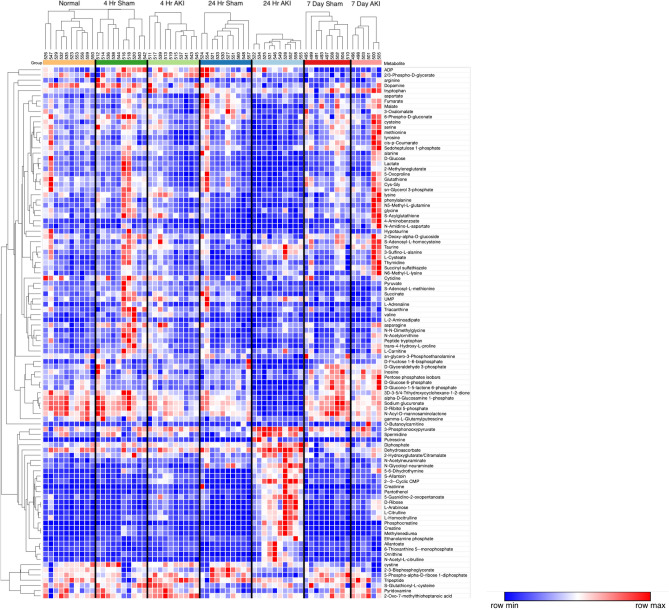
Acute kidney injury (AKI) is a systemic disease that affects energy metabolism in various remote organs in murine models of ischemic AKI. However, AKI-mediated effects in the liver have not been comprehensively assessed. After inducing ischemic AKI in 8-10-week-old, male C57BL/6 mice, mass spectrometry metabolomics revealed that the liver had the most distinct phenotype 24 h after AKI versus 4 h and 7 days. Follow up studies with in vivo [C]-glucose tracing on liver and kidney 24 h after AKI revealed 4 major findings: (1) increased flux through glycolysis and the tricarboxylic (TCA) cycle in both kidney and liver; (2) depleted hepatic glutathione levels and its intermediates despite unchanged level of reactive oxygen species, suggesting glutathione consumption exceeds production due to systemic oxidative stress after AKI; (3) hepatic ATP depletion despite unchanged rate of mitochondrial respiration, suggesting increased ATP consumption relative to production; (4) increased hepatic and renal urea cycle intermediates suggesting hypercatabolism and upregulation of the urea cycle independent of impaired renal clearance of nitrogenous waste. Taken together, this is the first study to describe the hepatic metabolome after ischemic AKI in a murine model and demonstrates that there is significant liver-kidney crosstalk after AKI.
急性肾损伤(AKI)是一种全身性疾病,会影响缺血性 AKI 小鼠模型中各种远处器官的能量代谢。然而,尚未全面评估 AKI 对肝脏的影响。在诱导 8-10 周龄雄性 C57BL/6 小鼠发生缺血性 AKI 后,通过质谱代谢组学发现,与 AKI 后 4 小时和 7 天相比,肝脏在 AKI 后 24 小时具有最明显的表型。AKI 后 24 小时进行体内 [C]-葡萄糖追踪肝脏和肾脏的后续研究揭示了 4 个主要发现:(1)肾脏和肝脏中糖酵解和三羧酸(TCA)循环的通量增加;(2)尽管活性氧水平不变,但肝谷胱甘肽水平及其中间产物耗竭,表明由于 AKI 后全身氧化应激,谷胱甘肽消耗超过产生;(3)尽管线粒体呼吸率不变,但肝 ATP 耗竭,表明与产生相比,ATP 消耗增加;(4)肝脏和肾脏尿素循环中间产物增加,表明在不影响氮废物肾清除率的情况下发生代谢亢进和尿素循环上调。总之,这是第一项描述缺血性 AKI 后小鼠模型中肝脏代谢组的研究,并表明 AKI 后存在明显的肝肾交叉对话。