Department of Orthopedic Surgery, Jiujiang University Affiliated Hospital, Jiujiang, 332006, China.
Department of Orthopedic Surgery, The Fifth Affiliated Hospital of Jinan University (Heyuan Shenhe People's Hospital), Heyuan, 517000, China.
Sci Rep. 2024 Jun 16;14(1):13880. doi: 10.1038/s41598-024-64626-z.
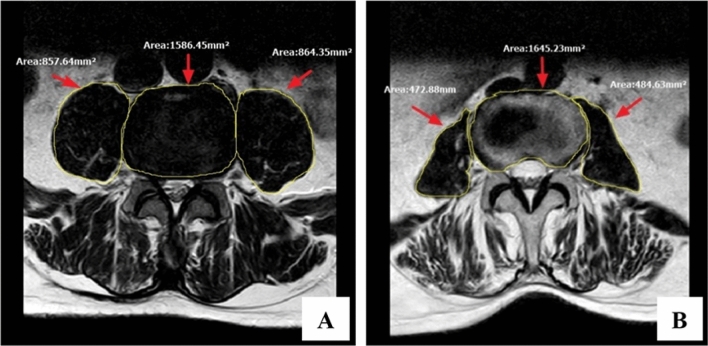
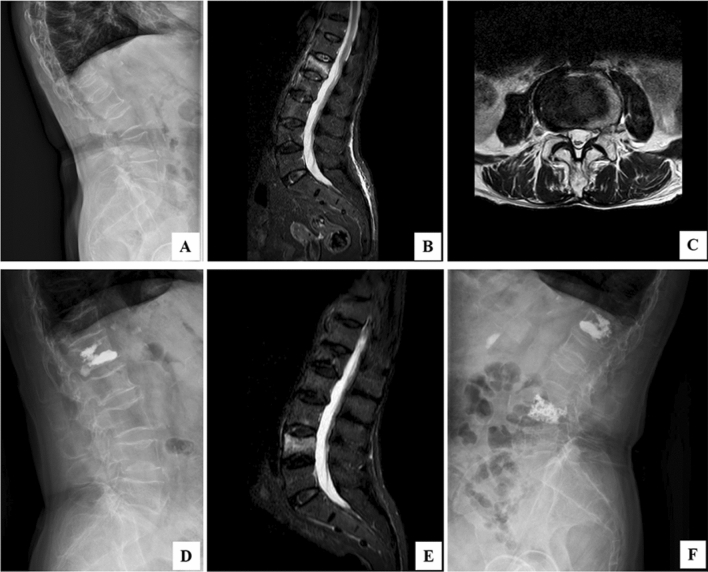
The correlation between lower psoas mass and the prognosis of osteoporotic vertebral compression fractures (OVCF) is still unclear. This study aims to investigate the impact of lower psoas mass on the prognosis of patients undergoing percutaneous vertebroplasty (PVP). One hundred and sixty-three elderly patients who underwent single-segment PVP from January 2018 to December 2021 were included. The psoas to L4 vertebral index (PLVI) via MRI were measured to assess psoas mass. Patients were divided into high PLVI (> 0.79) and low PLVI (≤ 0.79) groups based on the median PLVI in the cohort. The basic information (age, gender, body mass index (BMI) and bone mineral density (BMD)), surgical intervention-related elements (duration of operation, latency to ambulation, period of hospital stay, and surgical site), postoperative clinical outcomes (Visual Analog Scale (VAS) scores, Oswestry Disability Index (ODI) scores, Japanese Orthopaedic Association (JOA) scores), and incidence of secondary fractures) were compared. Patients showed no statistically significant differences in terms of age, gender, surgical sute, BMI, BMD and preoperative VAS, ODI, JOA scores (P > 0.05) between the two groups. However, there were significant differences in terms of latency to ambulation, period of hospital stay (P < 0.05). VAS, ODI, and JOA scores at 1, 6, and 12 months after surgery showed that the high PLVI group had significantly better outcomes than the low PLVI group (P < 0.05). Additionally, the low PLVI group had a significantly higher incidence of recurrent fracture (P < 0.05). Lower psoas mass can reduce the clinical effect of PVP in patients with osteoporotic vertebral compression fractures, and is a risk factor for recurrent vertebral fracture.
下腰椎旁肌质量与骨质疏松性椎体压缩性骨折(OVCF)预后的相关性尚不清楚。本研究旨在探讨下腰椎旁肌质量对行经皮椎体成形术(PVP)治疗的患者预后的影响。纳入了 2018 年 1 月至 2021 年 12 月期间接受单节段 PVP 的 163 名老年患者。通过 MRI 测量腰椎旁肌与 L4 椎体指数(PLVI)以评估腰椎旁肌质量。根据队列中的中位数 PLVI,将患者分为高 PLVI(>0.79)和低 PLVI(≤0.79)组。比较两组患者的基本信息(年龄、性别、体重指数(BMI)和骨密度(BMD))、手术干预相关因素(手术时间、下床活动潜伏期、住院时间和手术部位)、术后临床结果(视觉模拟评分(VAS)、Oswestry 残疾指数(ODI)、日本骨科协会(JOA)评分)和继发性骨折发生率。两组患者在年龄、性别、手术部位、BMI、BMD 和术前 VAS、ODI、JOA 评分方面无统计学差异(P>0.05)。然而,在下床活动潜伏期和住院时间方面存在显著差异(P<0.05)。术后 1、6 和 12 个月的 VAS、ODI 和 JOA 评分显示,高 PLVI 组的结果明显优于低 PLVI 组(P<0.05)。此外,低 PLVI 组的复发性骨折发生率明显更高(P<0.05)。较低的腰椎旁肌质量会降低骨质疏松性椎体压缩性骨折患者行 PVP 的临床效果,是复发性椎体骨折的危险因素。