
与非新冠患者相比,奥密克戎变异株新冠病毒病的特定后遗症症状:日本的一项回顾性队列研究
Specific sequelae symptoms of COVID-19 of Omicron variant in comparison with non-COVID-19 patients: a retrospective cohort study in Japan.
作者信息
Omori Takahiro, Hanafusa Mariko, Kondo Nobuyuki, Miyazaki Yasunari, Okada Shusho, Fujiwara Takeo, Kuramochi Jin
机构信息
Department of Respiratory Medicine, Kuramochi Clinic Interpark, Utsunomiya City, Japan.
Department of Tokyo Metropolitan Health Policy Advisement, Tokyo Medical and Dental University, Tokyo, Japan.
出版信息
J Thorac Dis. 2024 May 31;16(5):3170-3180. doi: 10.21037/jtd-23-1672. Epub 2024 May 24.
BACKGROUND
The specific long-term sequela of coronavirus disease 2019 (COVID-19), also known as long COVID of the Omicron variant remain unclear, due to a lack of cohort studies that include non-COVID patients with cold-like symptoms. The study was conducted to examine specific sequelae symptoms after severe acute respiratory syndrome coronavirus-2 (SARS-CoV-2) infection, which is considered the Omicron variant, compared with patients who were never-infected.
METHODS
In this retrospective cohort study, we sent questionnaires in November 2022, targeting those who visited our fever outpatient unit of a single institution from July to September 2022. SARS-CoV-2 infection status was determined by SARS-CoV-2 polymerase chain reaction (PCR) test results during the study period collected in electronic medical records. Clinical characteristics at 30 days or more since the date of SARS-CoV-2 PCR test were assessed by the questionnaires. Multiple logistic regression was performed to investigate the independent association between SARS-CoV-2 infection and possible sequelae symptoms.
RESULTS
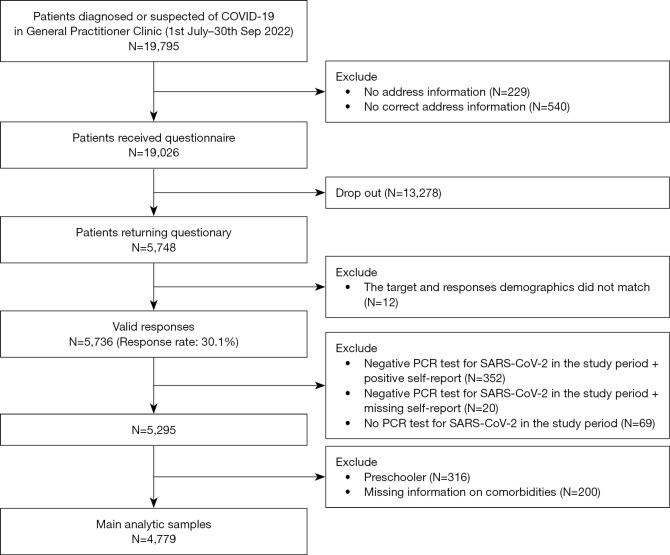
In total, valid responses were received from 4,779 patients (mean age: 41.4 years, standard deviation: 19.8 years old). Among them, 3,326 (69.6%) and 1,453 (30.4%) were SARS-CoV-2 PCR test positive and never-infected, respectively. We found that patients with SARS-CoV-2 infection were more likely to have a loss of taste or smell [odds ratio (OR) 4.55, 95% confidence interval (CI): 1.93, 10.71], hair loss (OR 3.19, 95% CI: 1.67, 6.09), neurocognitive symptoms (OR 1.95, 95% CI: 1.43, 2.65), and respiratory symptoms (OR 1.23, 95% CI: 1.03, 1.47) than never-infected patients. SARS-CoV-2 infection was not associated with common cold symptoms, chronic physical distress, or diarrhea as sequelae symptoms. Further, SARS-CoV-2 vaccination showed protective effects on sequelae of loss of taste or smell and hair loss.
CONCLUSIONS
Loss of taste or smell, hair loss, neurocognitive symptoms, and respiratory symptoms were found to be specific sequelae of the SARS-CoV-2 Omicron variant. It is important not to miss these symptoms that follow SARS-CoV-2 infection and to recognize and manage the long COVID.
背景
2019冠状病毒病(COVID-19),即奥密克戎变异株的长期后遗症,由于缺乏纳入有类似感冒症状的非COVID患者的队列研究,目前仍不清楚。本研究旨在调查严重急性呼吸综合征冠状病毒2(SARS-CoV-2)感染(被认为是奥密克戎变异株)后与未感染患者相比的特定后遗症症状。
方法
在这项回顾性队列研究中,我们于2022年11月向2022年7月至9月期间到我们单一机构发热门诊就诊的患者发送了问卷。SARS-CoV-2感染状态通过电子病历中收集的研究期间的SARS-CoV-2聚合酶链反应(PCR)检测结果确定。通过问卷评估自SARS-CoV-2 PCR检测之日起30天或更长时间后的临床特征。进行多因素逻辑回归以研究SARS-CoV-2感染与可能的后遗症症状之间的独立关联。
结果
总共收到了4779名患者的有效回复(平均年龄:41.4岁,标准差:19.8岁)。其中,3326名(69.6%)SARS-CoV-2 PCR检测呈阳性,1453名(30.4%)从未感染。我们发现,与未感染患者相比,SARS-CoV-2感染患者更有可能出现味觉或嗅觉丧失[比值比(OR)4.55,95%置信区间(CI):1.93,10.71]、脱发(OR 3.19,95%CI:1.67,6.09)、神经认知症状(OR 1.95,95%CI:1.43,2.65)和呼吸道症状(OR 1.23,95%CI:1.03,1.47)。SARS-CoV-2感染与普通感冒症状、慢性身体不适或腹泻等后遗症症状无关。此外,SARS-CoV-2疫苗接种对味觉或嗅觉丧失和脱发的后遗症具有保护作用。
结论
味觉或嗅觉丧失、脱发、神经认知症状和呼吸道症状被发现是SARS-CoV-2奥密克戎变异株的特定后遗症。重要的是不要遗漏SARS-CoV-2感染后的这些症状,并认识和管理长期新冠症状。

 Zotero 插件