Department of Pulmonology, Pulmonology Center of the Reformed Church in Hungary, Törökbálint, Hungary.
MSD Pharma Hungary Ltd., Budapest, Hungary.
Pathol Oncol Res. 2024 Jun 3;30:1611754. doi: 10.3389/pore.2024.1611754. eCollection 2024.
Hungary has repeatedly been shown to have the highest cancer-related mortality and incidence in Europe. Despite lung cancer being the most abundant malignant diagnosis in Hungary, numerous concerns have been raised recently regarding the bias inherent to reported incidence estimates. Re-analysis of reimbursement claims has been suggested previously by our group as an alternative approach, offering revised figures of lung cancer incidence between 2011 and 2016. Leveraging on this methodology, we aimed at updating Hungarian lung cancer incidence estimates with an additional 5 years (2017-2021), including years affected by the COVID-19 pandemic. Additionally, we also attempted to improve the robustness of estimates by taking additional characteristics of the patient pathway into account.
Lung cancer patients between 2011 and 2021 were identified based on reimbursement-associated ICD-10 codes, histology codes and time patterns. Multiple query architectures were tested for sensitivity and compared to official estimates of the Hungarian National Cancer Registry (HNCR). Epidemiological trends were estimated by Poisson-regression, corrected for age and sex.
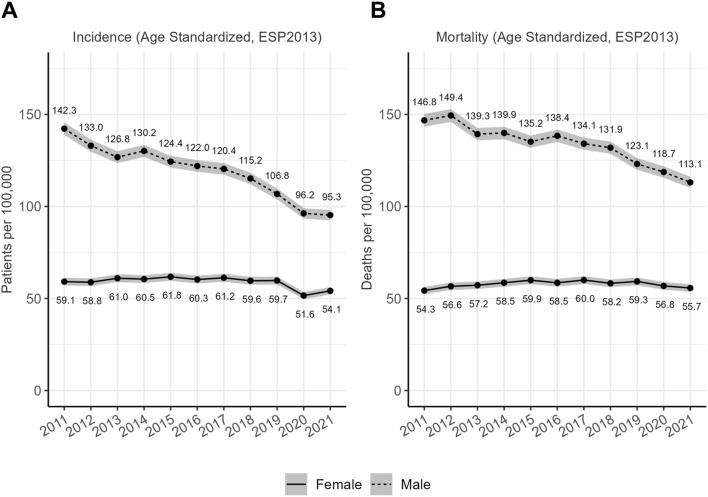
A total of 89,948 lung cancer patients diagnosed in Hungary between 2011 and 2021 have been identified by our study. In 2019 alone, 7,887 patients were diagnosed according to our optimized query. ESP2013 standardized rate was estimated between 92.5/100,000 (2011) and 78.4/100,000 (2019). In 2019, standardized incidence was 106.8/100,000 for men and 59.7/100,000 for women. Up until the COVID-19 pandemic, lung cancer incidence was decreasing by 3.18% (2.1%-4.3%) yearly in men, while there was no significant decrease in women. Young age groups (40-49 and 50-59) featured the largest improvement, but women aged 60-79 are at an increasing risk for developing lung cancer. The COVID-19 pandemic resulted in a statistically significant decrease in lung cancer incidence, especially in the 50-59 age group (both sexes).
Our results show that using an optimized approach, re-analysis of reimbursement claims yields robust estimates of lung cancer incidence. According to this approach, the incidence rate of male lung cancer is declining in Hungary, in concordance with the trend observed for lung cancer mortality. Among women aged 60-79, the incidence of lung cancer has risen, requiring more attention in the near future.
匈牙利的癌症相关死亡率和发病率一直位居欧洲之首。尽管肺癌是匈牙利最常见的恶性诊断,但最近人们对报告的发病率估计值所固有的偏差提出了诸多质疑。我们小组之前曾提出重新分析报销索赔作为一种替代方法,提供 2011 年至 2016 年期间修订的肺癌发病率数据。利用这种方法,我们旨在利用另外 5 年(2017-2021 年)的数据更新匈牙利肺癌发病率估计值,其中包括受 COVID-19 大流行影响的年份。此外,我们还试图通过考虑患者途径的其他特征来提高估计值的稳健性。
根据与报销相关的 ICD-10 代码、组织学代码和时间模式,确定 2011 年至 2021 年间的肺癌患者。测试了多种查询架构的敏感性,并与匈牙利国家癌症登记处(HNCR)的官方估计值进行了比较。通过泊松回归估计流行病学趋势,校正年龄和性别。
通过我们的研究,共确定了 2011 年至 2021 年间在匈牙利诊断出的 89948 例肺癌患者。仅在 2019 年,根据我们优化的查询,就诊断出了 7887 例患者。ESP2013 标准化率估计值在 92.5/100,000(2011 年)和 78.4/100,000(2019 年)之间。2019 年,男性标准化发病率为 106.8/100,000,女性为 59.7/100,000。在 COVID-19 大流行之前,男性肺癌发病率每年下降 3.18%(2.1%-4.3%),而女性肺癌发病率没有明显下降。年轻年龄组(40-49 岁和 50-59 岁)的改善幅度最大,但 60-79 岁的女性患肺癌的风险正在增加。COVID-19 大流行导致肺癌发病率出现统计学上的显著下降,尤其是在 50-59 岁年龄组(男女均如此)。
我们的结果表明,使用优化方法重新分析报销索赔可以得出可靠的肺癌发病率估计值。根据这一方法,匈牙利男性肺癌的发病率正在下降,与肺癌死亡率的趋势一致。在 60-79 岁的女性中,肺癌的发病率有所上升,在不久的将来需要更多关注。