Department of Stomatology, Shanghai Tenth People's Hospital, School of Medicine, Tongji University, Shanghai, China.
iView Therapeutics, Inc., Cranbury, NJ, USA.
Cell Commun Signal. 2024 Jun 18;22(1):335. doi: 10.1186/s12964-024-01709-4.
Kappa opioid receptor (KOR) signaling is involved in joint development and inflammation in Osteoarthritis (OA), while the biochemical mechanism remains unclarified. This study aims to investigate downstream molecular events of KOR activation, to provide novel perspectives in OA pathology.
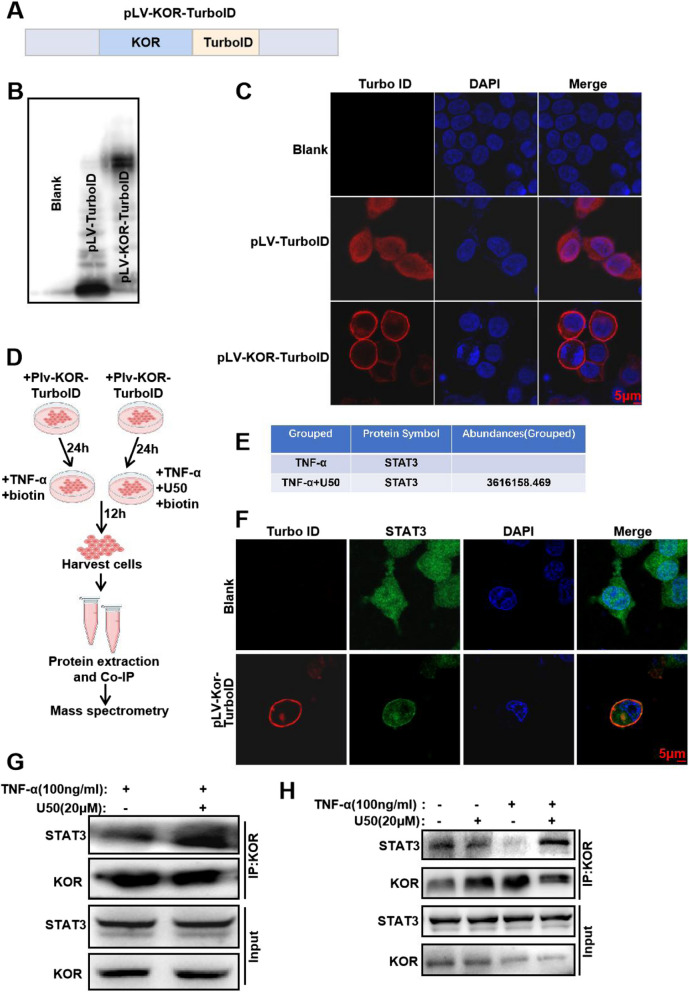
U50,488H, a selective KOR agonist, was intra-articularly injected in mice upon destabilization of the medial meniscus (DMM) as OA models, with PBS injection as control. The behavioral and histological evaluation was assessed by hot plate test and red solid green staining, respectively. Alterations in mRNA and protein expression were assessed by RNA-seq, RT-qPCR, immunohistochemistry and western blotting (WB) in chondrocytes treated with TNF-α or TNF-α + U50,488H. Proteins interacted with KOR were explored using proximity labeling followed by mass spectrometry and then testified by co-immunoprecipitation (Co-IP) assay and immunofluorescence (IF).
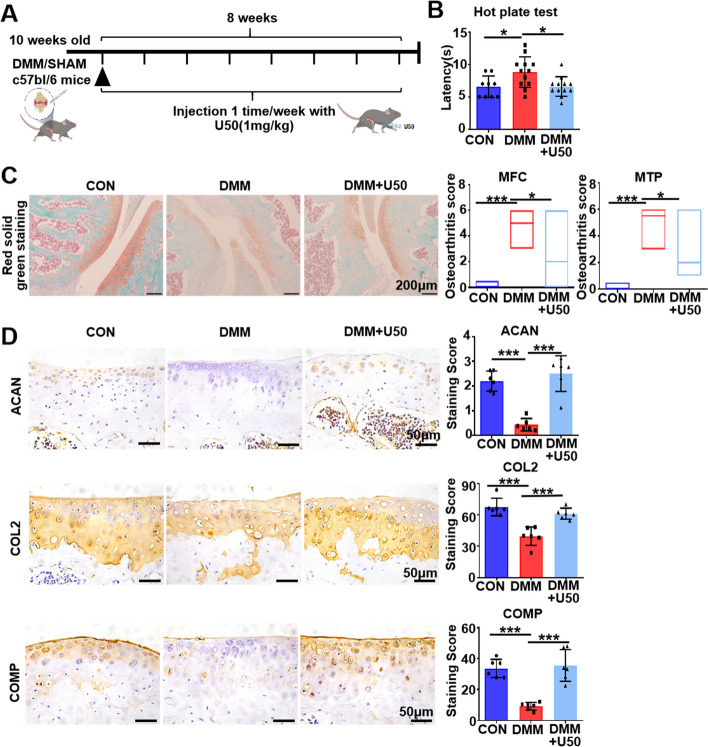
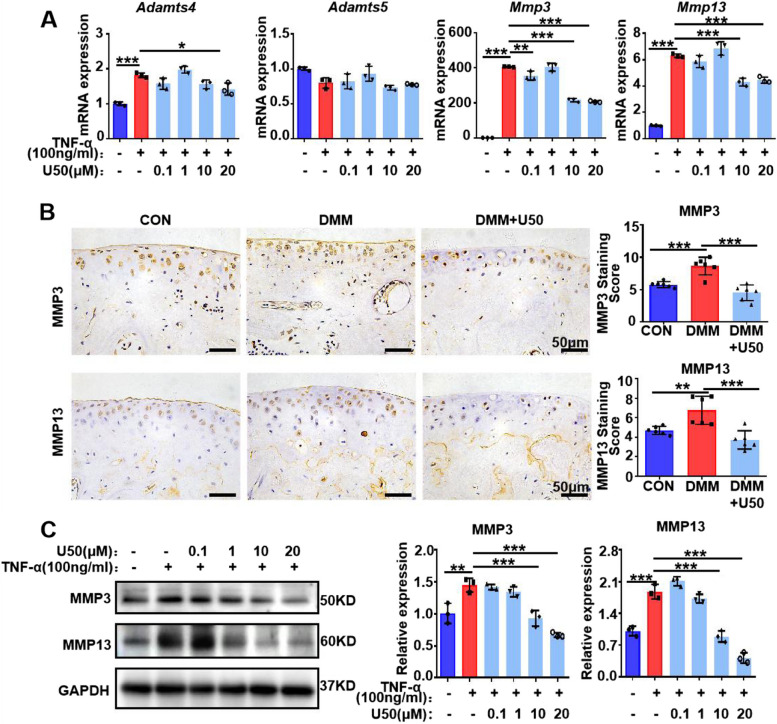
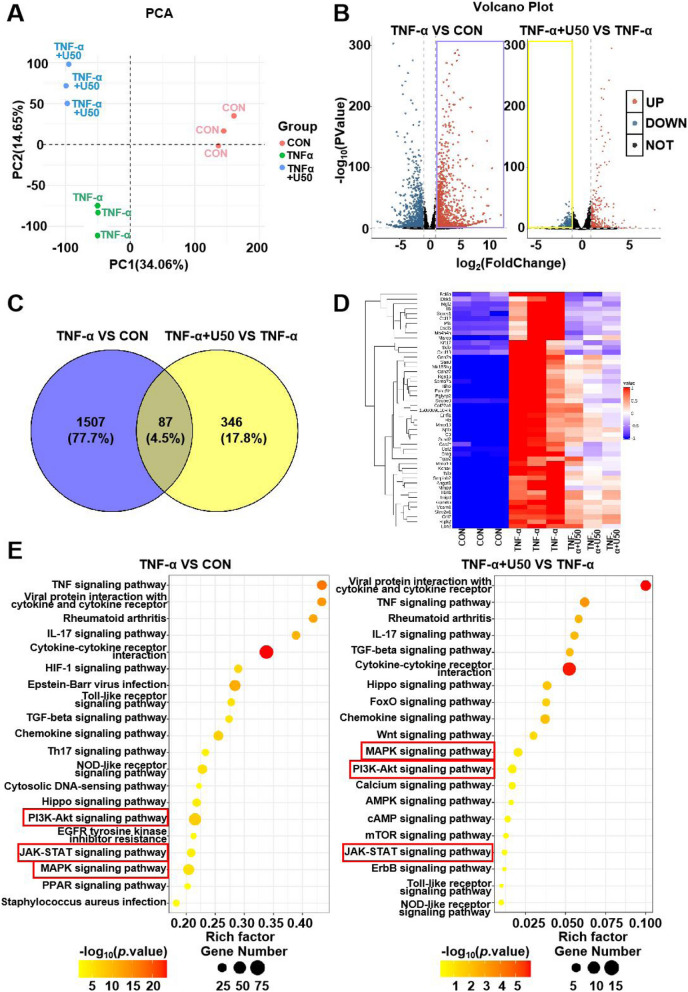
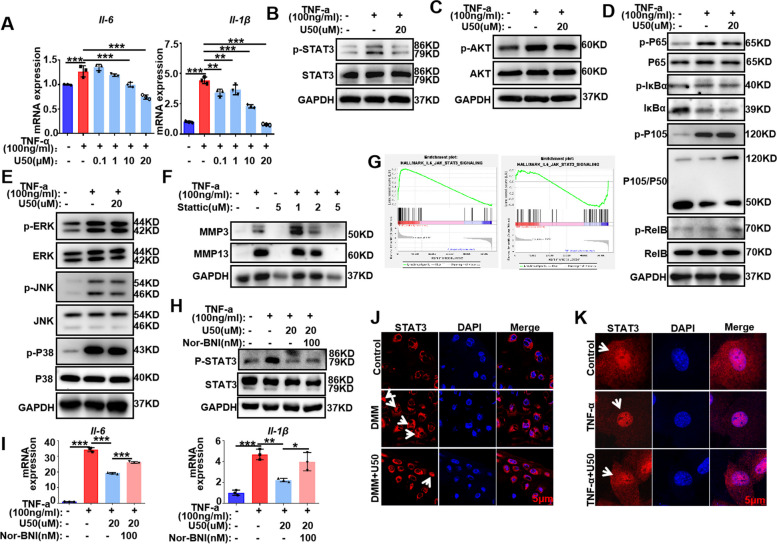
OA-induced pain was reduced and cartilage degeneration was alleviated upon KOR activation in DMM mice. In chondrocytes, activation of KOR reversed the upregulation of MMPs, IL-6, IL-1β and phosphorylated(p-) STAT3, stimulated by TNF-α, while the expression of NF-κB, MAPKs and AKT signaling weren't reversed. RNA-seq and IF results presented that KOR activation evidently reduced STAT3 nuclear translocation in chondrocytes upon TNF-α stimuli. The reduction may be resulted from the binding of KOR and STAT3 in the plasma membrane, revealed by proximity labeling and Co-IP results.
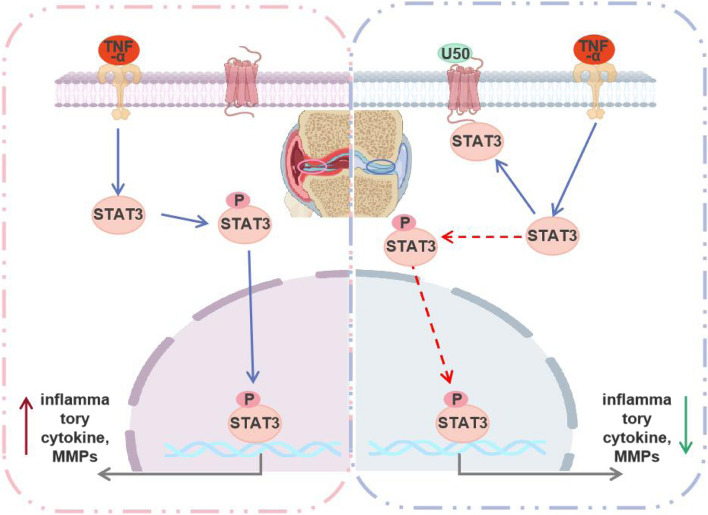
KOR activation protects cartilage from OA, and this protective effect is mainly exerted via sequestering STAT3 on the plasma membrane, resulting in inactivation of STAT3-dependent immune responses which otherwise contributes to OA.
κ 阿片受体(KOR)信号参与骨关节炎(OA)的关节发育和炎症,但其生化机制尚不清楚。本研究旨在探讨 KOR 激活的下游分子事件,为 OA 病理学提供新的视角。
采用内侧半月板不稳定(DMM)建立 OA 模型,在小鼠关节内注射选择性 KOR 激动剂 U50,488H,以 PBS 注射为对照。通过热板试验和红固绿染色分别评估行为学和组织学评估。用 TNF-α或 TNF-α+U50,488H 处理软骨细胞,通过 RNA-seq、RT-qPCR、免疫组织化学和 Western blot 检测 mRNA 和蛋白表达的变化。使用邻近标记结合质谱(PL-MS)技术探索与 KOR 相互作用的蛋白,然后通过免疫共沉淀(Co-IP)和免疫荧光(IF)进行验证。
在 DMM 小鼠中,KOR 激活可减轻 OA 诱导的疼痛和软骨退化。在软骨细胞中,KOR 激活逆转了 TNF-α刺激下 MMPs、IL-6、IL-1β 和磷酸化(p-)STAT3 的上调,而 NF-κB、MAPKs 和 AKT 信号的表达没有逆转。RNA-seq 和 IF 结果表明,KOR 激活明显减少了 TNF-α刺激下软骨细胞中 STAT3 的核转位。这种减少可能是由于 KOR 和 STAT3 在质膜上的结合,PL-MS 和 Co-IP 结果证实了这一点。
KOR 激活可保护软骨免受 OA 影响,这种保护作用主要通过将 STAT3 隔离在质膜上来发挥作用,从而使 STAT3 依赖性免疫反应失活,而这种免疫反应有助于 OA 的发生。