Department of Health Sciences, University of York, York, UK.
Hull York Medical School, University of York, York, UK.
Nicotine Tob Res. 2024 Oct 22;26(11):1512-1520. doi: 10.1093/ntr/ntae130.
Exposure to secondhand smoke (SHS) risks children's health. However, biomarkers are rarely used to study SHS exposure among children in low- and middle-income countries.
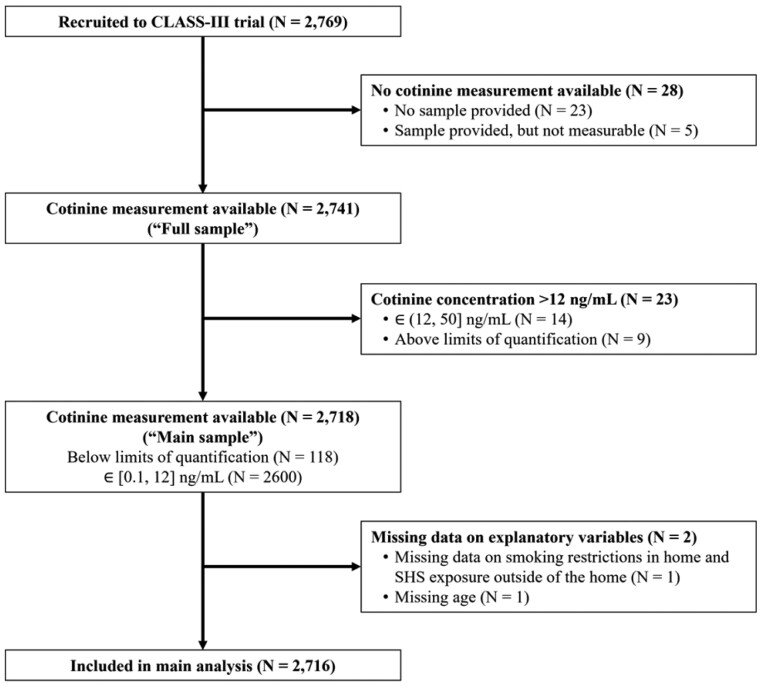
We analyzed cross-sectional data collected between March and November 2022 for a cluster-randomized controlled trial investigating a Smoke-Free Intervention in 2769 children aged 9-15 in 74 schools (34 in Dhaka, Bangladesh, and 40 in Karachi, Pakistan). Children's saliva was tested for the concentration of cotinine-a highly sensitive and specific biomarker for SHS exposure. Based on their reports, children's homes were categorized as Nonsmoking Homes (NSH) when residents were nonsmokers; Smoke-free Homes (SFH) when residents and visitors smoked outdoors only; and Smoke-permitted Homes (SPH) when either residents or visitors smoked indoors. We compared cotinine concentrations across these home types and the two cities using a proportional odds model.
Overall, 95.7% of children (92% in Dhaka; and 99.4% in Karachi) had cotinine levels between 0.1 and 12 ng/mL, indicating SHS exposure. Median cotinine levels were higher in Karachi (0.58 ng/mL, IQR 0.37 to 0.93) than in Dhaka (0.27 ng/mL, IQR 0.16 to 0.49). Median cotinine concentration was also higher among children living in SPH than those in either NSH or SFH; with absolute differences of approximately 0.1-0.3 and 0.05 ng/mL, respectively.
The level of SHS exposure in Dhaka and Karachi indicates widespread and unrestricted smoking. Smoking restrictions in households and enforcement of smoking bans are urgently needed.
The high levels of SHS exposure in children living in SFH suggest parental behavior to hide their smoking and/or exposure in private vehicles or public spaces. It is important to advocate for SFH and cars to protect children from SHS exposure. However, these initiatives alone may not be enough. There is a need to enforce smoking bans in enclosed public places and transportation, as well as extend these bans to playgrounds, parks, fairgrounds, and other public spaces that children frequently visit. It is essential to complement smoking restrictions with tobacco cessation advice and support in these settings.
接触二手烟 (SHS) 会危害儿童健康。然而,在中低收入国家,很少使用生物标志物来研究儿童的 SHS 暴露情况。
我们分析了 2022 年 3 月至 11 月间在孟加拉国达卡和巴基斯坦卡拉奇的 74 所学校(34 所学校在达卡,40 所学校在卡拉奇)中 2769 名 9-15 岁儿童进行的一项随机对照试验中收集的横断面数据。通过测试儿童唾液中可替宁的浓度来检测 SHS 暴露情况,可替宁是一种高度敏感和特异的 SHS 暴露生物标志物。根据他们的报告,当居民不吸烟时,儿童的家庭被归类为无烟家庭(NSH);当居民和访客仅在户外吸烟时,家庭被归类为无烟家庭(SFH);当居民或访客在室内吸烟时,家庭被归类为允许吸烟家庭(SPH)。我们使用比例优势模型比较了这些家庭类型和两个城市的可替宁浓度。
总体而言,95.7%的儿童(达卡为 92%,卡拉奇为 99.4%)的可替宁水平在 0.1 至 12ng/ml 之间,表明他们接触过 SHS。卡拉奇的可替宁中位数水平较高(0.58ng/ml,IQR 0.37-0.93),而达卡的可替宁中位数水平较低(0.27ng/ml,IQR 0.16-0.49)。与 NSH 或 SFH 相比,居住在 SPH 的儿童的可替宁浓度中位数也较高,绝对差异约为 0.1-0.3 和 0.05ng/ml。
达卡和卡拉奇的 SHS 暴露水平表明存在广泛和不受限制的吸烟现象。迫切需要在家庭中实施吸烟限制并执行禁烟令。
居住在 SFH 的儿童的 SHS 暴露水平较高,表明父母有隐藏其吸烟行为的倾向,或者在私人车辆或公共场所吸烟。提倡 SFH 和汽车来保护儿童免受 SHS 暴露是很重要的。然而,仅靠这些举措可能还不够。需要在封闭的公共场所和交通工具中执行禁烟令,并将这些禁令扩大到儿童经常光顾的游乐场、公园、集市和其他公共场所。在这些场所,通过提供烟草戒断建议和支持来补充吸烟限制是至关重要的。