Scottish Centre for Indoor Air, Environmental & Occupational Medicine, Population Health, Division of Applied Health Sciences, School of Medicine and Dentistry, Foresterhill, University of Aberdeen, UK.
BMC Public Health. 2011 Aug 8;11:634. doi: 10.1186/1471-2458-11-634.
There is a lack of data describing the exposure of Malaysian schoolchildren to Secondhand Smoke (SHS). The aim of this study is to identify factors influencing schoolchildren's exposures to SHS in Malaysia.
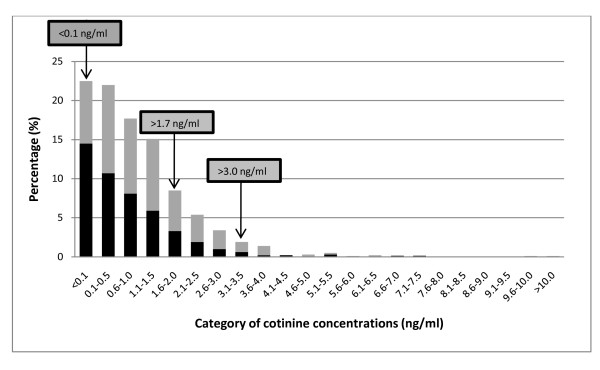
This cross-sectional study was carried out to measure salivary cotinine concentrations among 1064 schoolchildren (10-11 years) attending 24 schools in Malaysia following recent partial smoke-free restrictions. Parents completed questionnaires and schoolchildren provided saliva samples for cotinine assay.
The geometric mean (GM) salivary cotinine concentrations for 947 non-smoking schoolchildren stratified by household residents' smoking behaviour were: for children living with non-smoking parents 0.32 ng/ml (95% CI 0.28-0.37) (n = 446); for children living with a smoker father 0.65 ng/ml (95% CI 0.57-0.72) (n = 432); for children living with two smoking parents 1.12 ng/ml (95% CI 0.29-4.40) (n = 3); for children who live with an extended family member who smokes 0.62 ng/ml (95% CI 0.42-0.89) (n = 33) and for children living with two smokers (father and extended family member) 0.71 ng/ml (95% CI 0.40-0.97) (n = 44). Parental-reported SHS exposures showed poor agreement with children's self-reported SHS exposures. Multiple linear regression demonstrated that cotinine levels were positively associated with living with one or more smokers, urban residence, occupation of father (Armed forces), parental-reported exposure to SHS and education of the father (Diploma/Technical certificate).
This is the first study to characterise exposures to SHS using salivary cotinine concentrations among schoolchildren in Malaysia and also the first study documenting SHS exposure using salivary cotinine as a biomarker in a South-East Asian population of schoolchildren. Compared to other populations of similarly aged schoolchildren, Malaysian children have higher salivary cotinine concentrations. The partial nature of smoke-free restrictions in Malaysia is likely to contribute to these findings. Enforcement of existing legislation to reduce exposure in public place settings and interventions to reduce exposure at home, especially to implement effective home smoking restriction practices are required.
目前缺乏描述马来西亚学童接触二手烟(SHS)的数据。本研究旨在确定影响马来西亚学童接触 SHS 的因素。
本横断面研究旨在测量马来西亚 24 所学校的 1064 名 10-11 岁学龄儿童的唾液可替宁浓度,这些儿童是在最近实施部分无烟限制后入组的。家长完成问卷调查,儿童提供唾液样本进行可替宁检测。
根据家庭居民吸烟行为对 947 名非吸烟学龄儿童的唾液可替宁浓度进行分层,结果为:与不吸烟父母同住的儿童的几何平均(GM)唾液可替宁浓度为 0.32ng/ml(95%CI 0.28-0.37)(n=446);与吸烟者父亲同住的儿童为 0.65ng/ml(95%CI 0.57-0.72)(n=432);与两位吸烟父母同住的儿童为 1.12ng/ml(95%CI 0.29-4.40)(n=3);与吸烟的家庭成员同住的儿童为 0.62ng/ml(95%CI 0.42-0.89)(n=33);与父亲和吸烟的家庭成员同住的儿童为 0.71ng/ml(95%CI 0.40-0.97)(n=44)。父母报告的 SHS 暴露与儿童自我报告的 SHS 暴露之间一致性较差。多元线性回归显示,可替宁水平与与一位或多位吸烟者同住、居住在城市、父亲的职业(武装部队)、父母报告的 SHS 暴露以及父亲的教育程度(大专/技术证书)呈正相关。
这是第一项使用马来西亚学龄儿童唾液可替宁浓度描述 SHS 暴露情况的研究,也是第一项使用唾液可替宁作为生物标志物在东南亚学龄儿童人群中检测 SHS 暴露情况的研究。与其他年龄相似的学龄儿童人群相比,马来西亚儿童的唾液可替宁浓度更高。马来西亚部分无烟限制的性质可能导致了这些发现。需要加强执行现有的立法,以减少公共场所的暴露,并采取干预措施,减少家庭中的暴露,特别是实施有效的家庭吸烟限制措施。