Stem Cell Laboratory, Dino Ferrari Center, Department of Pathophysiology and Transplantation, University of Milan, 20122 Milan, Italy.
Neurology Unit, Fondazione IRCCS Ca' Granda Ospedale Maggiore Policlinico, 20122 Milan, Italy.
Int J Mol Sci. 2024 May 21;25(11):5589. doi: 10.3390/ijms25115589.
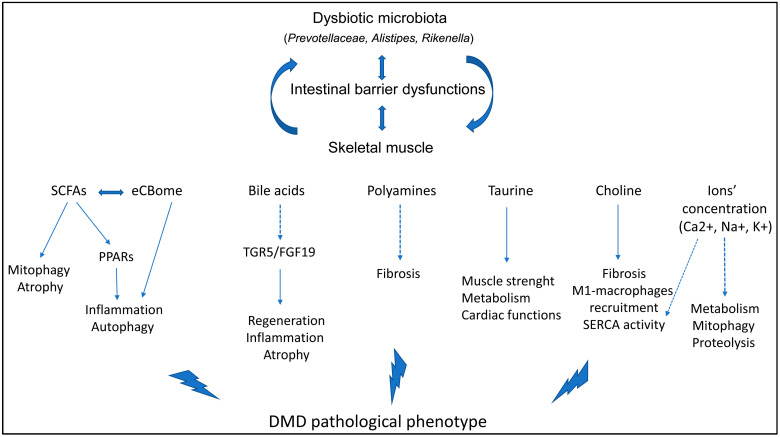
The gut microbiota plays a pivotal role in maintaining the dynamic balance of intestinal epithelial and immune cells, crucial for overall organ homeostasis. Dysfunctions in these intricate relationships can lead to inflammation and contribute to the pathogenesis of various diseases. Recent findings uncovered the existence of a gut-muscle axis, revealing how alterations in the gut microbiota can disrupt regulatory mechanisms in muscular and adipose tissues, triggering immune-mediated inflammation. In the context of Duchenne muscular dystrophy (DMD), alterations in intestinal permeability stand as a potential origin of molecules that could trigger muscle degeneration via various pathways. Metabolites produced by gut bacteria, or fragments of bacteria themselves, may have the ability to migrate from the gut into the bloodstream and ultimately infiltrate distant muscle tissues, exacerbating localized pathologies. These insights highlight alternative pathological pathways in DMD beyond the musculoskeletal system, paving the way for nutraceutical supplementation as a potential adjuvant therapy. Understanding the complex interplay between the gut microbiota, immune system, and muscular health offers new perspectives for therapeutic interventions beyond conventional approaches to efficiently counteract the multifaceted nature of DMD.
肠道微生物群在维持肠道上皮细胞和免疫细胞的动态平衡中起着关键作用,这对整体器官稳态至关重要。这些复杂关系的功能障碍会导致炎症,并有助于各种疾病的发病机制。最近的发现揭示了肠道-肌肉轴的存在,揭示了肠道微生物群的改变如何破坏肌肉和脂肪组织中的调节机制,引发免疫介导的炎症。在杜氏肌营养不良症(DMD)中,肠道通透性的改变可能是通过多种途径引发肌肉退化的分子的潜在来源。肠道细菌产生的代谢物或细菌本身的片段可能有能力从肠道迁移到血液中,并最终渗透到远处的肌肉组织中,使局部病变恶化。这些观点强调了 DMD 中除肌肉骨骼系统以外的其他病理途径,为营养补充作为一种潜在的辅助治疗方法铺平了道路。了解肠道微生物群、免疫系统和肌肉健康之间的复杂相互作用,为超越传统方法的治疗干预提供了新的视角,从而有效地对抗 DMD 的多方面性质。