Institute of Cardiac Diagnostics and Therapy, IKDT GmbH, 12203 Berlin, Germany.
Robert Koch Institute, Unit 15: Viral Gastroenteritis and Hepatitis Pathogens and Enteroviruses, Department of Infectious Diseases, 13353 Berlin, Germany.
Int J Mol Sci. 2024 May 28;25(11):5845. doi: 10.3390/ijms25115845.
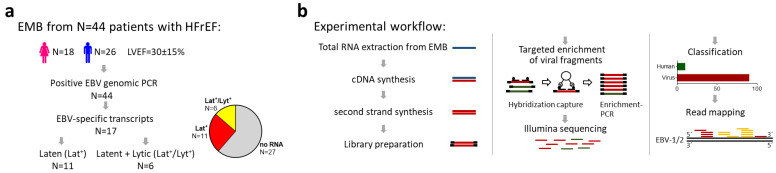
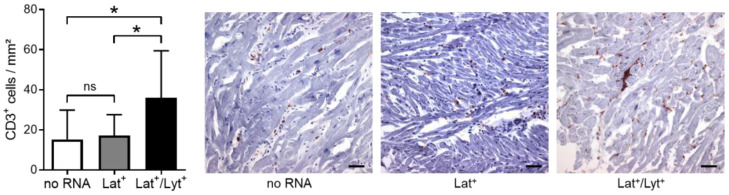
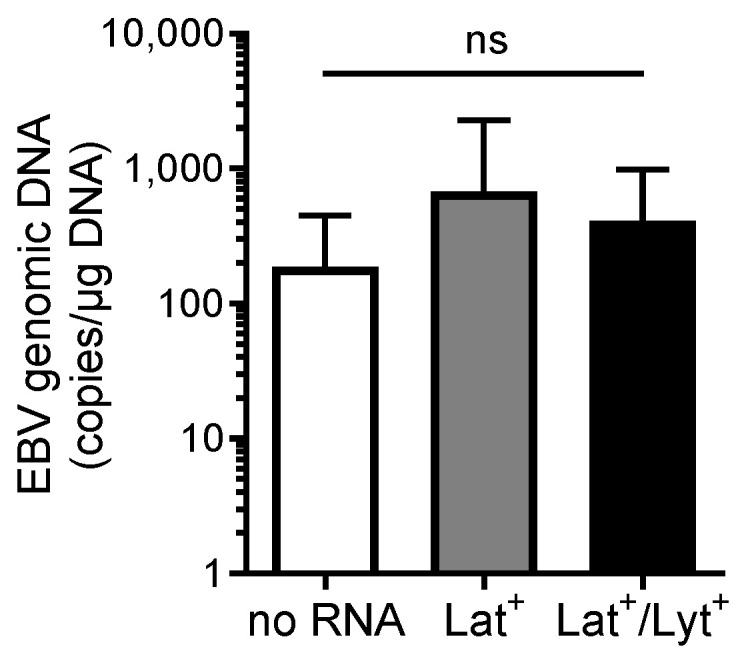
The Epstein-Barr virus (EBV) is frequently found in endomyocardial biopsies (EMBs) from patients with heart failure, but the detection of EBV-specific DNA has not been associated with progressive hemodynamic deterioration. In this paper, we investigate the use of targeted next-generation sequencing (NGS) to detect EBV transcripts and their correlation with myocardial inflammation in EBV-positive patients with heart failure with reduced ejection fraction (HFrEF). Forty-four HFrEF patients with positive EBV DNA detection and varying degrees of myocardial inflammation were selected. EBV-specific transcripts from EMBs were enriched using a custom hybridization capture-based workflow and, subsequently, sequenced by NGS. The short-read sequencing revealed the presence of EBV-specific transcripts in 17 patients, of which 11 had only latent EBV genes and 6 presented with lytic transcription. The immunohistochemical staining for CD3 T lymphocytes showed a significant increase in the degree of myocardial inflammation in the presence of EBV lytic transcripts, suggesting a possible influence on the clinical course. These results imply the important role of EBV lytic transcripts in the pathogenesis of inflammatory heart disease and emphasize the applicability of targeted NGS in EMB diagnostics as a basis for specific treatment.
EB 病毒(EBV)在心力衰竭患者的心内膜心肌活检(EMB)中经常被发现,但 EBV 特异性 DNA 的检测并未与进行性血流动力学恶化相关。在本文中,我们研究了靶向下一代测序(NGS)在检测 EBV 阳性心力衰竭伴射血分数降低(HFrEF)患者中的 EBV 转录本及其与心肌炎症的相关性。选择了 44 名 EBV DNA 检测阳性且心肌炎症程度不同的 HFrEF 患者。使用基于定制杂交捕获的工作流程从 EMB 中富集 EBV 特异性转录本,然后通过 NGS 进行测序。短读测序显示 17 名患者中存在 EBV 特异性转录本,其中 11 名患者只有潜伏 EBV 基因,6 名患者出现裂解转录。CD3 T 淋巴细胞的免疫组织化学染色显示,在存在 EBV 裂解转录本的情况下,心肌炎症程度显著增加,提示其可能对临床病程有影响。这些结果表明 EBV 裂解转录本在炎症性心脏病发病机制中的重要作用,并强调了靶向 NGS 在 EMB 诊断中的适用性,作为特定治疗的基础。