HIV and Viral Hepatitis Research Laboratory, Instituto de Investigación Sanitaria Fundación Jiménez Díaz, Universidad Autónoma de Madrid (IIS-FJD, UAM), 28040 Madrid, Spain.
Hospital Universitario Rey Juan Carlos, 28933 Móstoles, Spain.
Int J Mol Sci. 2024 May 29;25(11):5937. doi: 10.3390/ijms25115937.
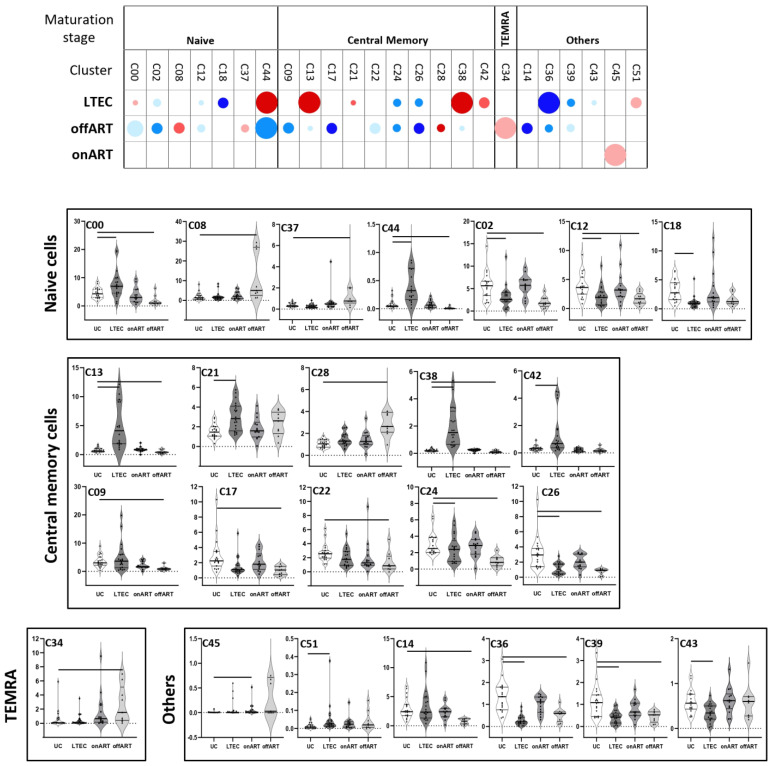
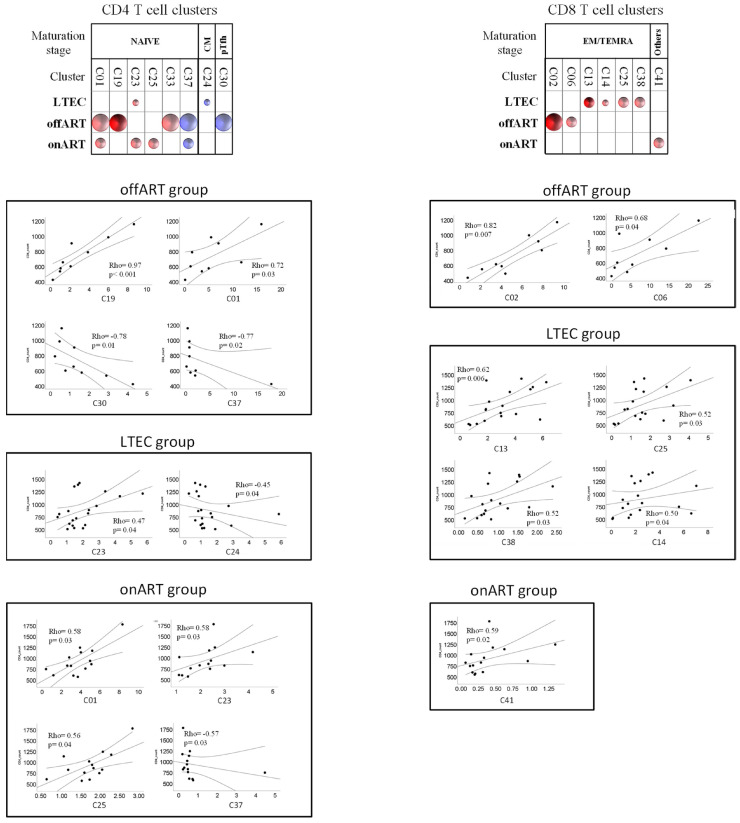
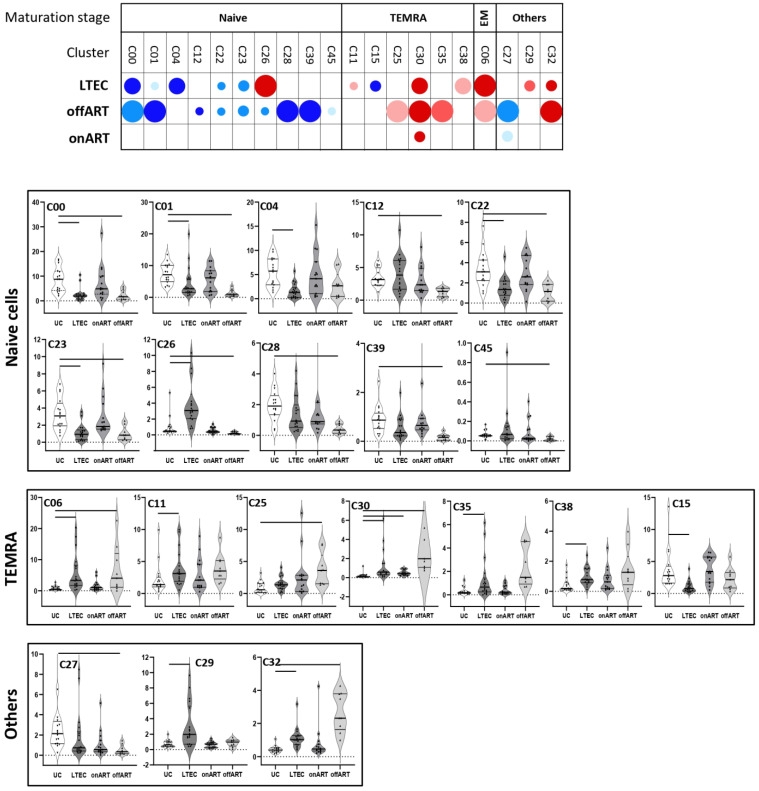
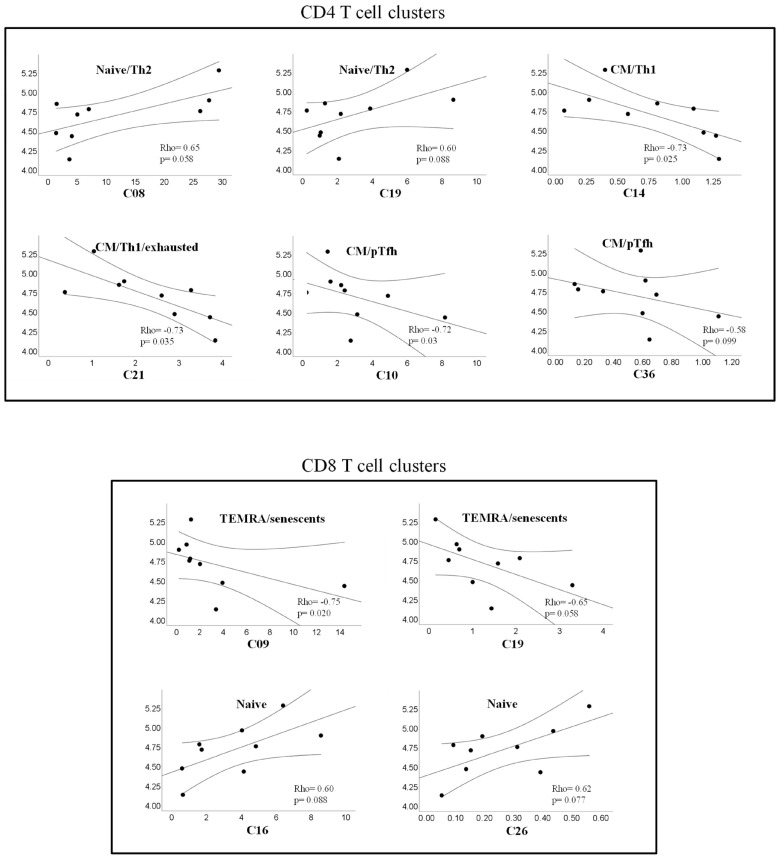
Elite controllers (ECs) are people living with HIV (PLWH) able to control HIV replication without antiretroviral therapy and have been proposed as a model of a functional HIV cure. Much evidence suggests that this spontaneous control of HIV has a cost in terms of T cell homeostasis alterations. We performed a deep phenotypic study to obtain insight into T cell homeostasis disturbances in ECs maintaining long-term virologic and immunologic control of HIV (long-term elite controllers; LTECs). Forty-seven PLWH were included: 22 LTECs, 15 non-controllers under successful antiretroviral therapy (onART), and 10 non-controllers not receiving ART (offART). Twenty uninfected participants (UCs) were included as a reference. T cell homeostasis was analyzed by spectral flow cytometry and data were analyzed using dimensionality reduction and clustering using R software v3.3.2. Dimensionality reduction and clustering yielded 57 and 54 different CD4 and CD8 T cell clusters, respectively. The offART group showed the highest perturbation of T cell homeostasis, with 18 CD4 clusters and 15 CD8 clusters significantly different from those of UCs. Most of these alterations were reverted in the onART group. Interestingly, LTECs presented several disturbances of T cell homeostasis with 15 CD4 clusters and 13 CD8 clusters different from UC. Moreover, there was a specific profile of T cell homeostasis alterations associated with LTECs, characterized by increases in clusters of naïve T cells, increases in clusters of non-senescent effector CD8 cells, and increases in clusters of central memory CD4 cells. These results demonstrate that, compared to ART-mediated control of HIV, the spontaneous control of HIV is associated with several disturbances in CD4 and CD8 T cell homeostasis. These alterations could be related to the existence of a potent and efficient virus-specific T cell response, and to the ability to halt disease progression by maintaining an adequate pool of CD4 T cells.
精英控制者(ECs)是指能够在没有抗逆转录病毒治疗的情况下控制 HIV 复制的 HIV 感染者(PLWH),并被提议作为功能性 HIV 治愈的模型。大量证据表明,这种 HIV 的自发控制会导致 T 细胞稳态改变。我们进行了一项深入的表型研究,以深入了解长期维持 HIV 病毒学和免疫学控制的 ECs 中 T 细胞稳态紊乱。纳入了 47 名 PLWH:22 名长期精英控制者(LTECs)、15 名接受成功抗逆转录病毒治疗(ART)的非控制者(onART)和 10 名未接受 ART 的非控制者(offART)。纳入了 20 名未感染参与者(UCs)作为参考。通过光谱流式细胞术分析 T 细胞稳态,并使用 R 软件 v3.3.2 进行降维和聚类分析数据。降维和聚类分别产生了 57 个和 54 个不同的 CD4 和 CD8 T 细胞簇。offART 组显示 T 细胞稳态受到的干扰最大,与 UCs 相比,有 18 个 CD4 簇和 15 个 CD8 簇显著不同。这些改变中的大多数在 onART 组中得到了逆转。有趣的是,LTECs 呈现出多种 T 细胞稳态紊乱,与 UC 相比,有 15 个 CD4 簇和 13 个 CD8 簇不同。此外,LTECs 还存在一种特定的 T 细胞稳态改变特征,表现为幼稚 T 细胞簇增加、非衰老效应 CD8 细胞簇增加和中央记忆 CD4 细胞簇增加。这些结果表明,与 ART 介导的 HIV 控制相比,HIV 的自发控制与 CD4 和 CD8 T 细胞稳态的几种紊乱有关。这些改变可能与存在有效的病毒特异性 T 细胞反应有关,也可能与通过维持足够的 CD4 T 细胞池来阻止疾病进展有关。