Department of Environmental Science and Engineering, Tunghai University, Taichung 407224, Taiwan.
Int J Mol Sci. 2024 May 30;25(11):6009. doi: 10.3390/ijms25116009.
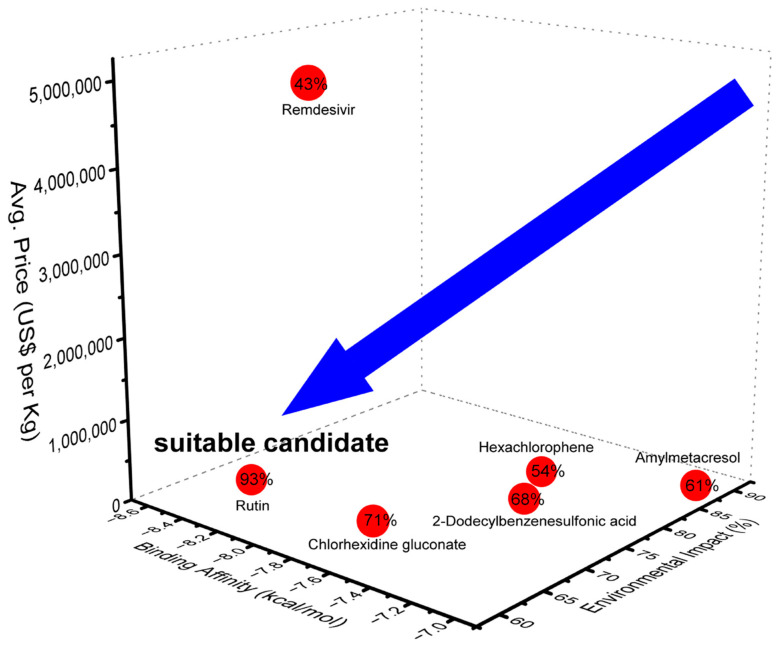
Viral pathogens pose a substantial threat to public health and necessitate the development of effective remediation and antiviral strategies. This short communication aimed to investigate the antiviral efficacy of disinfectants on the surface proteins of human pathogenic viruses. Using in silico modeling, the ligand-binding energies (LBEs) of selected disinfectants were predicted and combined with their environmental impacts and costs through an eco-pharmaco-economic analysis (EPEA). The results revealed that the binding affinities of chemical disinfectants to viral proteins varied significantly ( < 0.005). Rutin demonstrated promising broad-spectrum antiviral efficacy with an LBE of -8.49 ± 0.92 kcal/mol across all tested proteins. Additionally, rutin showed a superior eco-pharmaco-economic profile compared to the other chemicals, effectively balancing high antiviral effectiveness, moderate environmental impact, and affordability. These findings highlight rutin as a key phytochemical for use in remediating viral contaminants.
病毒病原体对公共健康构成重大威胁,因此需要开发有效的补救和抗病毒策略。本简短交流旨在研究消毒剂对人体致病病毒表面蛋白的抗病毒功效。通过计算机模拟,预测了选定消毒剂的配体结合能 (LBE),并通过生态-药物经济学分析 (EPEA) 将其与环境影响和成本相结合。结果表明,化学消毒剂与病毒蛋白的结合亲和力差异很大(<0.005)。芦丁对所有测试蛋白的 LBE 为-8.49±0.92 kcal/mol,表现出有前景的广谱抗病毒功效。此外,芦丁与其他化学物质相比具有优越的生态-药物经济学特征,有效地平衡了高抗病毒效果、适度的环境影响和可负担性。这些发现强调了芦丁作为一种用于修复病毒污染物的关键植物化学物质的重要性。