
动态对比增强磁共振成像中的相对洗入率作为82例骨肉瘤患者无事件生存期的新预后生物标志物:一项多中心研究
Relative Wash-In Rate in Dynamic Contrast-Enhanced Magnetic Resonance Imaging as a New Prognostic Biomarker for Event-Free Survival in 82 Patients with Osteosarcoma: A Multicenter Study.
作者信息
Kalisvaart Gijsbert M, Evenhuis Richard E, Grootjans Willem, Van Den Berghe Thomas, Callens Martijn, Bovée Judith V M G, Creytens David, Gelderblom Hans, Speetjens Frank M, Lapeire Lore, Sys Gwen, Fiocco Marta, Verstraete Koenraad L, van de Sande Michiel A J, Bloem Johan L
机构信息
Department of Radiology, Leiden University Medical Center, 2333 Leiden, The Netherlands.
Department of Orthopedic Surgery, Leiden University Medical Center, Albinusdreef 2, 2333 Leiden, The Netherlands.
出版信息
Cancers (Basel). 2024 May 21;16(11):1954. doi: 10.3390/cancers16111954.
BACKGROUND
The decreased perfusion of osteosarcoma in dynamic contrast-enhanced (DCE) MRI, reflecting a good histological response to neoadjuvant chemotherapy, has been described.
PURPOSE
In this study, we aim to explore the potential of the relative wash-in rate as a prognostic factor for event-free survival (EFS).
METHODS
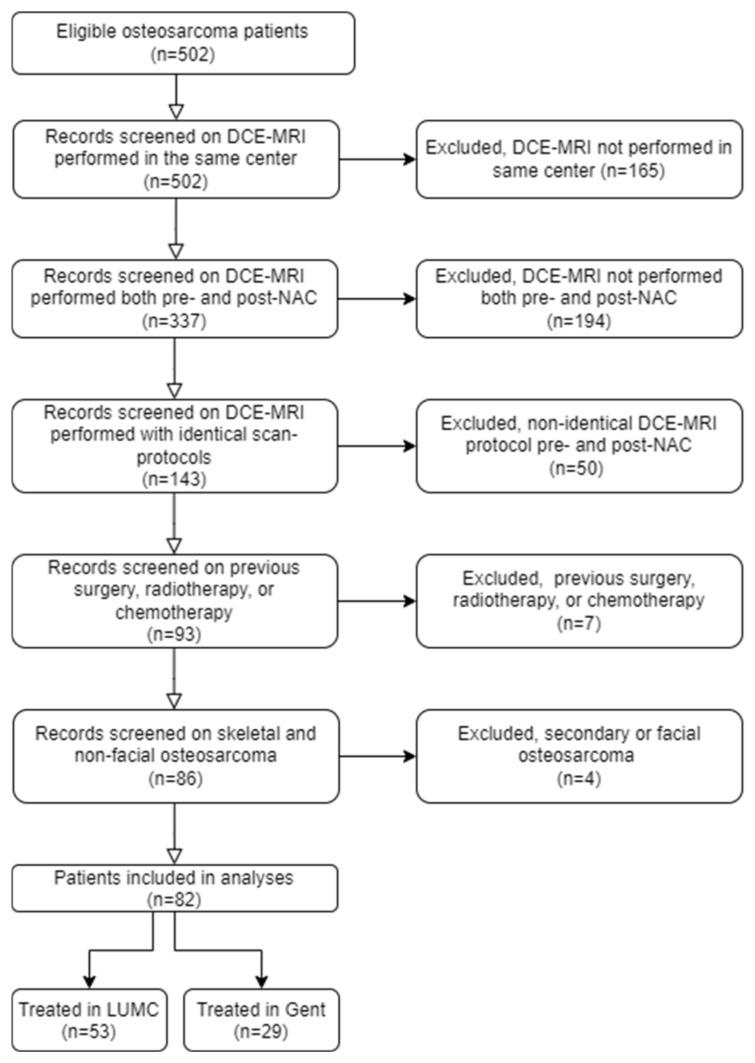
Skeletal high-grade osteosarcoma patients, treated in two tertiary referral centers between 2005 and 2022, were retrospectively included. The relative wash-in rate (rWIR) was determined with DCE-MRI before, after, or during the second cycle of chemotherapy (pre-resection). A previously determined cut-off was used to categorize patients, where rWIR < 2.3 was considered poor and rWIR ≥ 2.3 a good radiological response. EFS was defined as the time from resection to the first event: local recurrence, new metastases, or tumor-related death. EFS was estimated using Kaplan-Meier's methodology. Multivariate Cox proportional hazard model was used to estimate the effect of histological response and rWIR on EFS, adjusted for traditional prognostic factors.
RESULTS
Eighty-two patients (median age: 17 years; IQR: 14-28) were included. The median follow-up duration was 11.8 years (95% CI: 11.0-12.7). During follow-up, 33 events occurred. Poor histological response was not significantly associated with EFS (HR: 1.8; 95% CI: 0.9-3.8), whereas a poor radiological response was associated with a worse EFS (HR: 2.4; 95% CI: 1.1-5.0). In a subpopulation without initial metastases, the binary assessment of rWIR approached statistical significance (HR: 2.3; 95% CI: 1.0-5.2), whereas its continuous evaluation demonstrated a significant association between higher rWIR and improved EFS (HR: 0.7; 95% CI: 0.5-0.9), underlining the effect of response to chemotherapy. The 2- and 5-year EFS for patients with a rWIR ≥ 2.3 were 85% and 75% versus 55% and 50% for patients with a rWIR < 2.3.
CONCLUSION
The predicted poor chemo response with MRI (rWIR < 2.3) is associated with shorter EFS even when adjusted for known clinical covariates and shows similar results to histological response evaluation. rWIR is a potential tool for future response-based individualized healthcare in osteosarcoma patients before surgical resection.
背景
动态对比增强(DCE)磁共振成像(MRI)显示骨肉瘤灌注减少,这反映了对新辅助化疗具有良好的组织学反应。
目的
在本研究中,我们旨在探讨相对流入率作为无事件生存期(EFS)预后因素的潜力。
方法
回顾性纳入2005年至2022年在两个三级转诊中心接受治疗的骨骼高级别骨肉瘤患者。在化疗(术前切除)的第二个周期之前、之后或期间,通过DCE-MRI测定相对流入率(rWIR)。使用先前确定的临界值对患者进行分类,其中rWIR<2.3被认为反应较差,rWIR≥2.3被认为具有良好的放射学反应。EFS定义为从切除到首次事件的时间:局部复发、新转移或肿瘤相关死亡。使用Kaplan-Meier方法估计EFS。多变量Cox比例风险模型用于估计组织学反应和rWIR对EFS的影响,并针对传统预后因素进行调整。
结果
纳入82例患者(中位年龄:17岁;四分位间距:14-28岁)。中位随访时间为11.8年(95%置信区间:11.0-12.7)。随访期间发生了33起事件。组织学反应较差与EFS无显著相关性(风险比:1.8;95%置信区间:0.9-3.8),而放射学反应较差与较差的EFS相关(风险比:2.4;95%置信区间:1.1-5.0)。在没有初始转移的亚组中,rWIR的二元评估接近统计学意义(风险比:2.3;95%置信区间:1.0-5.2),而其连续评估显示较高的rWIR与改善的EFS之间存在显著相关性(风险比:0.7;95%置信区间:0.5-0.9),强调了化疗反应的影响。rWIR≥2.3的患者2年和5年EFS分别为85%和75%,而rWIR<2.3的患者分别为55%和50%。
结论
即使在对已知临床协变量进行调整后,MRI预测的化疗反应较差(rWIR<2.3)也与较短的EFS相关,并且与组织学反应评估结果相似。rWIR是骨肉瘤患者手术切除前基于未来反应的个体化医疗的潜在工具。


 Zotero 插件