Zhang Lu, Ge Yinghui, Gao Qiuru, Zhao Fei, Cheng Tianming, Li Hailiang, Xia Yuwei
Department of Medical Imaging, People's Hospital of Zhengzhou University Henan Provincial People's Hospital, Zhengzhou, China.
Department of Orthopedics, People's Hospital of Zhengzhou University Henan Provincial People's Hospital, Zhengzhou, China.
Front Oncol. 2021 Nov 15;11:758921. doi: 10.3389/fonc.2021.758921. eCollection 2021.
This study aims to evaluate the value of machine learning-based dynamic contrast-enhanced MRI (DCE-MRI) radiomics nomogram in prediction treatment response of neoadjuvant chemotherapy (NAC) in patients with osteosarcoma.
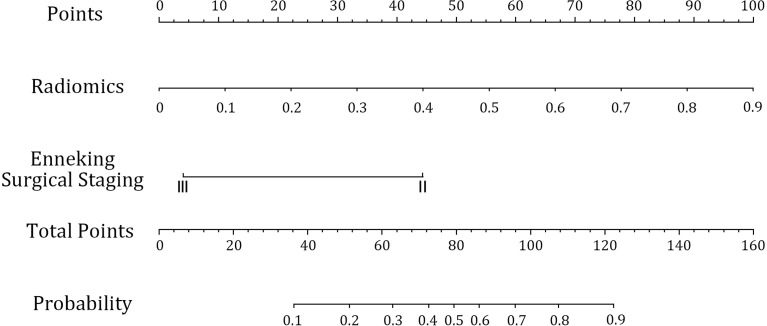
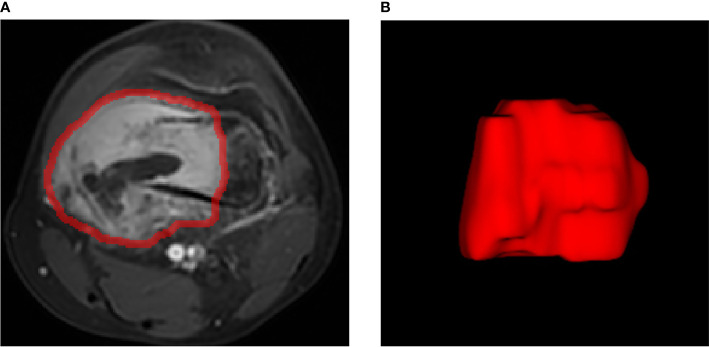
A total of 102 patients with osteosarcoma and who underwent NAC were enrolled in this study. All patients received a DCE-MRI scan before NAC. The Response Evaluation Criteria in Solid Tumors was used as the standard to evaluate the NAC response with complete remission and partial remission in the effective group, stable disease, and progressive disease in the ineffective group. The following semi-quantitative parameters of DCE-MRI were calculated: early dynamic enhancement wash-in slope (Slope), time to peak (TTP), and enhancement rate (R). The acquired data is randomly divided into 70% for training and 30% for testing. Variance threshold, univariate feature selection, and least absolute shrinkage and selection operator were used to select the optimal features. Three classifiers (K-nearest neighbor, KNN; support vector machine, SVM; and logistic regression, LR) were implemented for model establishment. The performance of different classifiers and conventional semi-quantitative parameters was evaluated by confusion matrix and receiver operating characteristic curves. Furthermore, clinically relevant risk factors including age, tumor size and site, pathological fracture, and surgical staging were collected to evaluate their predictive values for the efficacy of NAC. The selected clinical features and imaging features were combined to establish the model and the nomogram, and then the predictive efficacy was evaluated.
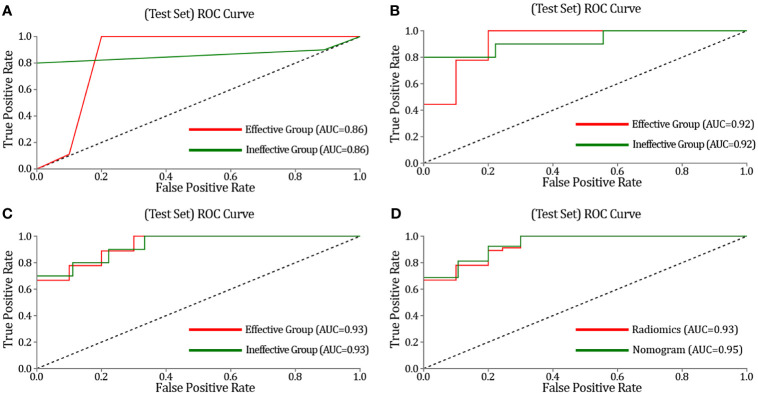
The clinical relevance risk factor analysis demonstrates that only surgical stage was an independent predictor of NAC. A total of seven radiomic features were selected, and three machine learning models (KNN, SVM, and LR) were established based on such features. The prediction accuracy (ACC) of these three models was 0.89, 0.84, and 0.84, respectively. The area under the subject curve (AUC) of these three models was 0.86, 0.92, and 0.93, respectively. As for Slope, TTP, and R parameters, the prediction ACC was 0.91, 0.89, and 0.81, respectively, while the AUC was 0.87, 0.85, and 0.83, respectively. In both the training and testing sets, the ACC and AUC of the combined model were higher than those of the radiomics models (ACC = 0.91 and AUC = 0.95), which indicate an outstanding performance of our proposed model.
The radiomics nomogram demonstrates satisfactory predictive results for the treatment response of patients with osteosarcoma before NAC. This finding may provide a new decision basis to improve the treatment plan.
本研究旨在评估基于机器学习的动态对比增强磁共振成像(DCE-MRI)影像组学列线图在预测骨肉瘤患者新辅助化疗(NAC)治疗反应中的价值。
本研究共纳入102例接受NAC的骨肉瘤患者。所有患者在NAC前均接受了DCE-MRI扫描。实体瘤疗效评价标准被用作评估NAC反应的标准,有效组为完全缓解和部分缓解,无效组为疾病稳定和疾病进展。计算DCE-MRI的以下半定量参数:早期动态增强流入斜率(Slope)、达峰时间(TTP)和增强率(R)。将获取的数据随机分为70%用于训练,30%用于测试。采用方差阈值、单变量特征选择和最小绝对收缩和选择算子来选择最佳特征。实施三种分类器(K近邻,KNN;支持向量机,SVM;逻辑回归,LR)进行模型建立。通过混淆矩阵和受试者工作特征曲线评估不同分类器和传统半定量参数的性能。此外,收集包括年龄、肿瘤大小和部位、病理性骨折和手术分期等临床相关危险因素,以评估它们对NAC疗效的预测价值。将选定的临床特征和影像特征相结合建立模型和列线图,然后评估预测疗效。
临床相关性危险因素分析表明,只有手术分期是NAC的独立预测因素。共选择了七个影像组学特征,并基于这些特征建立了三种机器学习模型(KNN、SVM和LR)。这三种模型的预测准确率(ACC)分别为0.89、0.84和0.84。这三种模型的受试者曲线下面积(AUC)分别为0.86、0.92和0.93。至于Slope、TTP和R参数,预测ACC分别为0.91、0.89和0.81,而AUC分别为0.87、0.85和0.83。在训练集和测试集中,联合模型的ACC和AUC均高于影像组学模型(ACC = 0.91,AUC = 0.95),这表明我们提出的模型具有出色的性能。
影像组学列线图对骨肉瘤患者NAC前的治疗反应显示出令人满意的预测结果。这一发现可能为改进治疗方案提供新的决策依据。