Fanciullo Cristiana, Gitto Salvatore, Carlicchi Eleonora, Albano Domenico, Messina Carmelo, Sconfienza Luca Maria
Scuola di Specializzazione in Radiodiagnostica, Università degli Studi di Milano, 20122 Milan, Italy.
Dipartimento di Scienze Biomediche per la Salute, Università degli Studi di Milano, via Riccardo Galeazzi 4, 20161 Milan, Italy.
J Imaging. 2022 Feb 13;8(2):45. doi: 10.3390/jimaging8020045.
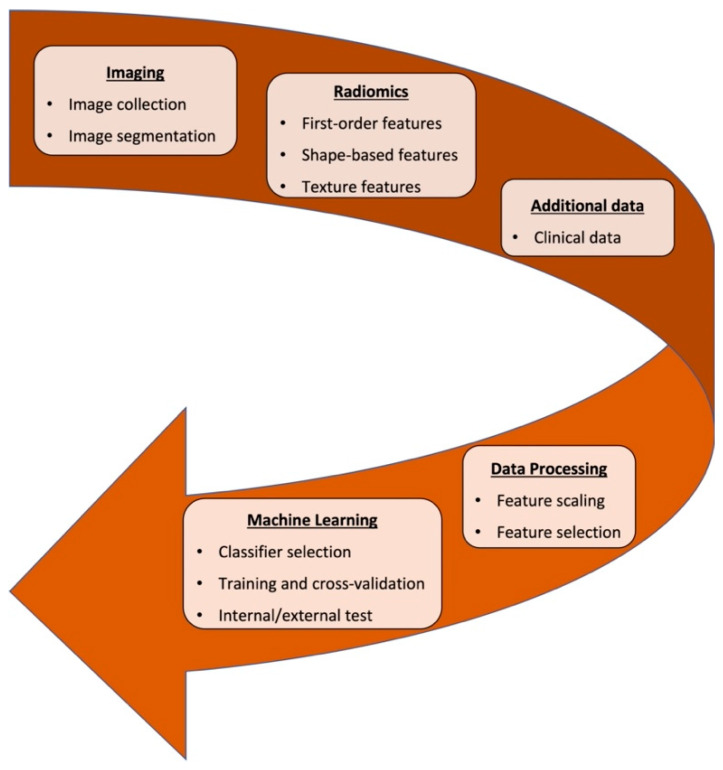
Bone and soft-tissue primary malignant tumors or sarcomas are a large, diverse group of mesenchymal-derived malignancies. They represent a model for intra- and intertumoral heterogeneities, making them particularly suitable for radiomics analyses. Radiomic features offer information on cancer phenotype as well as the tumor microenvironment which, combined with other pertinent data such as genomics and proteomics and correlated with outcomes data, can produce accurate, robust, evidence-based, clinical-decision support systems. Our purpose in this narrative review is to offer an overview of radiomics studies dealing with Magnetic Resonance Imaging (MRI)-based radiomics models of bone and soft-tissue sarcomas that could help distinguish different histotypes, low-grade from high-grade sarcomas, predict response to multimodality therapy, and thus better tailor patients' treatments and finally improve their survivals. Although showing promising results, interobserver segmentation variability, feature reproducibility, and model validation are three main challenges of radiomics that need to be addressed in order to translate radiomics studies to clinical applications. These efforts, together with a better knowledge and application of the "Radiomics Quality Score" and Image Biomarker Standardization Initiative reporting guidelines, could improve the quality of sarcoma radiomics studies and facilitate radiomics towards clinical translation.
骨与软组织原发性恶性肿瘤或肉瘤是一大类多样的间充质来源恶性肿瘤。它们代表了肿瘤内和肿瘤间异质性的模型,使其特别适合进行放射组学分析。放射组学特征提供了有关癌症表型以及肿瘤微环境的信息,这些信息与基因组学和蛋白质组学等其他相关数据相结合,并与结果数据相关联,能够产生准确、可靠、基于证据的临床决策支持系统。在这篇叙述性综述中,我们的目的是概述有关基于磁共振成像(MRI)的骨与软组织肉瘤放射组学模型的放射组学研究,这些模型有助于区分不同的组织学类型、低级与高级肉瘤,预测对多模态治疗的反应,从而更好地为患者量身定制治疗方案并最终提高其生存率。尽管取得了有前景的结果,但观察者间分割变异性、特征可重复性和模型验证是放射组学的三个主要挑战,为了将放射组学研究转化为临床应用需要加以解决。这些努力,连同对“放射组学质量评分”和图像生物标志物标准化倡议报告指南的更好了解和应用,可提高肉瘤放射组学研究的质量,并促进放射组学向临床转化。