• 文献检索
  • 文档翻译
  • 深度研究
  • 学术资讯
  • Suppr Zotero 插件Zotero 插件
  • 邀请有礼
  • 套餐&价格
  • 历史记录
应用&插件
Suppr Zotero 插件Zotero 插件浏览器插件Mac 客户端Windows 客户端微信小程序
定价
高级版会员购买积分包购买API积分包
服务
文献检索文档翻译深度研究API 文档MCP 服务
关于我们
关于 Suppr公司介绍联系我们用户协议隐私条款
关注我们

Suppr 超能文献

核心技术专利:CN118964589B侵权必究
粤ICP备2023148730 号-1Suppr @ 2026

文献检索

告别复杂PubMed语法,用中文像聊天一样搜索,搜遍4000万医学文献。AI智能推荐,让科研检索更轻松。

立即免费搜索

文件翻译

保留排版,准确专业,支持PDF/Word/PPT等文件格式,支持 12+语言互译。

免费翻译文档

深度研究

AI帮你快速写综述,25分钟生成高质量综述,智能提取关键信息,辅助科研写作。

立即免费体验

CASCADE:用于肿瘤学中简化多学科肿瘤委员会建议的上下文感知数据驱动人工智能

CASCADE: Context-Aware Data-Driven AI for Streamlined Multidisciplinary Tumor Board Recommendations in Oncology.

作者信息

Daye Dania, Parker Regina, Tripathi Satvik, Cox Meredith, Brito Orama Sebastian, Valentin Leonardo, Bridge Christopher P, Uppot Raul N

机构信息

Massachusetts General Hospital, Boston, MA 02114, USA.

Harvard Medical School, Boston, MA 02115, USA.

出版信息

Cancers (Basel). 2024 May 23;16(11):1975. doi: 10.3390/cancers16111975.

DOI:10.3390/cancers16111975
PMID:38893096
原文链接:https://pmc.ncbi.nlm.nih.gov/articles/PMC11171258/
Abstract

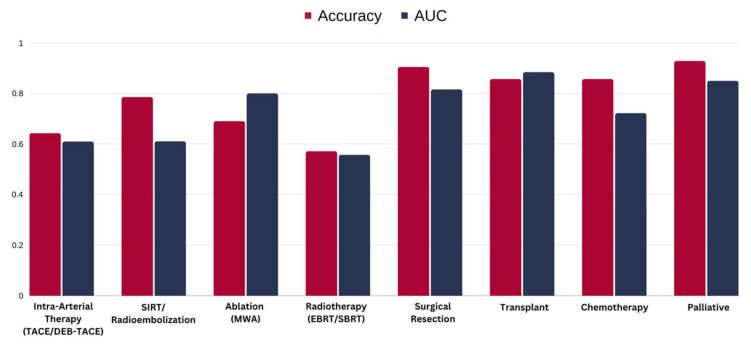
This study addresses the potential of machine learning in predicting treatment recommendations for patients with hepatocellular carcinoma (HCC). Using an IRB-approved retrospective study of patients discussed at a multidisciplinary tumor board, clinical and imaging variables were extracted and used in a gradient-boosting machine learning algorithm, XGBoost. The algorithm's performance was assessed using confusion matrix metrics and the area under the Receiver Operating Characteristics (ROC) curve. The study included 140 patients (mean age 67.7 ± 8.9 years), and the algorithm was found to be predictive of all eight treatment recommendations made by the board. The model's predictions were more accurate than those based on published therapeutic guidelines by ESMO and NCCN. The study concludes that a machine learning model incorporating clinical and imaging variables can predict treatment recommendations made by an expert multidisciplinary tumor board, potentially aiding clinical decision-making in settings lacking subspecialty expertise.

摘要

本研究探讨了机器学习在预测肝细胞癌(HCC)患者治疗建议方面的潜力。通过对多学科肿瘤委员会讨论的患者进行一项经机构审查委员会批准的回顾性研究,提取了临床和影像变量,并将其用于梯度提升机器学习算法XGBoost。使用混淆矩阵指标和受试者操作特征(ROC)曲线下面积评估该算法的性能。该研究纳入了140名患者(平均年龄67.7±8.9岁),发现该算法能够预测委员会提出的所有八项治疗建议。该模型的预测比基于欧洲肿瘤内科学会(ESMO)和美国国立综合癌症网络(NCCN)发布的治疗指南的预测更准确。该研究得出结论,纳入临床和影像变量的机器学习模型可以预测专家多学科肿瘤委员会提出的治疗建议,这可能有助于在缺乏专科专业知识的情况下进行临床决策。
https://cdn.ncbi.nlm.nih.gov/pmc/blobs/2111/11171258/7fdcd051ce79/cancers-16-01975-g001.jpg

相似文献

1
CASCADE: Context-Aware Data-Driven AI for Streamlined Multidisciplinary Tumor Board Recommendations in Oncology.CASCADE:用于肿瘤学中简化多学科肿瘤委员会建议的上下文感知数据驱动人工智能
Cancers (Basel). 2024 May 23;16(11):1975. doi: 10.3390/cancers16111975.
2
Can Predictive Modeling Tools Identify Patients at High Risk of Prolonged Opioid Use After ACL Reconstruction?预测模型工具能否识别 ACL 重建术后阿片类药物使用时间延长的高风险患者?
Clin Orthop Relat Res. 2020 Jul;478(7):0-1618. doi: 10.1097/CORR.0000000000001251.
3
Computational prediction of multidisciplinary team decision-making for adjuvant breast cancer drug therapies: a machine learning approach.辅助性乳腺癌药物治疗多学科团队决策的计算预测:一种机器学习方法。
BMC Cancer. 2016 Dec 1;16(1):929. doi: 10.1186/s12885-016-2972-z.
4
How Does the Skeletal Oncology Research Group Algorithm's Prediction of 5-year Survival in Patients with Chondrosarcoma Perform on International Validation?骨肿瘤研究组算法对软骨肉瘤患者 5 年生存率的预测在国际验证中的表现如何?
Clin Orthop Relat Res. 2020 Oct;478(10):2300-2308. doi: 10.1097/CORR.0000000000001305.
5
Develop a radiomics-based machine learning model to predict the stone-free rate post-percutaneous nephrolithotomy.建立基于放射组学的机器学习模型,以预测经皮肾镜取石术后的无石率。
Urolithiasis. 2024 Apr 13;52(1):64. doi: 10.1007/s00240-024-01562-7.
6
[Constructing a predictive model for the death risk of patients with septic shock based on supervised machine learning algorithms].基于监督机器学习算法构建脓毒症休克患者死亡风险预测模型
Zhonghua Wei Zhong Bing Ji Jiu Yi Xue. 2024 Apr;36(4):345-352. doi: 10.3760/cma.j.cn121430-20230930-00832.
7
Predicting postoperative outcomes in lumbar spinal fusion: development of a machine learning model.预测腰椎融合术后结局:机器学习模型的建立。
Spine J. 2024 Feb;24(2):239-249. doi: 10.1016/j.spinee.2023.09.029. Epub 2023 Oct 20.
8
Deep learning models for predicting the survival of patients with hepatocellular carcinoma based on a surveillance, epidemiology, and end results (SEER) database analysis.基于监测、流行病学和最终结果(SEER)数据库分析的肝细胞癌患者生存预测的深度学习模型。
Sci Rep. 2024 Jun 9;14(1):13232. doi: 10.1038/s41598-024-63531-9.
9
Development of a machine learning-based model for predicting risk of early postoperative recurrence of hepatocellular carcinoma.基于机器学习的肝癌术后早期复发风险预测模型的建立。
World J Gastroenterol. 2023 Nov 21;29(43):5804-5817. doi: 10.3748/wjg.v29.i43.5804.
10
Identification of High-Risk Patients for Postoperative Myocardial Injury After CME Using Machine Learning: A 10-Year Multicenter Retrospective Study.使用机器学习识别结直肠癌根治术后心肌损伤的高危患者:一项为期10年的多中心回顾性研究
Int J Gen Med. 2023 Apr 7;16:1251-1264. doi: 10.2147/IJGM.S409363. eCollection 2023.

本文引用的文献

1
Clinical Prediction Models for Prognosis of Colorectal Liver Metastases: A Comprehensive Review of Regression-Based and Machine Learning Models.结直肠癌肝转移预后的临床预测模型:基于回归和机器学习模型的综合综述
Cancers (Basel). 2024 Apr 25;16(9):1645. doi: 10.3390/cancers16091645.
2
Machine learning-based classifiers to predict metastasis in colorectal cancer patients.基于机器学习的分类器用于预测结直肠癌患者的转移情况。
Front Artif Intell. 2024 Jan 24;7:1285037. doi: 10.3389/frai.2024.1285037. eCollection 2024.
3
From Machine Learning to Patient Outcomes: A Comprehensive Review of AI in Pancreatic Cancer.
从机器学习到患者预后:胰腺癌人工智能的全面综述
Diagnostics (Basel). 2024 Jan 12;14(2):174. doi: 10.3390/diagnostics14020174.
4
Machine learning-based models for the prediction of breast cancer recurrence risk.基于机器学习的乳腺癌复发风险预测模型。
BMC Med Inform Decis Mak. 2023 Nov 29;23(1):276. doi: 10.1186/s12911-023-02377-z.
5
Breast cancer prediction using different machine learning methods applying multi factors.应用多因素的不同机器学习方法进行乳腺癌预测。
J Cancer Res Clin Oncol. 2023 Dec;149(19):17133-17146. doi: 10.1007/s00432-023-05388-5. Epub 2023 Sep 29.
6
Machine learning (ML) techniques to predict breast cancer in imbalanced datasets: a systematic review.用于预测不平衡数据集中乳腺癌的机器学习(ML)技术:一项系统综述。
J Cancer Surviv. 2025 Feb;19(1):270-294. doi: 10.1007/s11764-023-01465-3. Epub 2023 Sep 26.
7
Understanding Biases and Disparities in Radiology AI Datasets: A Review.理解放射学人工智能数据集的偏差和差异:综述。
J Am Coll Radiol. 2023 Sep;20(9):836-841. doi: 10.1016/j.jacr.2023.06.015. Epub 2023 Jul 16.
8
Machine learning for prediction of immunotherapeutic outcome in non-small-cell lung cancer based on circulating cytokine signatures.基于循环细胞因子特征的机器学习预测非小细胞肺癌的免疫治疗结果。
J Immunother Cancer. 2023 Jul;11(7). doi: 10.1136/jitc-2023-006788.
9
The artificial intelligence and machine learning in lung cancer immunotherapy.人工智能和机器学习在肺癌免疫治疗中的应用。
J Hematol Oncol. 2023 May 24;16(1):55. doi: 10.1186/s13045-023-01456-y.
10
Machine learning-based colorectal cancer prediction using global dietary data.基于机器学习的全球饮食数据结直肠癌预测。
BMC Cancer. 2023 Feb 10;23(1):144. doi: 10.1186/s12885-023-10587-x.