Ivanova Mariia, Pescia Carlo, Trapani Dario, Venetis Konstantinos, Frascarelli Chiara, Mane Eltjona, Cursano Giulia, Sajjadi Elham, Scatena Cristian, Cerbelli Bruna, d'Amati Giulia, Porta Francesca Maria, Guerini-Rocco Elena, Criscitiello Carmen, Curigliano Giuseppe, Fusco Nicola
Division of Pathology, European Institute of Oncology IRCCS, 20141 Milan, Italy.
Division of New Drugs and Early Drug Development for Innovative Therapies, European Institute of Oncology IRCCS, 20141 Milan, Italy.
Cancers (Basel). 2024 May 23;16(11):1981. doi: 10.3390/cancers16111981.
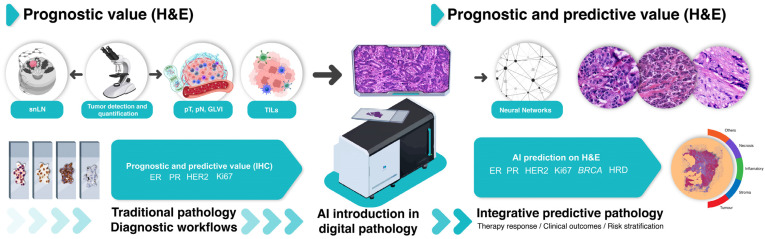
Effective risk assessment in early breast cancer is essential for informed clinical decision-making, yet consensus on defining risk categories remains challenging. This paper explores evolving approaches in risk stratification, encompassing histopathological, immunohistochemical, and molecular biomarkers alongside cutting-edge artificial intelligence (AI) techniques. Leveraging machine learning, deep learning, and convolutional neural networks, AI is reshaping predictive algorithms for recurrence risk, thereby revolutionizing diagnostic accuracy and treatment planning. Beyond detection, AI applications extend to histological subtyping, grading, lymph node assessment, and molecular feature identification, fostering personalized therapy decisions. With rising cancer rates, it is crucial to implement AI to accelerate breakthroughs in clinical practice, benefiting both patients and healthcare providers. However, it is important to recognize that while AI offers powerful automation and analysis tools, it lacks the nuanced understanding, clinical context, and ethical considerations inherent to human pathologists in patient care. Hence, the successful integration of AI into clinical practice demands collaborative efforts between medical experts and computational pathologists to optimize patient outcomes.
早期乳腺癌的有效风险评估对于明智的临床决策至关重要,但在定义风险类别方面达成共识仍具有挑战性。本文探讨了风险分层中不断发展的方法,包括组织病理学、免疫组织化学和分子生物标志物,以及前沿的人工智能(AI)技术。人工智能利用机器学习、深度学习和卷积神经网络,正在重塑复发风险的预测算法,从而彻底改变诊断准确性和治疗规划。除了检测之外,人工智能应用还扩展到组织学亚型分类、分级、淋巴结评估和分子特征识别,促进个性化治疗决策。随着癌症发病率的上升,实施人工智能以加速临床实践中的突破至关重要,这将使患者和医疗服务提供者都受益。然而,重要的是要认识到,虽然人工智能提供了强大的自动化和分析工具,但它缺乏人类病理学家在患者护理中所固有的细致入微的理解、临床背景和伦理考量。因此,将人工智能成功整合到临床实践中需要医学专家和计算病理学家之间的合作努力,以优化患者预后。