Department of Environmental and Public Health Sciences, University of Cincinnati, College of Medicine, Cincinnati, Ohio, USA.
Department of Environmental and Public Health Sciences, University of Cincinnati, College of Medicine, Cincinnati, Ohio, USA.
J Biol Chem. 2024 Jul;300(7):107486. doi: 10.1016/j.jbc.2024.107486. Epub 2024 Jun 18.
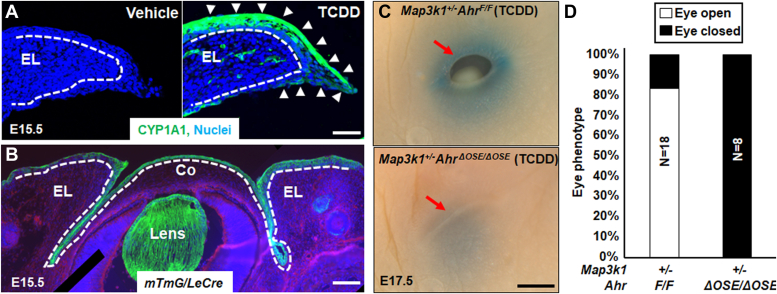
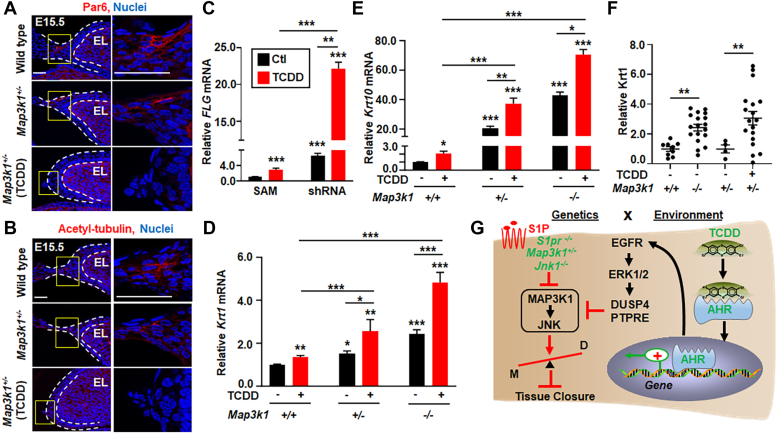
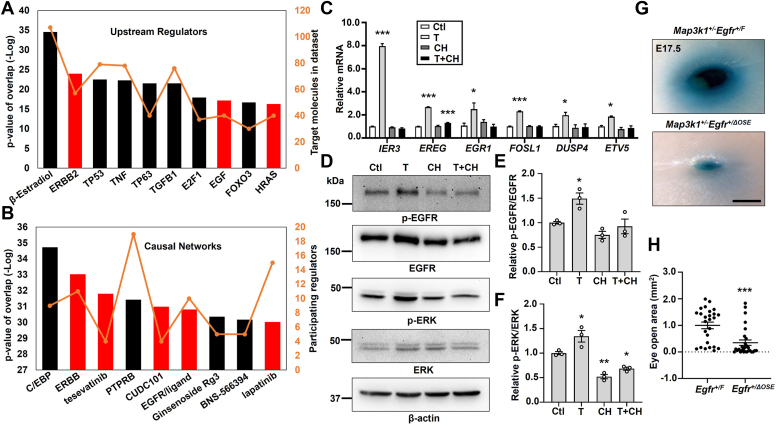
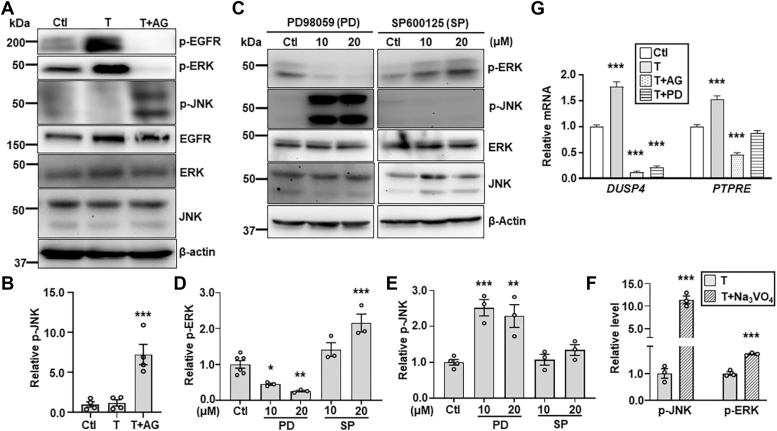
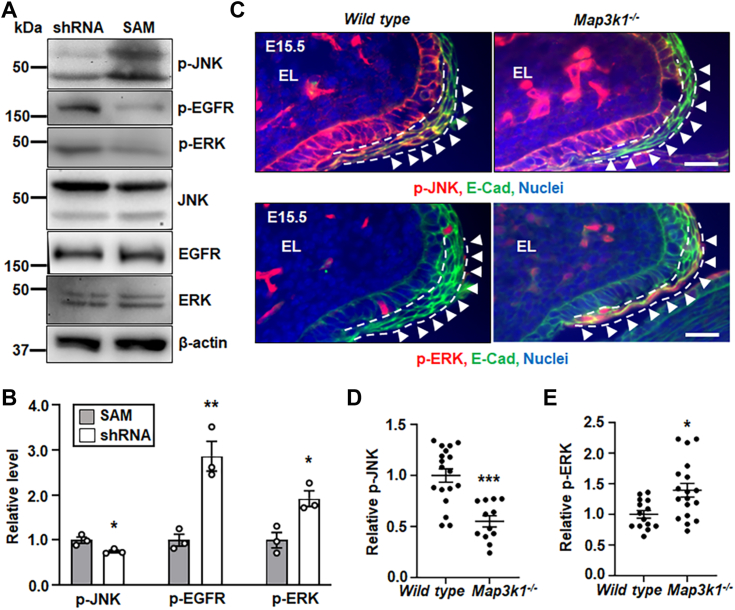
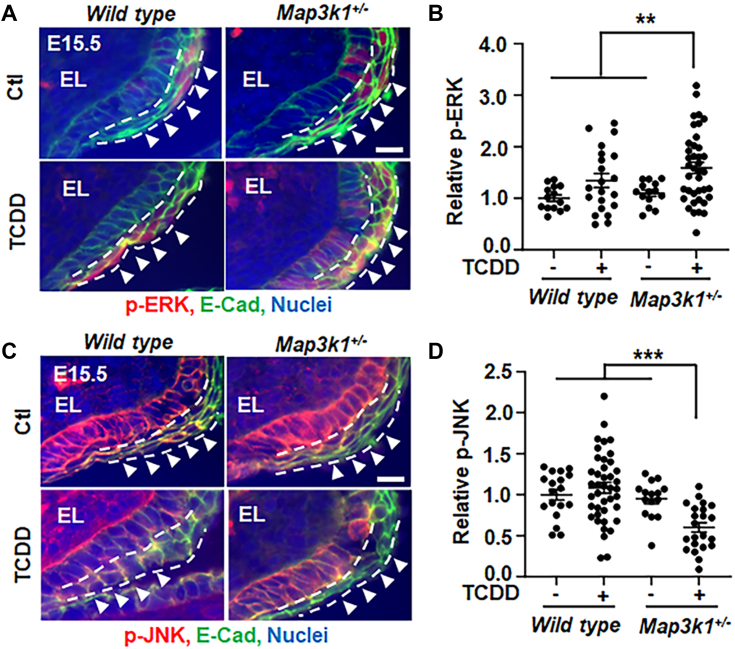
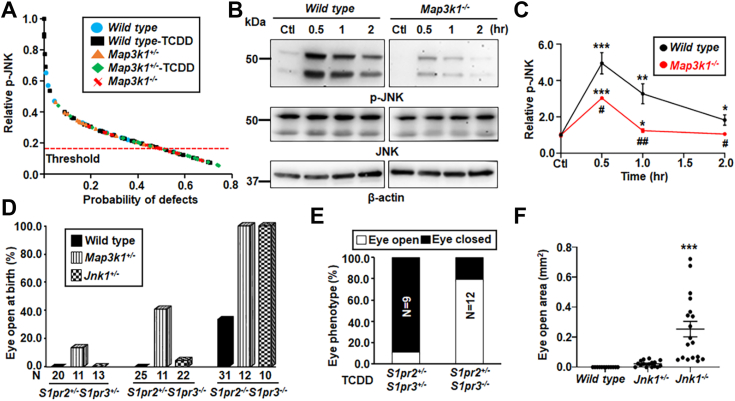
Aberrant regulation of signal transduction pathways can adversely derail biological processes for tissue development. One such process is the embryonic eyelid closure that is dependent on the mitogen-activated protein kinase kinase kinase 1 (MAP3K1). Map3k1 KO in mice results in defective eyelid closure and an autosomal recessive eye-open at birth phenotype. We have shown that in utero exposure to dioxin, a persistent environmental toxicant, induces the same eye defect in Map3k1 heterozygous but not WT pups. Here, we explore the mechanisms of the Map3k1 (gene) and dioxin (environment) interactions (GxE) underlying defective eyelid closure. We show that, acting through the aryl hydrocarbon receptor, dioxin activates epidermal growth factor receptor signaling, which in turn depresses MAP3K1-dependent Jun N-terminal kinase (JNK) activity. The dioxin-mediated JNK repression is moderate but is exacerbated by Map3k1 heterozygosity. Therefore, dioxin exposed Map3k1 embryonic eyelids have a marked reduction of JNK activity, accelerated differentiation and impeded polarization in the epithelial cells. Knocking out Ahr or Egfr in eyelid epithelium attenuates the open-eye defects in dioxin-treated Map3k1 pups, whereas knockout of Jnk1 and S1pr that encodes the sphigosin-1-phosphate (S1P) receptors upstream of the MAP3K1-JNK pathway potentiates the dioxin toxicity. Our novel findings show that the crosstalk of aryl hydrocarbon receptor, epidermal growth factor receptor, and S1P-MAP3K1-JNK pathways determines the outcome of dioxin exposure. Thus, gene mutations targeting these pathways are potential risk factors for the toxicity of environmental chemicals.
信号转导通路的异常调节会对组织发育的生物学过程产生不利影响。其中一个过程是胚胎眼睑闭合,这依赖于丝裂原活化蛋白激酶激酶激酶 1(MAP3K1)。在小鼠中敲除 Map3k1 会导致眼睑闭合缺陷和常染色体隐性出生时睁眼表型。我们已经表明,在子宫内暴露于持久性环境毒物二恶英会导致 Map3k1 杂合子而非 WT 幼仔出现相同的眼部缺陷。在这里,我们探讨了 MAP3K1(基因)和二恶英(环境)相互作用(GxE)导致眼睑闭合缺陷的机制。我们表明,二恶英通过芳香烃受体作用激活表皮生长因子受体信号,进而抑制 MAP3K1 依赖性 Jun N 末端激酶(JNK)活性。二恶英介导的 JNK 抑制作用中等,但 Map3k1 杂合性会加剧这种抑制作用。因此,暴露于二恶英的 Map3k1 胚胎眼睑的 JNK 活性明显降低,上皮细胞的分化加速和极化受阻。在眼睑上皮细胞中敲除 Ahr 或 Egfr 可减轻二恶英处理的 Map3k1 幼仔的睁眼缺陷,而敲除 Jnk1 和编码 Sphigosin-1-磷酸(S1P)受体的 S1pr,该受体位于 MAP3K1-JNK 通路的上游,则增强了二恶英的毒性。我们的新发现表明,芳香烃受体、表皮生长因子受体和 S1P-MAP3K1-JNK 通路的串扰决定了二恶英暴露的结果。因此,针对这些通路的基因突变可能是环境化学物毒性的潜在危险因素。