Front Endocrinol (Lausanne). 2024 Jun 5;15:1353494. doi: 10.3389/fendo.2024.1353494. eCollection 2024.
Post-operative CSF leak is the major source of morbidity following transsphenoidal approaches (TSA) and expanded endonasal approaches (EEA) to lesions of the sella turcica and the ventral skull base. There are conflicting reports in the literature as to whether obesity (BMI ≥30) is a risk factor for this complication. We aimed to evaluate data collected as part of prospective multi-centre cohort study to address this question.
The CRANIAL (CSF Rhinorrhoea After Endonasal Intervention to the Skull Base) study database was reviewed and patients were divided into obese and non-obese cohorts. Data on patient demographics, underlying pathology, intra-operative findings and skull base repair techniques were analysed.
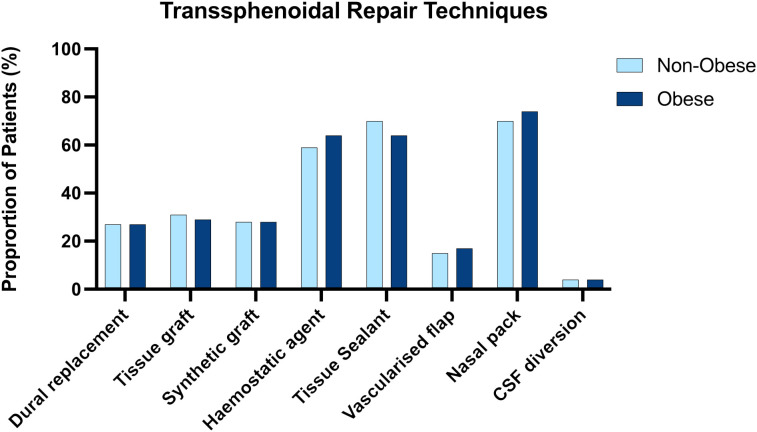
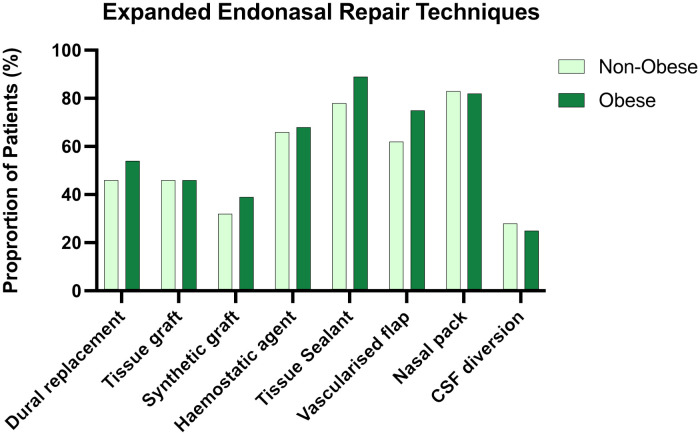
TSA were performed on 726 patients, of whom 210 were obese and 516 were non-obese. The rate of post-operative CSF leak in the obese cohort was 11/210 (5%), compared to 17/516 (3%) in the non-obese cohort, which was not statistically significant (χ 1.520, p=0.217). EEA were performed on 140 patients, of whom 28 were obese and 112 were non-obese. The rate of post-operative CSF leak in the obese cohort was 2/28 (7%), which was identical to the rate observed in the non-obese cohort 8/112 (7%) Fisher's Exact Test, p=1.000). These results persisted following adjustment for inter-institutional variation and baseline risk of post-operative CSF leak.
CSF leak rates following TSA and EEA, in association with modern skull base repair techniques, were found to be low in both obese and non-obese patients. However, due to the low rate of post-operative CSF leak, we were unable to fully exclude a small contributory effect of obesity to the risk of this complication.
经蝶窦入路(TSA)和扩大经鼻内镜入路(EEA)治疗鞍区和颅底腹侧面病变后,脑脊液漏是主要的发病率来源。文献中关于肥胖(BMI≥30)是否是这种并发症的危险因素存在矛盾的报告。我们旨在评估作为前瞻性多中心队列研究的一部分收集的数据,以解决这个问题。
对颅底(CSF 经鼻内镜干预后的鼻漏)研究数据库进行了回顾,将患者分为肥胖组和非肥胖组。分析了患者的人口统计学、基础病理学、术中发现和颅底修复技术的数据。
726 例患者行 TSA,其中 210 例肥胖,516 例非肥胖。肥胖组术后脑脊液漏的发生率为 11/210(5%),而非肥胖组为 17/516(3%),差异无统计学意义(χ 1.520,p=0.217)。140 例患者行 EEA,其中 28 例肥胖,112 例非肥胖。肥胖组术后脑脊液漏的发生率为 2/28(7%),与非肥胖组 8/112(7%)的发生率相同(Fisher 确切检验,p=1.000)。在调整了机构间变异和术后脑脊液漏的基线风险后,这些结果仍然存在。
在使用现代颅底修复技术的情况下,TSA 和 EEA 后的脑脊液漏率在肥胖和非肥胖患者中均较低。然而,由于术后脑脊液漏的发生率较低,我们无法完全排除肥胖对这种并发症风险的微小影响。