Front Oncol. 2023 Jan 4;12:1049627. doi: 10.3389/fonc.2022.1049627. eCollection 2022.
Despite progress in endonasal skull-base neurosurgery, cerebrospinal fluid (CSF) rhinorrhoea remains common and significant. The CRANIAL study sought to determine 1) the scope of skull-base repair methods used, and 2) corresponding rates of postoperative CSF rhinorrhoea in the endonasal transsphenoidal approach (TSA) and the expanded endonasal approach (EEA) for skull-base tumors.
A prospective observational cohort study of 30 centres performing endonasal skull-base neurosurgery in the UK and Ireland (representing 91% of adult units). Patients were identified for 6 months and followed up for 6 months. Data collection and analysis was guided by our published protocol and pilot studies. Descriptive statistics, univariate and multivariable logistic regression models were used for analysis.
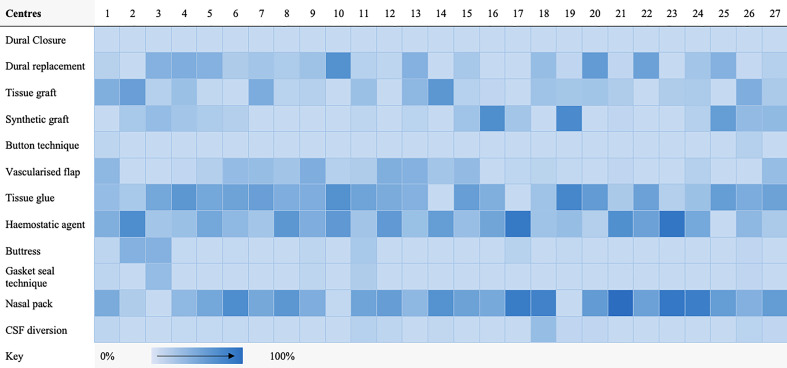
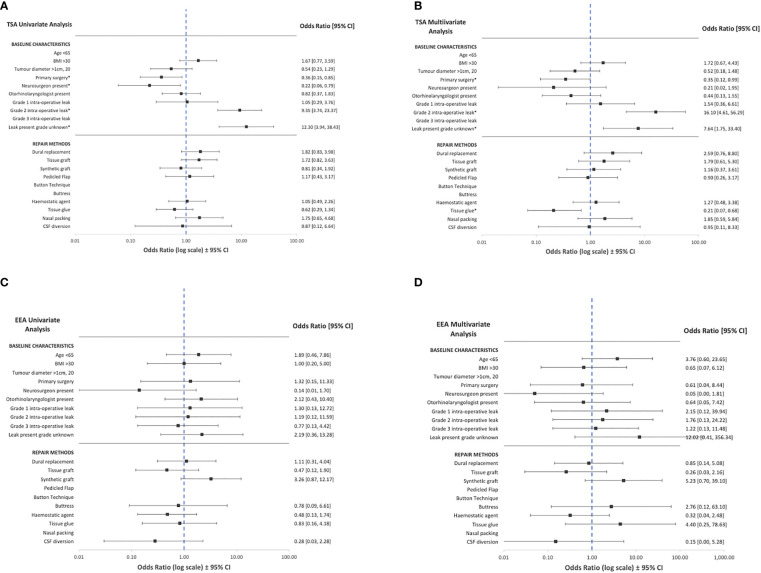
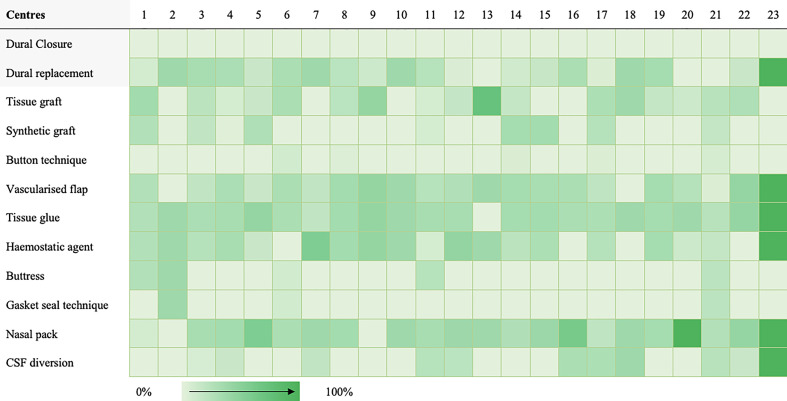
A total of 866 patients were included - 726 TSA (84%) and 140 EEA (16%). There was significant heterogeneity in repair protocols across centres. In TSA cases, nasal packing (519/726, 72%), tissue glues (474/726, 65%) and hemostatic agents (439/726, 61%) were the most common skull base repair techniques. Comparatively, pedicled flaps (90/140, 64%), CSF diversion (38/140, 27%), buttresses (17/140, 12%) and gasket sealing (11/140, 9%) were more commonly used in EEA cases. CSF rhinorrhoea (biochemically confirmed or requiring re-operation) occurred in 3.9% of TSA (28/726) and 7.1% of EEA (10/140) cases. A significant number of patients with CSF rhinorrhoea (15/38, 39%) occurred when no intraoperative CSF leak was reported. On multivariate analysis, there may be marginal benefits with using tissue glues in TSA (OR: 0.2, CI: 0.1-0.7, p<0.01), but no other technique reached significance. There was evidence that certain characteristics make CSF rhinorrhoea more likely - such as previous endonasal surgery and the presence of intraoperative CSF leak.
There is a wide range of skull base repair techniques used across centres. Overall, CSF rhinorrhoea rates across the UK and Ireland are lower than generally reported in the literature. A large proportion of postoperative leaks occurred in the context of occult intraoperative CSF leaks, and decisions for universal sellar repairs should consider the risks and cost-effectiveness of repair strategies. Future work could include longer-term, higher-volume studies, such as a registry; and high-quality interventional studies.
尽管鼻内镜下颅底神经外科手术取得了进展,但脑脊液鼻漏仍然很常见且较为严重。CRANIAL研究旨在确定:1)所采用的颅底修复方法的范围;2)在经鼻蝶窦入路(TSA)和扩大经鼻入路(EEA)治疗颅底肿瘤时相应的术后脑脊液鼻漏发生率。
一项对英国和爱尔兰30个进行鼻内镜下颅底神经外科手术中心(占成年手术单元的91%)的前瞻性观察队列研究。对患者进行6个月的识别并随访6个月。数据收集和分析遵循我们已发表的方案和试点研究。采用描述性统计、单变量和多变量逻辑回归模型进行分析。
共纳入866例患者——726例TSA(84%)和140例EEA(16%)。各中心的修复方案存在显著异质性。在TSA病例中,鼻腔填塞(519/726,72%)、组织胶水(474/726,65%)和止血剂(439/726,61%)是最常用的颅底修复技术。相比之下,带蒂皮瓣(90/140,64%)、脑脊液分流(38/140,27%)、支撑物(17/140,12%)和垫片密封(11/140,9%)在EEA病例中更常用。脑脊液鼻漏(经生化证实或需要再次手术)在TSA病例中发生率为3.9%(28/726),在EEA病例中为7.1%(10/140)。相当数量的脑脊液鼻漏患者(15/38,39%)在术中未报告脑脊液漏的情况下发生。多变量分析显示,TSA使用组织胶水可能有一定益处(OR:0.2,CI:0.1 - 0.7,p<0.01),但其他技术均未达到显著水平。有证据表明某些特征使脑脊液鼻漏更易发生,如既往鼻内镜手术史和术中脑脊液漏的存在。
各中心使用的颅底修复技术范围广泛。总体而言,英国和爱尔兰的脑脊液鼻漏发生率低于文献中普遍报道的水平。很大一部分术后漏液发生在隐匿性术中脑脊液漏的情况下,对于全鞍区修复的决策应考虑修复策略的风险和成本效益。未来的工作可能包括开展长期、大样本量的研究,如建立登记系统;以及高质量的干预性研究。