Baden Tom
Center for Sensory Neuroscience and Computation, School of Life Sciences, University of Sussex, Brighton BN19QG, UK.
Curr Opin Behav Sci. 2024 Jun;57:None. doi: 10.1016/j.cobeha.2024.101391.
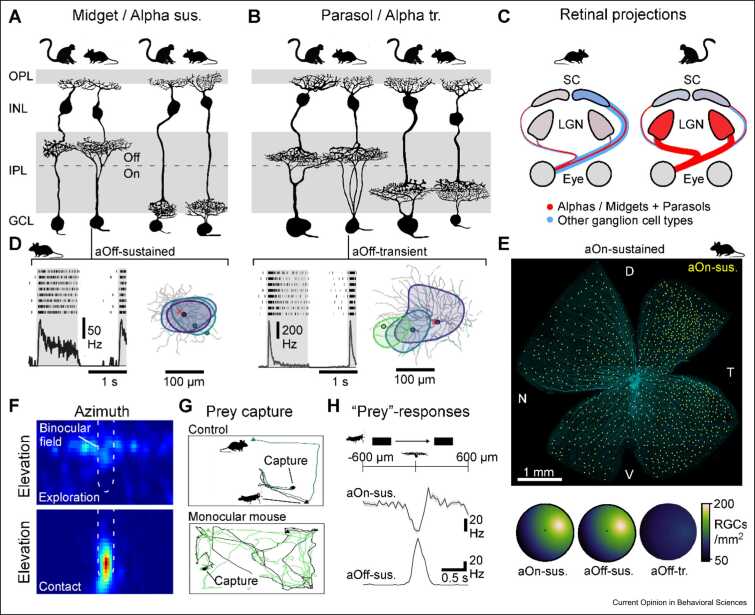
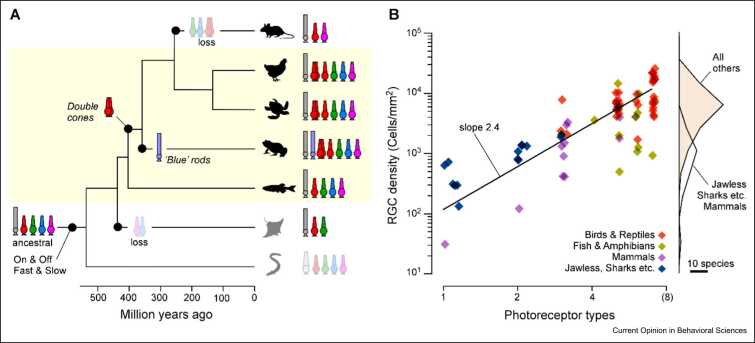
Animal brains are probably the most complex computational machines on our planet, and like everything in biology, they are the product of evolution. Advances in developmental and palaeobiology have been expanding our general understanding of how nervous systems can change at a molecular and structural level. However, how these changes translate into altered function - that is, into 'computation' - remains comparatively sparsely explored. What, concretely, does it mean for neuronal computation when neurons change their morphology and connectivity, when new neurons appear or old ones disappear, or when transmitter systems are slowly modified over many generations? And how does evolution use these many possible knobs and dials to constantly tune computation to give rise to the amazing diversity in animal behaviours we see today? Addressing these major gaps of understanding benefits from choosing a suitable model system. Here, I present the vertebrate retina as one perhaps unusually promising candidate. The retina is ancient and displays highly conserved core organisational principles across the entire vertebrate lineage, alongside a myriad of adjustments across extant species that were shaped by the history of their visual ecology. Moreover, the computational logic of the retina is readily interrogated experimentally, and our existing understanding of retinal circuits in a handful of species can serve as an anchor when exploring the visual circuit adaptations across the entire vertebrate tree of life, from fish deep in the aphotic zone of the oceans to eagles soaring high up in the sky.
动物大脑可能是我们这个星球上最复杂的计算机器,而且和生物学中的所有事物一样,它们是进化的产物。发育生物学和古生物学的进展一直在拓展我们对神经系统如何在分子和结构层面发生变化的总体认识。然而,这些变化如何转化为功能改变——也就是转化为“计算”——仍相对较少被探索。具体而言,当神经元改变其形态和连接性、新神经元出现或旧神经元消失,或者神经递质系统在许多代的时间里缓慢改变时,对神经元计算意味着什么?进化又是如何利用这些众多可能的调节旋钮来不断调整计算,从而产生我们如今所看到的动物行为的惊人多样性的?通过选择一个合适的模型系统有助于填补这些主要的认知空白。在此,我将脊椎动物视网膜作为一个或许异常有前景的候选对象进行介绍。视网膜由来已久,在整个脊椎动物谱系中展现出高度保守的核心组织原则,同时现存物种中也存在着无数由其视觉生态历史塑造的适应性变化。此外,视网膜的计算逻辑很容易通过实验进行探究,而且我们目前对少数物种视网膜回路的了解可以作为探索整个脊椎动物生命之树视觉回路适应性的一个基础,从海洋无光带深处的鱼类到翱翔在高空的鹰类。