Hofherr Alexis, Liarte Marin Elena, Musial Barbara, Seth Asha, Slidel Tim, Conway James, Baker David, Hansen Pernille B L, Challis Benjamin, Bartesaghi Stefano, Bhat Maria, Pecoits-Filho Roberto, Tu Xiao, Selvarajah Viknesh, Woollard Kevin, Heerspink Hiddo J L
Research and Early Clinical Development, Cardiovascular, Renal and Metabolism, BioPharmaceuticals R&D, AstraZeneca, Gothenburg, Sweden.
Bioscience Renal, Research and Early Development, Cardiovascular, Renal and Metabolism, BioPharmaceuticals R&D, AstraZeneca, Cambridge, UK.
Kidney Int Rep. 2024 Mar 18;9(6):1876-1891. doi: 10.1016/j.ekir.2024.03.009. eCollection 2024 Jun.
Inflammation is a significant contributor to cardiorenal morbidity and mortality in diabetic kidney disease (DKD). The pathophysiological mechanisms linking systemic, subacute inflammation and local, kidney injury-initiated immune maladaptation is partially understood.
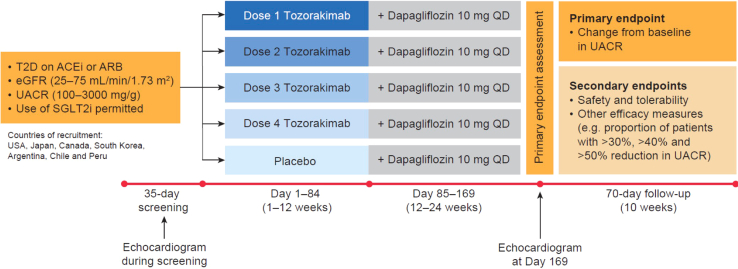
Here, we explored the expression of proinflammatory cytokines in patients with DKD; investigated mouse models of type 1 and type 2 diabetes (T2D); evaluated glomerular signaling ; performed analyses of systemic and urinary markers of inflammation; and initiated a phase 2b clinical study (FRONTIER-1; NCT04170543).
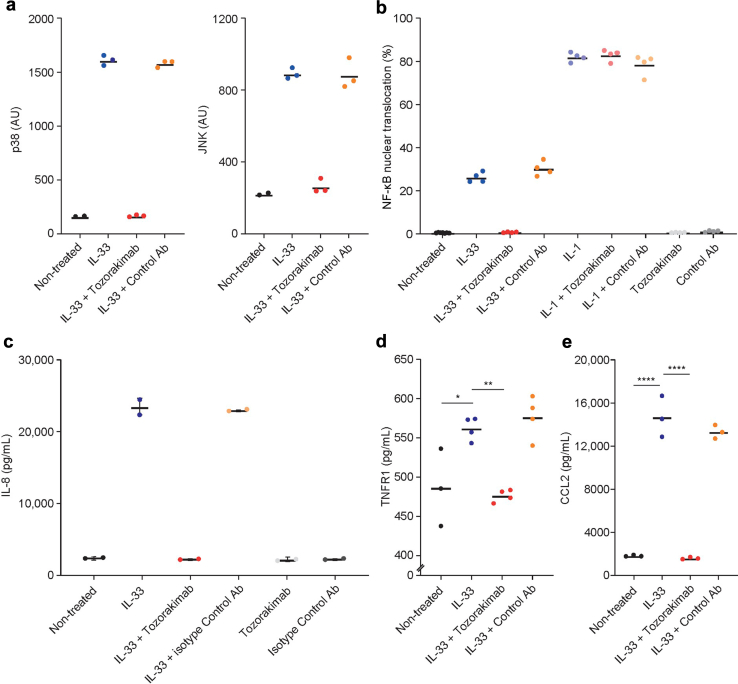
Transcriptomic profiling of kidney biopsies from patients with DKD revealed significant glomerular upregulation of interleukin-33 (IL-33). Inhibition of IL-33 signaling reduced glomerular damage and albuminuria in the uninephrectomized mouse model (T2D/DKD). On a cellular level, inhibiting IL-33 improved glomerular endothelial health by decreasing cellular inflammation and reducing release of proinflammatory cytokines. Therefore, FRONTIER-1 was designed to test the safety and efficacy of the IL-33-targeted monoclonal antibody tozorakimab in patients with DKD. So far, 578 patients are enrolled in FRONTIER-1. The baseline inflammation status of participants ( > 146) was assessed in blood and urine. Comparison to independent reference cohorts ( > 200) validated the distribution of urinary tumor necrosis factor receptor 1 (TNFR1) and C-C motif chemokine ligand 2 (CCL2). Treatment with dapagliflozin for 6 weeks did not alter these biomarkers significantly.
We show that blocking the IL-33 pathway may mitigate glomerular endothelial inflammation in DKD. The findings from the FRONTIER-1 study will provide valuable insights into the therapeutic potential of IL-33 inhibition in DKD.
炎症是糖尿病肾病(DKD)中心肾疾病发病率和死亡率的重要促成因素。系统性、亚急性炎症与局部肾脏损伤引发的免疫适应不良之间的病理生理机制尚不完全清楚。
在此,我们探究了DKD患者促炎细胞因子的表达;研究了1型和2型糖尿病(T2D)小鼠模型;评估了肾小球信号传导;对炎症的全身和尿液标志物进行了分析;并启动了一项2b期临床研究(FRONTIER-1;NCT04170543)。
对DKD患者肾活检组织进行转录组分析发现,白细胞介素-33(IL-33)在肾小球中显著上调。在单侧肾切除的小鼠模型(T2D/DKD)中,抑制IL-33信号传导可减少肾小球损伤和蛋白尿。在细胞水平上,抑制IL-33可通过减少细胞炎症和促炎细胞因子的释放来改善肾小球内皮健康。因此,FRONTIER-1旨在测试IL-33靶向单克隆抗体托扎单抗在DKD患者中的安全性和有效性。到目前为止,已有578名患者入组FRONTIER-1。对参与者(>146名)的血液和尿液中的基线炎症状态进行了评估。与独立参考队列(>200名)进行比较,验证了尿肿瘤坏死因子受体1(TNFR1)和C-C基序趋化因子配体2(CCL2)的分布情况。用达格列净治疗6周并未显著改变这些生物标志物。
我们表明,阻断IL-33通路可能减轻DKD中的肾小球内皮炎症。FRONTIER-1研究的结果将为IL-33抑制在DKD中的治疗潜力提供有价值的见解。