
人冠状病毒 NL63 的 nsp1 诱导 RNA 聚合酶 II 的降解,从而抑制宿主蛋白合成。
Human coronavirus NL63 nsp1 induces degradation of RNA polymerase II to inhibit host protein synthesis.
机构信息
Department of Microbiology and Immunology, University of Rochester Medical Center, Rochester, New York, United States of America.
出版信息
PLoS Pathog. 2024 Jun 20;20(6):e1012329. doi: 10.1371/journal.ppat.1012329. eCollection 2024 Jun.
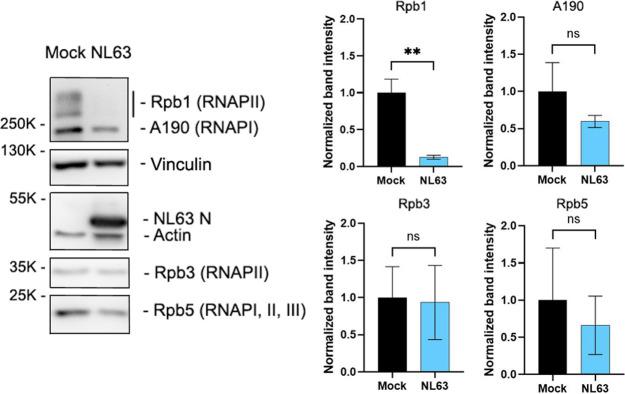
Coronavirus (CoV) nonstructural protein 1 (nsp1) is considered a pathogenic factor due to its ability to inhibit host antiviral responses by inducing general shutoff of host protein synthesis. Nsp1 is expressed by α- and β-CoVs, but its functions and strategies to induce host shutoff are not fully elucidated. We compared the nsp1s from two β-CoVs (SARS-CoV and SARS-CoV-2) and two α-CoVs (NL63 and 229E) and found that NL63 nsp1 has the strongest shutoff activity. Unlike SARS-CoV nsp1s, which bind to 40S ribosomes and block translation of cellular mRNA, NL63 nsp1 did not inhibit translation of mRNAs transfected into cells. Instead, NL63 nsp1 localized to the nucleus and specifically inhibited transcription of genes under an RNA polymerase II (RNAPII) promoter. Further analysis revealed that NL63 nsp1 induces degradation of the largest subunit of RNAPII, Rpb1. This degradation was detected regardless of the phosphorylation state of Rpb1 and was blocked by the proteasome inhibitor MG132. We also found that Rpb1 was ubiquitinated in NL63-infected cells, and inhibition of ubiquitination by a ubiquitin activating enzyme inhibitor (TAK243) prevented degradation of Rpb1 in virus-infected cells. These data reveal an unrecognized strategy of host shutoff by human α-CoV NL63: targeting host transcription by inducing Rpb1 degradation to prevent host protein expression. Our study indicates that viruses within the same family can use completely distinct mechanisms to regulate host antiviral responses.
冠状病毒(CoV)非结构蛋白 1(nsp1)被认为是一种致病因素,因为它能够通过诱导宿主蛋白合成的普遍关闭来抑制宿主抗病毒反应。nsp1 由 α- 和 β-CoV 表达,但它诱导宿主关闭的功能和策略尚未完全阐明。我们比较了两种 β-CoV(SARS-CoV 和 SARS-CoV-2)和两种 α-CoV(NL63 和 229E)的 nsp1,发现 NL63 nsp1 具有最强的关闭活性。与 SARS-CoV nsp1 不同,后者结合 40S 核糖体并阻断细胞 mRNA 的翻译,NL63 nsp1 不抑制转染到细胞中的 mRNA 的翻译。相反,NL63 nsp1 定位于细胞核,并特异性抑制 RNA 聚合酶 II(RNAPII)启动子下的基因转录。进一步分析表明,NL63 nsp1 诱导 RNAPII 大亚基 Rpb1 的降解。这种降解无论 Rpb1 的磷酸化状态如何都被检测到,并且被蛋白酶体抑制剂 MG132 阻断。我们还发现,NL63 感染细胞中 Rpb1 被泛素化,泛素激活酶抑制剂(TAK243)抑制泛素化可防止病毒感染细胞中 Rpb1 的降解。这些数据揭示了人类 α-CoV NL63 关闭宿主的一种未被识别的策略:通过诱导 Rpb1 降解来靶向宿主转录,从而阻止宿主蛋白表达。我们的研究表明,同一科的病毒可以使用完全不同的机制来调节宿主抗病毒反应。


 Zotero 插件