Department of Surgery, Scandinavian Surgical Outcomes Research Group, Institute of Clinical Sciences, Sahlgrenska Academy, University of Gothenburg, Gothenburg, Sweden.
Department of Surgery, Region Västra Götaland, Sahlgrenska University Hospital/Östra, Gothenburg, Sweden.
Dis Colon Rectum. 2024 Oct 1;67(10):1322-1331. doi: 10.1097/DCR.0000000000003358. Epub 2024 Jun 20.
Longitudinal studies on functional outcomes after colon resection are limited.
To evaluate bowel dysfunction and related distress 1 and 3 years after colon resection using the low anterior resection syndrome score as well as specific validated items.
This study presents the long-term results of bowel dysfunction and related distress based on the Quality of Life in Colon Cancer study, an observational, prospective multicenter study of patients with newly diagnosed colon cancer.
The study was conducted at 21 Swedish and Danish surgical centers between 2015 and 2019.
All patients who underwent right-sided or left-sided colon resection were considered eligible. Exclusion criteria were age younger than 18 years, cognitive impairment, or inability to understand Swedish/Danish. Patients completed extensive questionnaires at diagnosis and after 1 and 3 years. Clinical data were supplemented by national quality registries.
The low anterior resection syndrome score, specific bowel symptoms, and patient-reported distress were assessed.
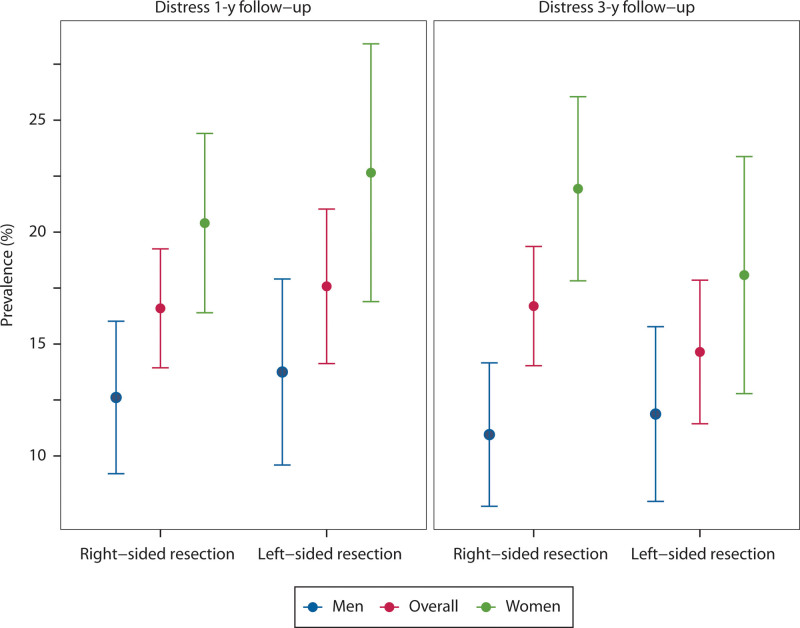
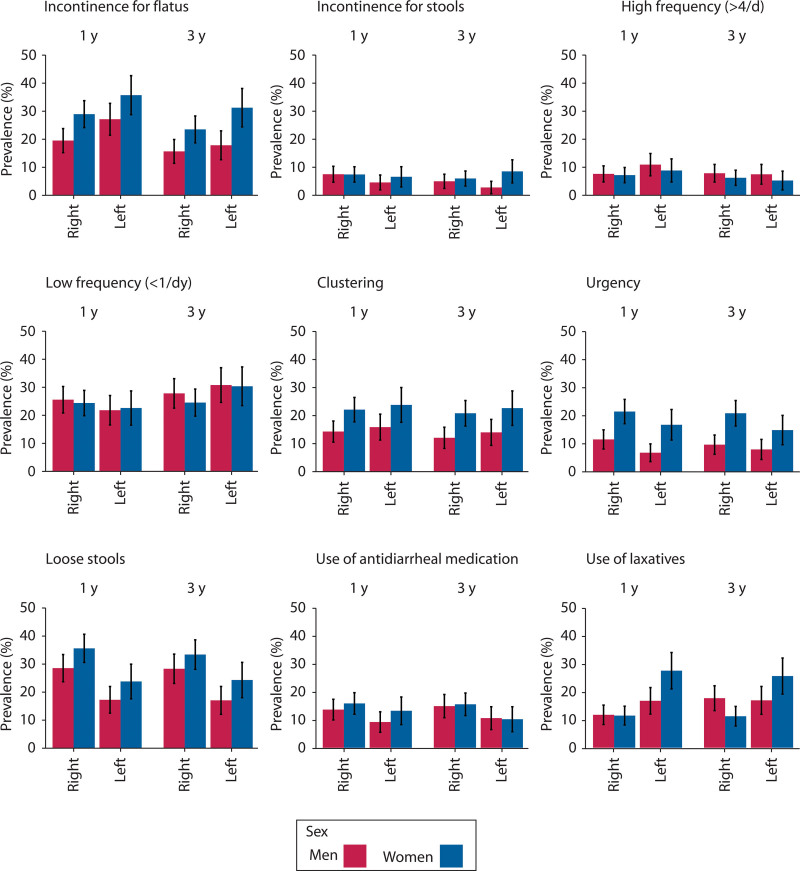
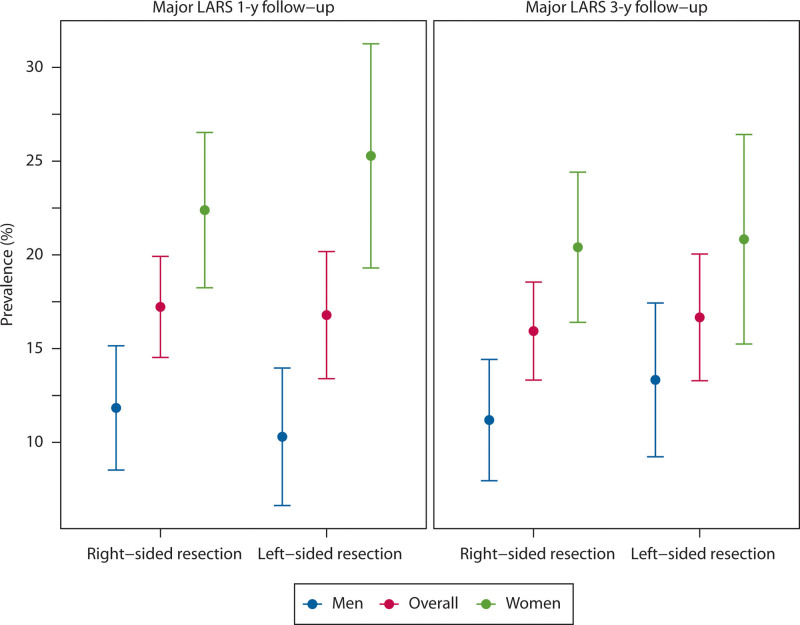
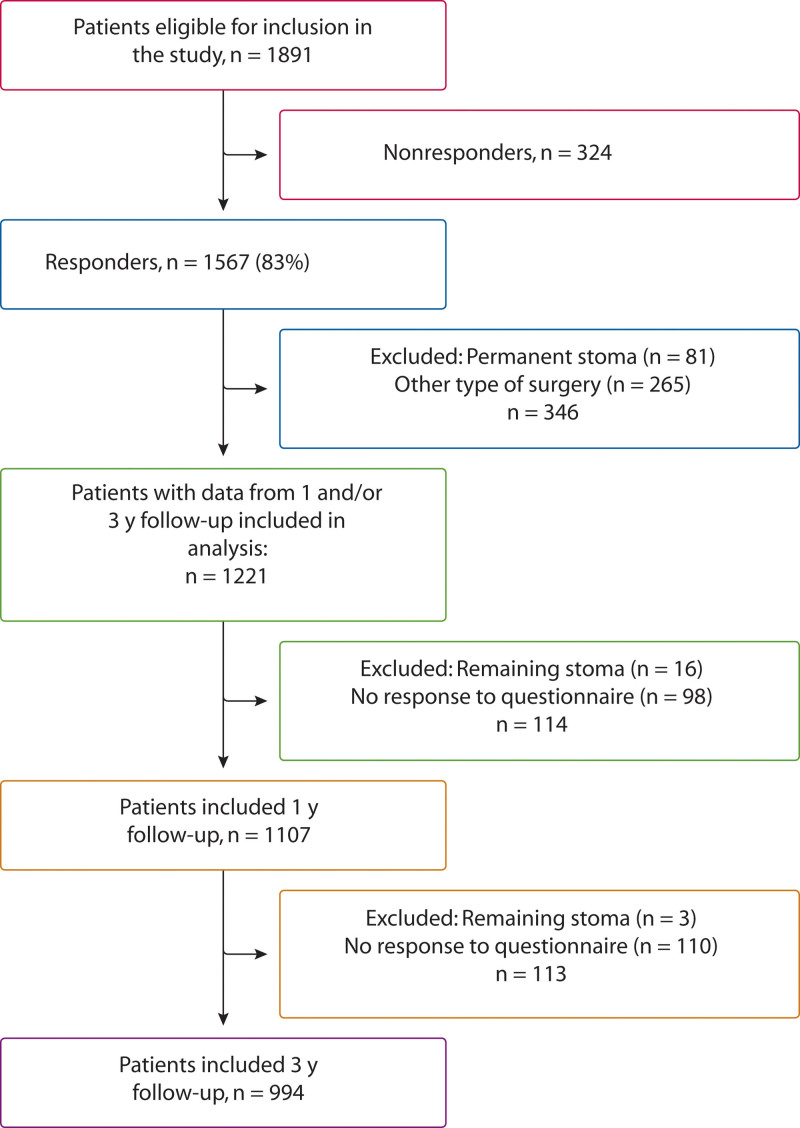
Of 1221 patients (83% response rate), 17% reported major low anterior resection syndrome 1 year after either type of resection; this finding was consistent at 3 years (17% right, 16% left). In the long-term, the only significant difference between types of resections was a high occurrence of loose stools after right-sided resections. Overall, less than one-fifth of patients experienced distress, with women reporting more frequent symptoms and greater distress. In particular, incontinence and loose stools correlated strongly with distress.
Absence of prediagnosis bowel function data.
Our study indicates that bowel function remains largely intact after colon resection, with only a minority reporting significant distress. Adverse outcomes were more common among women. The occurrence of loose stools after right-sided resection and the association between incontinence, loose stools, and distress highlights a need for postoperative evaluations and more thorough assessments beyond the low anterior resection syndrome score when evaluating patients with colon cancer. See the Video Abstract .
DISFUNCIONAMIENTO INTESTINAL DESPUS DE LA CIRUGA POR CNCER DE COLON ESTUDIO PROSPECTIVO, LONGITUDINAL Y MULTICNTRICO: ANTECEDENTES:Los estudios longitudinales sobre el resultado funcional después de una resección cólica son limitados.OBJETIVO:Examinar la disfunción intestinal y el malestar relacionado uno y tres años después de la resección del colon utilizando la puntuación de referencia en el síndrome de resección anterior baja (LARS), así como otros ítems de validez específica.DISEÑO:Este estudio presenta los resultados a largo plazo de la disfunción intestinal y la angustia relacionada según el estudio QoLiCOL (Quality of Life in COLon cancer), un analisis observacional, prospectivo y multicéntrico de pacientes con cáncer de colon recién diagnosticado.AJUSTES:El presente estudio fué realizado en 21 centros quirúrgicos suecos y daneses entre 2015 y 2019.PACIENTES:Todos los pacientes sometidos a resección de colon, tanto del lado derecho como el izquierdo se consideraron elegibles. Los criterios de exclusión fueron tener menos de 18 años, deterioro cognitivo o incapacidad para entender sueco/danés. Los pacientes completaron extensos cuestionarios en el momento del diagnóstico y después de uno y tres años. Los datos clínicos se complementaron con los registros de calidad binacionales.PRINCIPALES MEDIDAS DE RESULTADO:Se evaluaron los síntomas intestinales específicos, la puntuación LARS y la angustia manifestada por cada paciente.RESULTADOS:De 1221 pacientes (tasa de respuesta del 83%), el 17% informó LARS mayor un año después de cualquier tipo de resección, consistente a los tres años (17% derecha, 16% izquierda). A largo plazo, la única diferencia significativa entre los tipos de resección fue una alta incidencia de heces liquidas después de las resecciones del lado derecho. En general, menos de una quinta parte de los pacientes experimentaron angustia, y fué la poblacion femenina quién informó de síntomas más frecuentes y de mayor angustia. En particular, la incontinencia y las heces liquidas se correlacionaron fuertemente con la angustia.LIMITACIONES:Ausencia de datos de función intestinal previos al diagnóstico.CONCLUSIONES:Nuestro estudio indica que la función intestinal permanece en gran medida intacta después de la resección del colon, y sólo una minoría reporta malestar significativo. Los resultados adversos fueron más comunes en la población femenina. La aparición de heces liquidas después de la resección del lado derecho y la asociación entre incontinencia, heces liquidas y malestar resalta la necesidad de evaluaciones postoperatorias y valoraciones más exhaustivas más allá de la puntuación LARS al evaluar a los pacientes con cáncer de colon. (Traducción-Dr. Xavier Delgadillo ).
关于结肠切除术后功能结果的纵向研究有限。
使用低位前切除综合征评分以及特定的验证项目,评估结肠切除术后 1 年和 3 年的肠道功能障碍和相关痛苦。
本研究根据结肠癌生活质量研究(Quality of Life in Colon Cancer study)的结果,展示了肠道功能障碍和相关痛苦的长期结果,该研究是一项对新诊断为结肠癌的患者进行的观察性、前瞻性多中心研究。
21 家瑞典和丹麦的外科中心参与了这项研究。
所有接受右侧或左侧结肠切除术的患者均被认为符合入选标准。排除标准为年龄小于 18 岁、认知障碍或无法理解瑞典语/丹麦语。患者在诊断时以及术后 1 年和 3 年完成了广泛的问卷。临床数据由国家质量登记处补充。
低位前切除综合征评分、特定的肠道症状和患者报告的痛苦。
在 1221 名患者中(83%的应答率),17%的患者在接受任何类型的切除术后 1 年均报告有重大低位前切除综合征;这一发现在 3 年时也一致(右侧 17%,左侧 16%)。从长期来看,两种类型的切除术后唯一显著的差异是右侧切除术后出现稀便的发生率较高。总体而言,不到五分之一的患者有痛苦感,女性报告的症状和痛苦感更为频繁。特别是,失禁和稀便与痛苦感密切相关。
缺乏术前肠道功能数据。
我们的研究表明,结肠切除术后肠道功能基本保持完整,只有少数患者报告有明显的痛苦。女性的不良结局更为常见。右侧切除术后出现稀便以及失禁、稀便与痛苦之间的关联,突出了在评估结肠癌患者时需要进行术后评估和更全面的评估,而不仅仅是低位前切除综合征评分。详见视频摘要。