Department of Plastic and Burn Surgery, West China Hospital, Sichuan University, No.37, Guoxue Alley, Chengdu, Sichuan, 610041, China.
Lipids Health Dis. 2024 Jun 22;23(1):191. doi: 10.1186/s12944-024-02134-9.
Observational studies have indicated that the plasma lipid profiles of patients with atopic dermatitis show significant differences compared to healthy individuals. However, the causal relationship between these differences remains unclear due to the inherent limitations of observational studies. Our objective was to explore the causal effects between 179 plasma lipid species and atopic dermatitis, and to investigate whether circulating inflammatory proteins serve as mediators in this causal pathway.
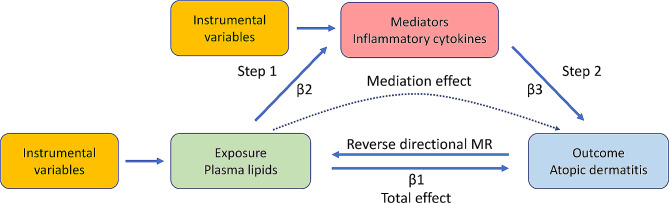
We utilized public genome-wide association studies data to perform a bidirectional two-sample, two-step mendelian randomization study. The inverse variance-weighted method was adopted as the primary analysis technique. MR-Egger and the weighted median were used as supplementary analysis methods. MR-PRESSO, Cochran's Q test, and MR-Egger intercept test were applied for sensitivity analyses to ensure the robustness of our findings.
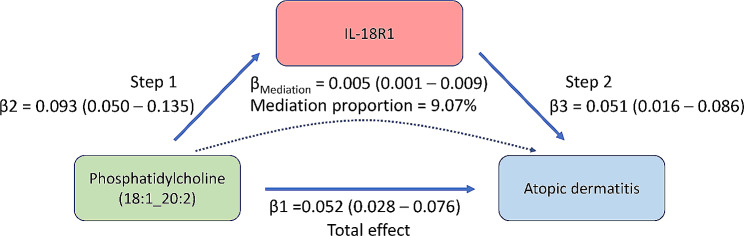
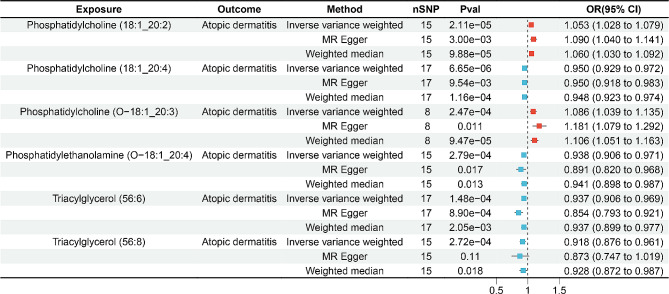
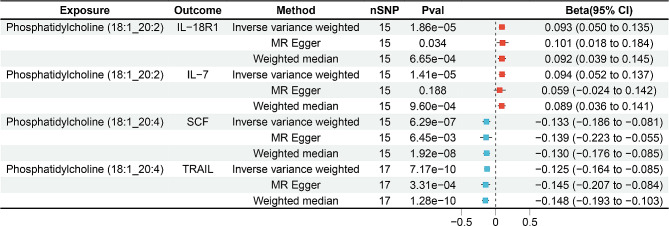
The Mendelian randomization analysis revealed that levels of Phosphatidylcholine (PC) (18:1_20:4) (OR: 0.950, 95% CI: 0.929-0.972, p = 6.65 × 10), Phosphatidylethanolamine (O-18:1_20:4) (OR: 0.938, 95% CI: 0.906-0.971, p = 2.79 × 10), Triacylglycerol (TAG) (56:6) (OR: 0.937, 95% CI: 0.906-0.969, p = 1.48 × 10) and TAG (56:8) (OR: 0.918, 95% CI: 0.876-0.961, p = 2.72 × 10) were inversely correlated with the risk of atopic dermatitis. Conversely, PC (18:1_20:2) (OR: 1.053, 95% CI: 1.028-1.079, p = 2.11 × 10) and PC (O-18:1_20:3) (OR: 1.086, 95% CI: 1.039-1.135, p = 2.47 × 10) were positively correlated with the risk of atopic dermatitis. The results of the reverse directional Mendelian randomization analysis indicated that atopic dermatitis exerted no significant causal influence on 179 plasma lipid species. The level of circulating IL-18R1 was identified as a mediator for the increased risk of atopic dermatitis associated with higher levels of PC (18:1_20:2), accounting for a mediation proportion of 9.07%.
Our research suggests that plasma lipids can affect circulating inflammatory proteins and may serve as one of the pathogenic factors for atopic dermatitis. Targeting plasma lipid levels as a treatment for atopic dermatitis presents a potentially novel approach.
观察性研究表明,特应性皮炎患者的血浆脂质谱与健康个体存在显著差异。然而,由于观察性研究的固有局限性,这些差异之间的因果关系仍不清楚。我们的目的是探讨 179 种血浆脂质与特应性皮炎之间的因果关系,并研究循环炎症蛋白是否作为该因果途径中的中介物。
我们利用公共全基因组关联研究数据进行双向两样本两阶段孟德尔随机化研究。采用逆方差加权法作为主要分析技术。MR-Egger 和加权中位数作为补充分析方法。MR-PRESSO、Cochran's Q 检验和 MR-Egger 截距检验用于敏感性分析,以确保研究结果的稳健性。
孟德尔随机化分析表明,磷脂酰胆碱(PC)(18:1_20:4)(OR:0.950,95%CI:0.929-0.972,p=6.65×10)、磷脂酰乙醇胺(O-18:1_20:4)(OR:0.938,95%CI:0.906-0.971,p=2.79×10)、三酰甘油(TAG)(56:6)(OR:0.937,95%CI:0.906-0.969,p=1.48×10)和 TAG(56:8)(OR:0.918,95%CI:0.876-0.961,p=2.72×10)与特应性皮炎的风险呈负相关。相反,磷脂酰胆碱(PC)(18:1_20:2)(OR:1.053,95%CI:1.028-1.079,p=2.11×10)和 PC(O-18:1_20:3)(OR:1.086,95%CI:1.039-1.135,p=2.47×10)与特应性皮炎的风险呈正相关。反向孟德尔随机化分析的结果表明,特应性皮炎对 179 种血浆脂质没有显著的因果影响。循环白细胞介素-18 受体 1(IL-18R1)水平被确定为与较高水平的 PC(18:1_20:2)相关的特应性皮炎风险增加的中介物,占 9.07%。
我们的研究表明,血浆脂质可以影响循环炎症蛋白,可能是特应性皮炎的致病因素之一。针对血浆脂质水平作为特应性皮炎的治疗方法可能是一种新的治疗方法。