Sakai Takashi, Herrmann Nadine, Maintz Laura, Nümm Tim Joachim, Welchowski Thomas, Claus Ralf A, Gräler Markus H, Bieber Thomas
Department of Dermatology and Allergy, Christine Kühne-Center for Allergy Research and Education (CK-CARE), University Hospital Bonn, Bonn, Germany.
Department of Dermatology, Faculty of Medicine, Oita University, Oita, Japan.
JID Innov. 2021 Dec 22;2(2):100092. doi: 10.1016/j.xjidi.2021.100092. eCollection 2022 Mar.
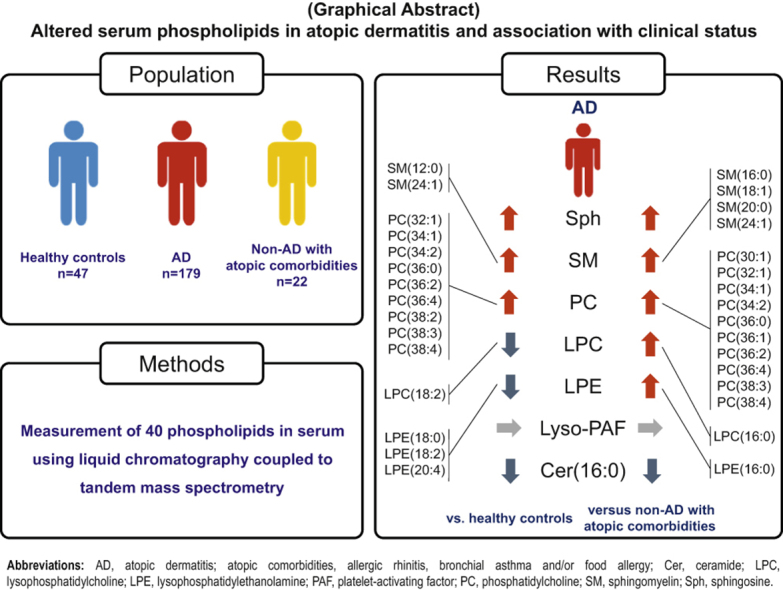
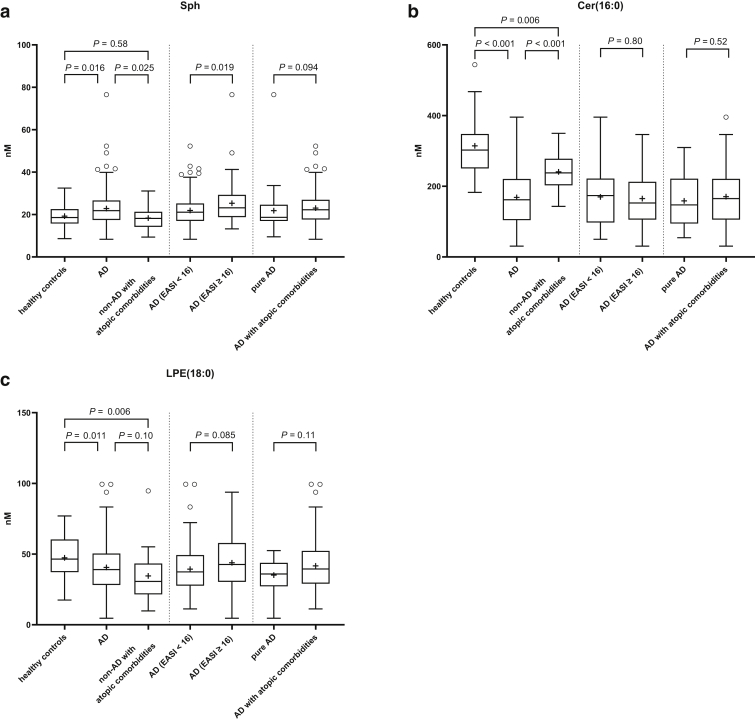
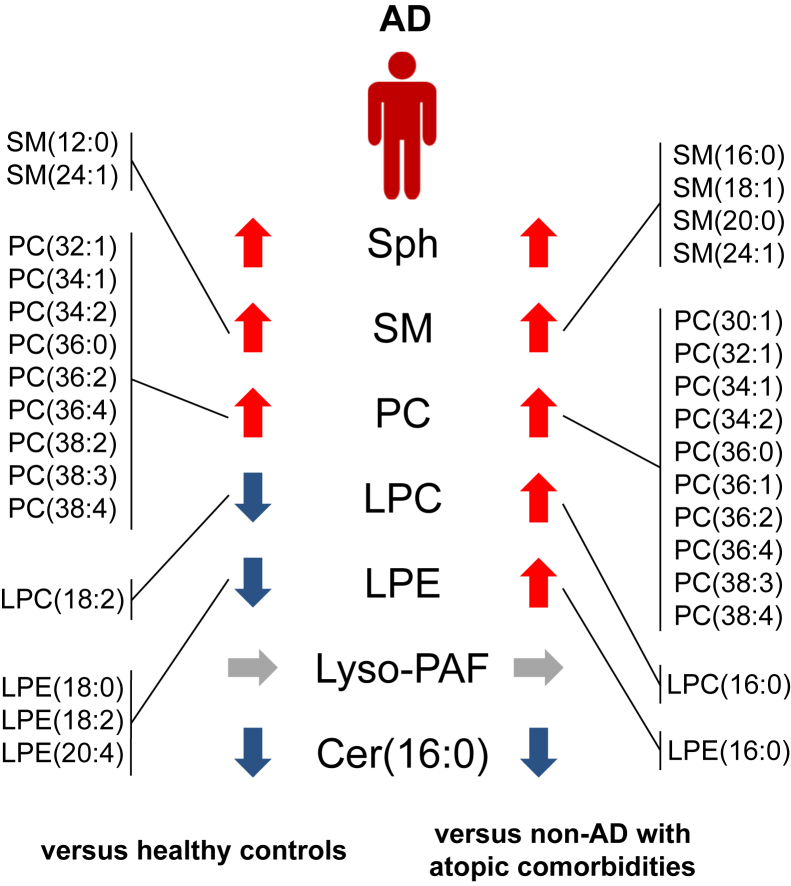
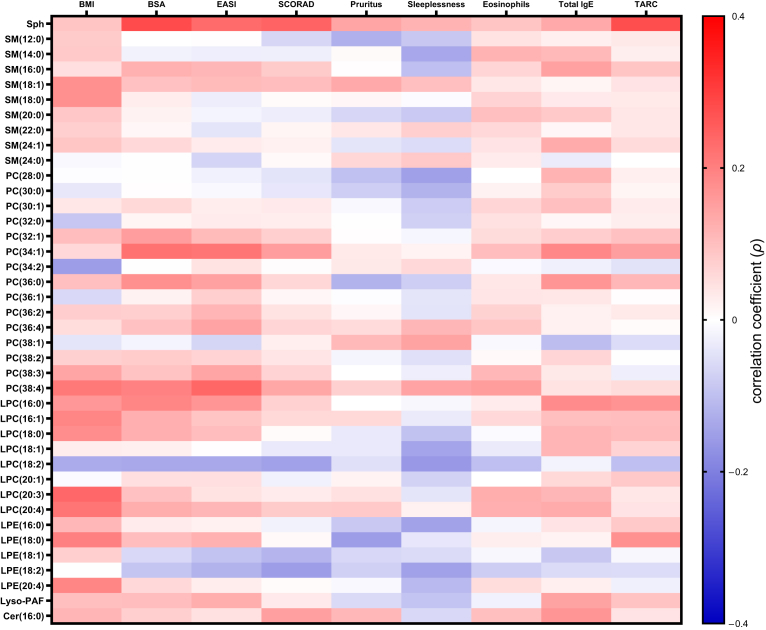
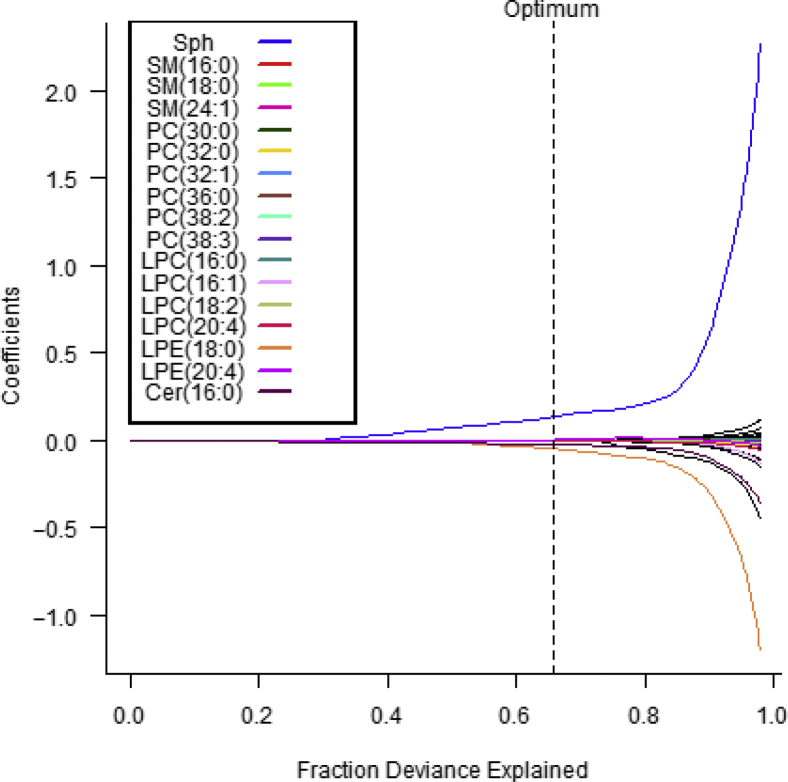
Circulating phospholipids have been considered as biomarkers and therapeutic targets in multiple disorders. Atopic dermatitis (AD) is the most common inflammatory skin disease. Although there are numerous studies having addressed stratum corneum lipids in the context of epidermal barrier, little is known about the circulating lipids in patients with AD. In this study, we explored the changes of serum phospholipids in AD using liquid chromatography coupled to tandem mass spectrometry and sought serum lipids' contribution to clinical status. Several serum levels of phospholipids were altered in the AD group (n = 179) compared with that in healthy controls (n = 47) and patients without AD with atopic comorbidities (n = 22); lipids exhibiting the apparent changes included increased sphingosine, multiple variants of phosphatidylcholine, and decreased ceramide (16:0) in patients with AD. Moreover, serum levels of sphingosine correlated with the severity of AD, and sphingosine and ceramide(16:0) were also detected as the risk-increasing effect and risk-reduction effect of AD, respectively. In summary, alterations in the serum concentration of phospholipids are seen in patients with AD. Although more detailed investigations will be needed to evaluate the significance of the changes in circulating lipids in AD, these findings can provide, to our knowledge, previously unreported insight into AD's pathogenesis and therapeutic strategies.
循环磷脂已被视为多种疾病的生物标志物和治疗靶点。特应性皮炎(AD)是最常见的炎症性皮肤病。尽管有许多研究探讨了角质层脂质与表皮屏障的关系,但对于AD患者的循环脂质却知之甚少。在本研究中,我们使用液相色谱-串联质谱法探究了AD患者血清磷脂的变化,并探讨了血清脂质对临床状况的影响。与健康对照组(n = 47)和无AD但有特应性合并症的患者(n = 22)相比,AD组(n = 179)的几种血清磷脂水平发生了改变;AD患者中表现出明显变化的脂质包括鞘氨醇增加、多种磷脂酰胆碱变体以及神经酰胺(16:0)减少。此外,鞘氨醇的血清水平与AD的严重程度相关,鞘氨醇和神经酰胺(16:0)也分别被检测为AD的风险增加效应和风险降低效应。总之,AD患者血清磷脂浓度存在改变。尽管需要更详细的研究来评估AD中循环脂质变化的意义,但据我们所知,这些发现可为AD的发病机制和治疗策略提供此前未报道的见解。