University of Uyo Teaching Hospital, Uyo, Akwa Ibom State, Nigeria.
Department of Health & Rehabilitation, University of Cape Town, Cape Town, South Africa.
PLoS One. 2024 Jun 26;19(6):e0302218. doi: 10.1371/journal.pone.0302218. eCollection 2024.
Generalized Joint hypermobility (GJH) is predominantly non-symptomatic. In fact, individuals with joint flexibility usually perform better than their non-hypermobile counterparts during physical activities. Notwithstanding, strength and balance are essential to maintain the control of the extra range of motion during activities and to prevent musculoskeletal complications. There are limited and conflicting pieces of evidence in literature regarding the association between strength and balance in children with GJH.
The purpose of this study was to examine differences in functional strength, dynamic balance, proprioception, and isometric strength in children with and without joint hypermobility and determine the association between strength outcomes and dynamic balance.
A cross-sectional study was conducted among children aged 6 to 11. Hypermobility was determined using the Beighton Score, with scores ≥6 representing hypermobility. Functional strength was assessed with the Functional Strength Measure (FSM), isometric strength was determined with a handheld dynamometer (HHD), the Y-Balance Test (YBT) was used to assess dynamic balance and the Wedges test to measure proprioception.
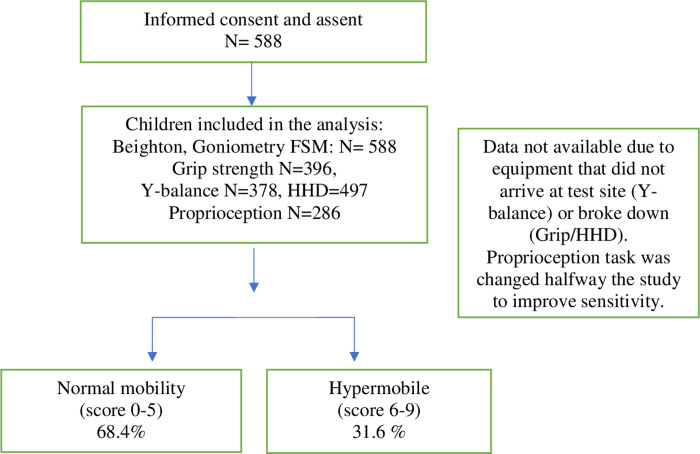
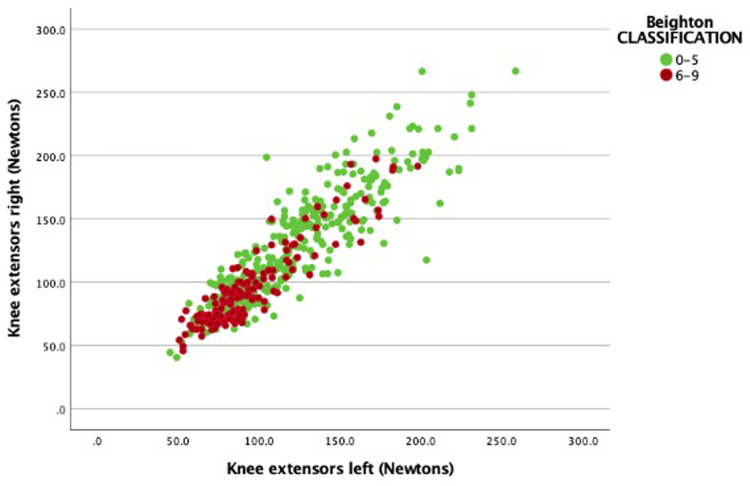
This study included 588 participants (age: 7.97 ± 1.3 years; height: 128±10.1 cm; mass: 27.18 ± 7.98 kg). 402 children were classified as having normal mobility and 186 as being hypermobile. Hypermobile children had better functional strength in the lower extremities than children with normal range mobility but lower reach distance in the YBT. No differences in proprioception, functional strength of the upper extremity or isometric strength in the hands were found. However, isometric lower extremity force was less in hypermobile children than children with normal range mobility. Irrespective of their joint mobility, a fair significant correlation existed between total Y-balance distance and FSM items r = 0.16-0.37, p = 0.01. Correlations between total Y-balance distance and isometric strength of knee and ankle muscles ranged between r = 0.26-0.42, p = 0.001.
Hypermobile joints seem to co-occur with lower extremity isometric strength, more functional strength in the lower extremities and less reaching distance in dynamic balance. The opposing direction of the results on functional and isometric strength tests highlights the importance of the type of outcome measures used to describe the association of strength and the range of motion.
全身性关节过度活动(GJH)主要是无症状的。事实上,在进行体育活动时,关节灵活性强的人通常比非过度活动的人表现更好。然而,力量和平衡对于维持活动时的额外活动范围的控制和预防肌肉骨骼并发症是至关重要的。关于 GJH 患儿的力量和平衡之间的关联,文献中仅有有限且相互矛盾的证据。
本研究旨在检查具有和不具有关节过度活动的儿童之间在功能性力量、动态平衡、本体感觉和等长力量方面的差异,并确定力量结果与动态平衡之间的关系。
对 6 至 11 岁的儿童进行了横断面研究。使用 Beighton 评分来确定关节过度活动,得分≥6 代表关节过度活动。功能性力量使用功能性力量测量(FSM)进行评估,等长力量使用手持测力计(HHD)进行测定,使用 Y 平衡测试(YBT)来评估动态平衡,使用楔入试验来测量本体感觉。
本研究纳入了 588 名参与者(年龄:7.97±1.3 岁;身高:128±10.1cm;体重:27.18±7.98kg)。其中 402 名儿童被归类为正常活动度,186 名儿童为关节过度活动。与具有正常活动度的儿童相比,过度活动的儿童下肢的功能性力量更好,但 YBT 中的伸手距离较短。未发现本体感觉、上肢功能性力量或手部等长力量存在差异。然而,过度活动儿童的下肢等长力量小于具有正常活动度的儿童。无论其关节活动度如何,总 Y 平衡距离与 FSM 项目之间均存在相当显著的相关性 r=0.16-0.37,p=0.01。总 Y 平衡距离与膝关节和踝关节肌肉的等长力量之间的相关性在 r=0.26-0.42 之间,p=0.001。
过度活动的关节似乎与下肢等长力量、下肢更强的功能性力量和动态平衡中较短的伸手距离同时出现。功能性和等长力量测试结果的相反方向突出了用于描述力量与运动范围之间的关联的结果测量类型的重要性。