Poptsi Eleni, Moraitou Despina, Tsardoulias Emmanouil, Symeonidis Andreas L, Tsolaki Magda
Laboratory of Psychology, Department of Cognition, Brain and Behavior, School of Psychology, Aristotle University of Thessaloniki (AUTh), 54124 Thessaloniki, Greece.
Laboratory of Neurodegenerative Diseases, Center for Interdisciplinary Research and Innovation, Aristotle University of Thessaloniki (CIRI-AUTh), 54124 Thessaloniki, Greece.
Brain Sci. 2024 May 27;14(6):548. doi: 10.3390/brainsci14060548.
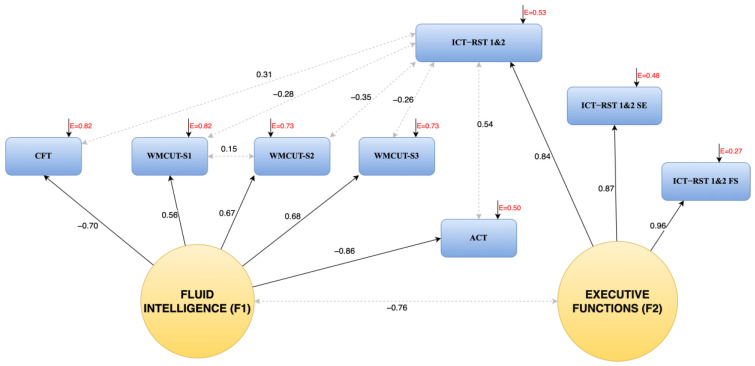
R4Alz is utilized for the early detection of minor neurocognitive disorders. It was designed to assess three main dimensions of cognitive-control abilities: working-memory capacity, attentional control, and executive functioning.
To reveal the cognitive-control dimensions that can differentiate between adults and older adults with healthy cognition, people with subjective cognitive impairment, and people diagnosed with mild cognitive impairment by examining the factorial structure of the R4Alz tool.
The study comprised 404 participants: (a) healthy adults (n = 192), (b) healthy older adults (n = 29), (c) people with SCI (n = 74), and (d) people diagnosed with MCI (n = 109). The R4Alz battery was administered to all participants, including tests that assess short-term memory storage, information processing, information updating in working memory, and selective, sustained and divided attention), task/rule-switching, inhibitory control, and cognitive flexibility.
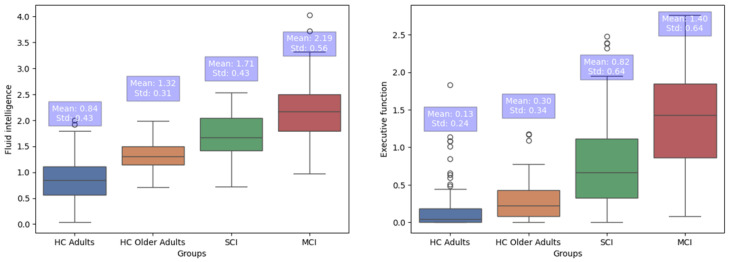
A two-factorial structural model was confirmed for R4Alz, with the first factor representing "fluid intelligence (FI)" and the second factor reflecting "executive functions (EF)". Both FI and EFs discriminate among all groups.
The R4Alz battery presents sound construct validity, evaluating abilities in FI and EF. Both abilities can differentiate very early cognitive impairment (SCI) from healthy cognitive aging and MCI.
R4Alz用于轻度神经认知障碍的早期检测。它旨在评估认知控制能力的三个主要维度:工作记忆容量、注意力控制和执行功能。
通过检查R4Alz工具的因子结构,揭示能够区分认知健康的成年人与老年人、主观认知障碍者以及被诊断为轻度认知障碍者的认知控制维度。
该研究包括404名参与者:(a)健康成年人(n = 192),(b)健康老年人(n = 29),(c)脊髓损伤患者(n = 74),以及(d)被诊断为轻度认知障碍者(n = 109)。对所有参与者进行了R4Alz测试组合,包括评估短期记忆存储、信息处理、工作记忆中的信息更新以及选择性、持续性和分散性注意力的测试,任务/规则切换、抑制控制和认知灵活性测试。
R4Alz的二因素结构模型得到证实,第一个因素代表“流体智力(FI)”,第二个因素反映“执行功能(EF)”。FI和EF在所有组中都具有区分能力。
R4Alz测试组合具有良好的结构效度,能够评估FI和EF方面的能力。这两种能力都可以将非常早期的认知障碍(SCI)与健康的认知老化和轻度认知障碍区分开来。