Mukhtar Mahwash, Csóka Ildikó, Martinović Josipa, Šelo Gordana, Bucić-Kojić Ana, Orosz László, Paróczai Dóra, Burian Katalin, Ambrus Rita
Institute of Pharmaceutical Technology and Regulatory Affairs, Faculty of Pharmacy, University of Szeged, Eötvös u.6, 6720 Szeged, Hungary.
Faculty of Food Technology Osijek, Josip Juraj Strossmayer University of Osijek, F. Kuhača 18, 31 000 Osijek, Croatia.
Pharmaceutics. 2024 May 21;16(6):691. doi: 10.3390/pharmaceutics16060691.
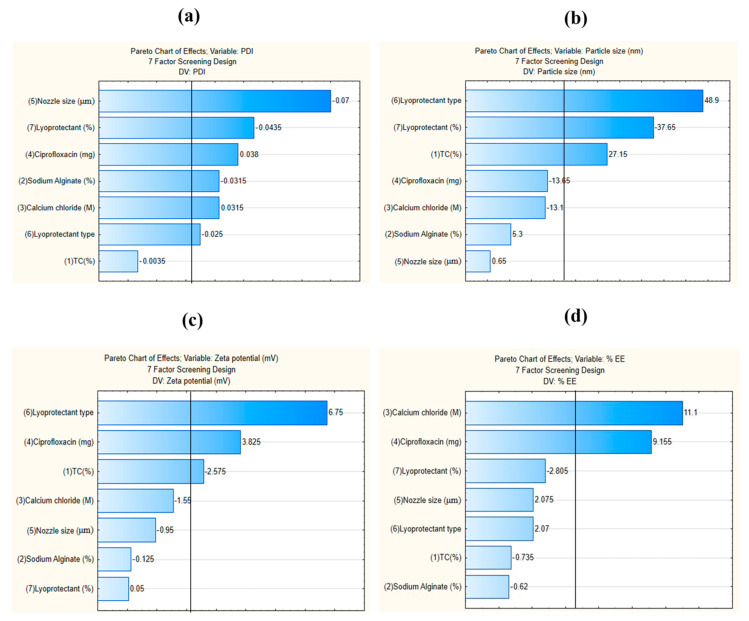
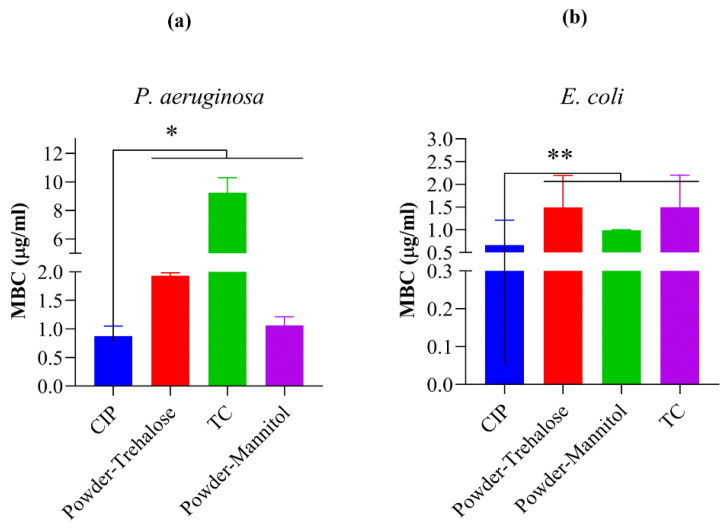
Most infectious diseases of the gastrointestinal tract can easily be treated by exploiting the already available antibiotics with the change in administration approach and delivery system. Ciprofloxacin (CIP) is used as a drug of choice for many bacterial infections; however, long-term therapy and off-site drug accumulation lead to an increased risk of tendinitis and peripheral neuropathy. To overcome this issue, nanotechnology is being exploited to encapsulate antibiotics within polymeric structures, which not only facilitates dose maintenance at the infection site but also limits off-site side effects. Here, sodium alginate (SA) and thiol-anchored chitosan (TC) were used to encapsulate CIP via a calcium chloride (CaCl) cross-linker. For this purpose, the B-390 encapsulator was employed in the preparation of nanobeads using a simple technique. The hydrogel-like sample was then freeze-dried, using trehalose or mannitol as a lyoprotectant, to obtain a fine dry powder. Design of Experiment (DoE) was utilized to optimize the nanobead production, in which the influence of different independent variables was studied for their outcome on the polydispersity index (PDI), particle size, zeta potential, and percentage encapsulation efficiency (% EE). In vitro dissolution studies were performed in simulated saliva fluid, simulated gastric fluid, and simulated intestinal fluid. Antibacterial and anti-inflammatory studies were also performed along with cytotoxicity profiling. By and large, the study presented positive outcomes, proving the advantage of using nanotechnology in fabricating new delivery approaches using already available antibiotics.
大多数胃肠道传染病通过改变给药方式和递送系统,利用现有的抗生素即可轻松治疗。环丙沙星(CIP)是许多细菌感染的首选药物;然而,长期治疗和药物在非感染部位的蓄积会导致肌腱炎和周围神经病变的风险增加。为克服这一问题,人们利用纳米技术将抗生素封装在聚合物结构中,这不仅有助于在感染部位维持药物剂量,还能限制非感染部位的副作用。在此,使用海藻酸钠(SA)和硫醇锚定壳聚糖(TC)通过氯化钙(CaCl)交联剂来封装CIP。为此,采用简单技术利用B - 390封装器制备纳米珠。然后,使用海藻糖或甘露醇作为冻干保护剂对水凝胶状样品进行冻干,以获得精细的干粉。利用实验设计(DoE)优化纳米珠的制备,研究不同自变量对多分散指数(PDI)、粒径、zeta电位和包封效率百分比(%EE)的影响。在模拟唾液液、模拟胃液和模拟肠液中进行体外溶出研究。还进行了抗菌和抗炎研究以及细胞毒性分析。总体而言,该研究呈现出积极的结果,证明了利用纳米技术使用现有抗生素制造新的递送方法的优势。