Chin Phoebe, Gorman Faye, Beck Fraser, Russell Bruce R, Stephan Klaas E, Harrison Olivia K
Department of Psychology, University of Otago, Dunedin, New Zealand.
Ngāpuhi, New Zealand.
Front Psychol. 2024 Jun 12;15:1412928. doi: 10.3389/fpsyg.2024.1412928. eCollection 2024.
Anxiety is one of the most prevalent mental health conditions worldwide, and psychotherapeutic techniques can be employed to help manage and mitigate symptoms. While the available therapies are numerous, key strategies often involve cognitive and/or embodiment techniques. Within body-centered methods, breathing-oriented approaches are particularly prevalent, using either attention towards or active control of breathing. As the perception of body states (i.e., interoception) is thought to be an integral component of emotion generation, these embodiment and breathing techniques may be key in addressing the miscommunication between the brain and body that is thought to exist with anxiety. Therefore, we conducted a systematic review and meta-analysis to assess the effects of acute administration of psychological interventions for state anxiety.
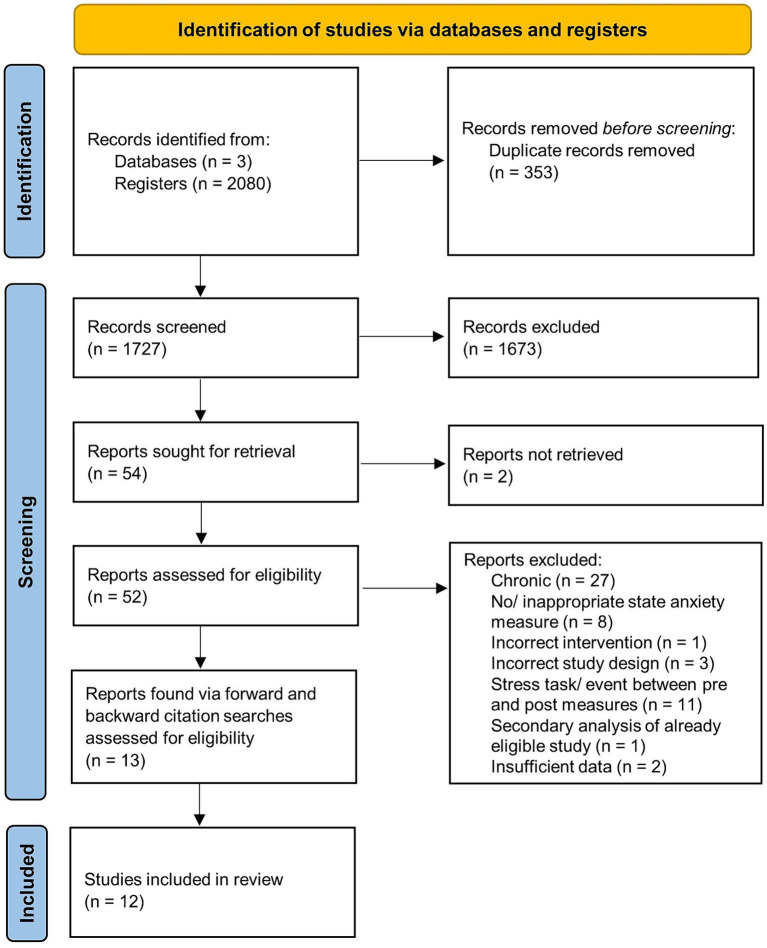
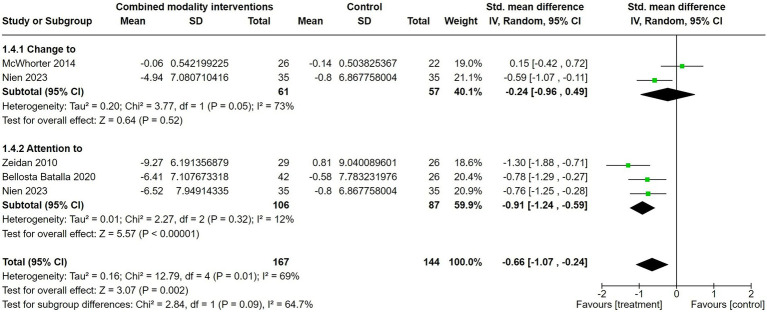
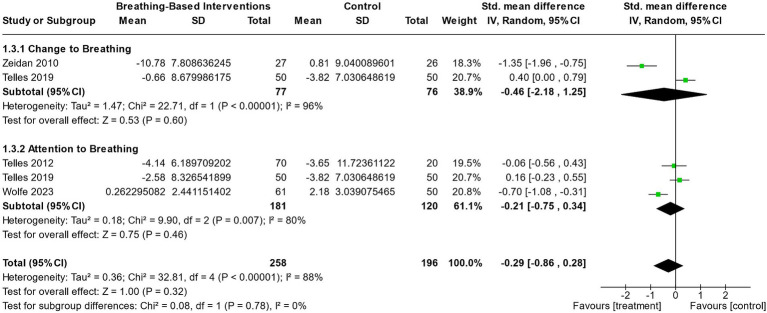
This systematic review was conducted in accordance with the PRISMA statement and registered prospectively in PROSPERO. A literature search for randomized controlled trials was conducted in PubMed, PsycINFO, and Scopus. We considered interventions that focused on cognitive, embodiment or breathing strategies, or a combination of these techniques. Twelve studies met our inclusion criteria, and study characteristics, quality and effect sizes were assessed. A single cognitive study was found to produce a moderate reduction in state anxiety, while moderate to large effects were found across studies assessing embodiment practices. In contrast, studies which utilized breathing-based interventions alone produced inconsistent results, with both attention towards and active control of breathing producing large to no effects depending on the technique employed. Finally, consistent moderate effects were found with combination techniques that involved passive attention (e.g., towards cognitions, body and/or breathing), with active combination techniques producing inconsistent results.
While study numbers are limited regarding brief interventions, cognitive and embodiment techniques are consistently helpful for reducing state anxiety, while breathing-based exercises need to consider the specific technique employed, and how successful this may be for each individual. Furthermore, combined practices such as mindfulness can also be successful, although care must be taken when introducing an active change to one or more elements.
CRD42024507585 Available from: https://www.crd.york.ac.uk/prospero/display_record.php?ID=CRD42024507585.
焦虑是全球最普遍的心理健康问题之一,心理治疗技术可用于帮助管理和减轻症状。虽然现有的治疗方法众多,但关键策略通常涉及认知和/或体现技术。在以身体为中心的方法中,以呼吸为导向的方法尤为普遍,包括对呼吸的关注或主动控制。由于身体状态的感知(即内感受)被认为是情绪产生的一个重要组成部分,这些体现和呼吸技术可能是解决被认为与焦虑相关的大脑和身体之间沟通不畅的关键。因此,我们进行了一项系统评价和荟萃分析,以评估急性心理干预对状态焦虑的影响。
本系统评价按照PRISMA声明进行,并在PROSPERO中进行了前瞻性注册。在PubMed、PsycINFO和Scopus中对随机对照试验进行了文献检索。我们考虑了专注于认知、体现或呼吸策略或这些技术组合的干预措施。十二项研究符合我们的纳入标准,并对研究特征、质量和效应大小进行了评估。发现一项单一的认知研究使状态焦虑有适度降低,而在评估体现实践的研究中发现了中度至较大的效应。相比之下,仅使用基于呼吸的干预措施的研究结果不一致,根据所采用的技术,对呼吸的关注和主动控制产生的效果从大到无效果不等。最后,涉及被动关注(如对认知、身体和/或呼吸)的组合技术产生了一致的中度效果,而主动组合技术产生的结果不一致。
虽然关于简短干预的研究数量有限,但认知和体现技术始终有助于减轻状态焦虑,而基于呼吸的练习需要考虑所采用的具体技术以及对每个个体的效果如何。此外,正念等综合实践也可能成功,尽管在对一个或多个元素进行主动改变时必须谨慎。
PROSPERO系统评价注册号:CRD42024507585 可从:https://www.crd.york.ac.uk/prospero/display_record.php?ID=CRD42024507585获取。