Droste Nils, Chatterton Benjamin, Skovgaard Jakob
Department of Political Science and Centre for Innovation Research, Lund University, Box 117, 221 00, Lund, Sweden.
Department of Economic History, Lund University, Box 117, 221 00, Lund, Sweden.
Nat Commun. 2024 Jun 27;15(1):5452. doi: 10.1038/s41467-024-49835-4.
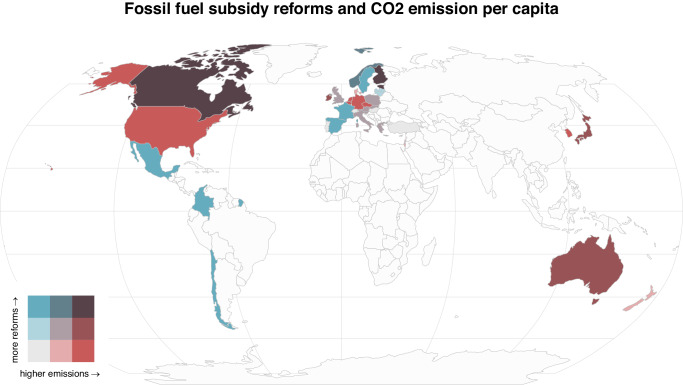
Fossil fuel subsidies continue to be a considerable barrier to meeting the targets of the Paris Agreement. It is thus crucial to understand the political economy of fossil fuel subsidies and their reform. To understand these mechanisms in the developed world, we use a database of different types of fossil fuel subsidy reforms among Organisation for Economic Co-operation and Development (OECD) countries. We find evidence for four intertwined processes i) a market-power mechanism: higher market shares for renewables ease fossil fuel subsidy reforms, and ii) a policy mechanism: reforms reduce the levels of fossil fuel subsidies. Importantly, both effects are contingent on iii) a polity mechanism where institutional quality influences the feasibility and effectiveness of political reforms, and iv) a feedback mechanism where systemic lock-ins determine the effectiveness of market competition. Our results even suggest that reforms carried out by effective governments with low corruption control are associated with increasing subsidies per capita. Renewable energy support can however provide a leverage point to break path-dependencies in fossil fuel-based economies. This turns out to be more effective when coupled with improvements to institutional quality and the insulation of political processes from pro-subsidy interests.
化石燃料补贴仍然是实现《巴黎协定》目标的重大障碍。因此,了解化石燃料补贴的政治经济学及其改革至关重要。为了理解发达国家的这些机制,我们使用了经济合作与发展组织(经合组织)国家不同类型化石燃料补贴改革的数据库。我们发现了四个相互交织的过程的证据:一)市场力量机制:可再生能源更高的市场份额推动了化石燃料补贴改革;二)政策机制:改革降低了化石燃料补贴水平。重要的是,这两种效应都取决于三)政治体制机制,即制度质量影响政治改革的可行性和有效性;四)反馈机制,即系统锁定决定市场竞争的有效性。我们的结果甚至表明,由腐败控制不力的有效政府进行的改革与人均补贴增加有关。然而,可再生能源支持可以提供一个杠杆点,以打破基于化石燃料的经济体中的路径依赖。当与制度质量的改善以及政治进程与支持补贴利益的隔绝相结合时,这一点会变得更加有效。