Beaudin Andrew E, Younes Magdy, Gerardy Bethany, Raneri Jill K, Hirsch Allen A J Marcus, Gomes Teresa, Gakwaya Simon, Sériès Frédéric, Kimoff John, Skomro Robert P, Ayas Najib T, Smith Eric E, Hanly Patrick J
Department of Clinical Neurosciences, Cumming School of Medicine, University of Calgary, Calgary, AB, Canada.
Hotchkiss Brain Institute, Cumming School of Medicine, University of Calgary, Calgary, AB, Canada.
Sleep. 2024 Dec 11;47(12). doi: 10.1093/sleep/zsae141.
Obstructive sleep apnea (OSA) increases the risk of cognitive impairment. Measures of sleep microarchitecture from EEG may help identify patients at risk of this complication.
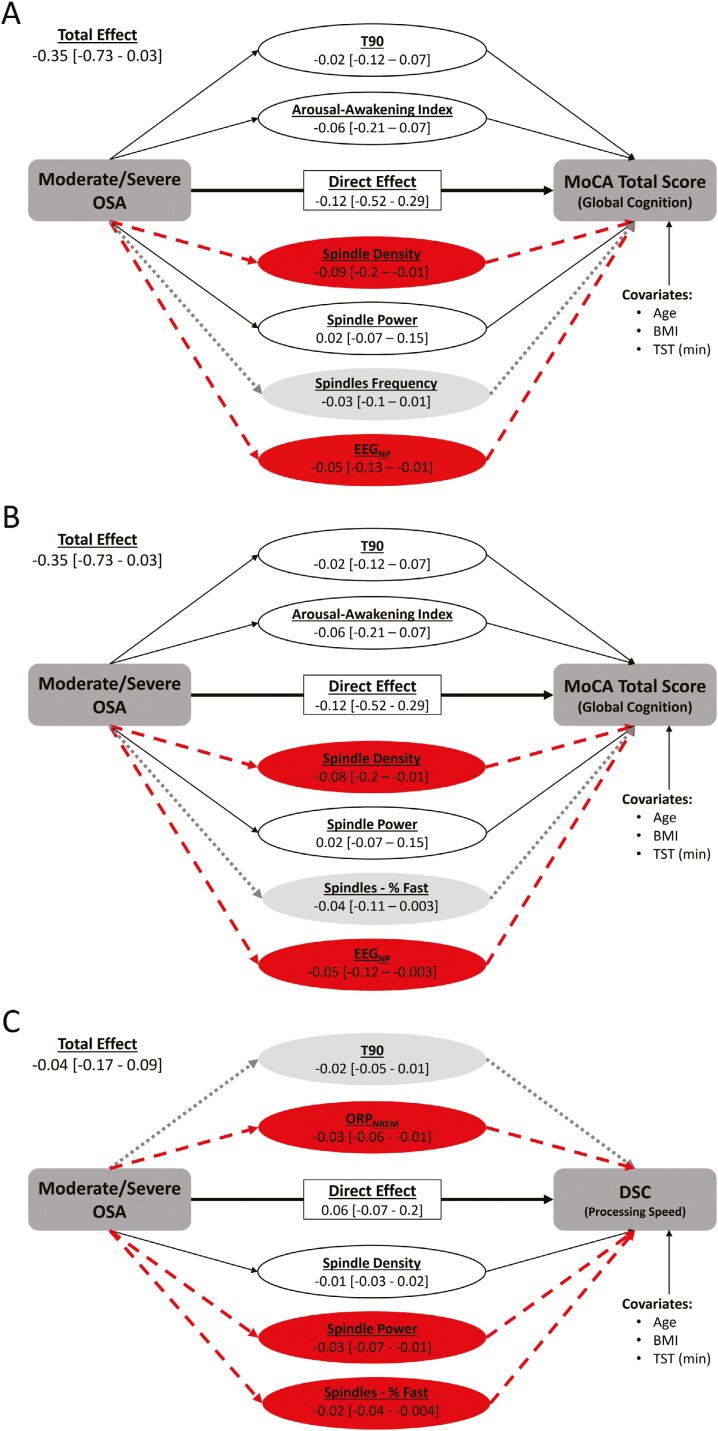
Participants with suspected OSA (n = 1142) underwent in-laboratory polysomnography and completed sleep and medical history questionnaires, and tests of global cognition (Montreal Cognitive Assessment, MoCA), memory (Rey Auditory Verbal Learning Test, RAVLT) and information processing speed (Digit-Symbol Coding, DSC). Associations between cognitive scores and stage 2 non-rapid eye movement (NREM) sleep spindle density, power, frequency and %-fast (12-16Hz), odds-ratio product (ORP), normalized EEG power (EEGNP), and the delta:alpha ratio were assessed using multivariable linear regression (MLR) adjusted for age, sex, education, and total sleep time. Mediation analyses were performed to determine if sleep microarchitecture indices mediate the negative effect of OSA on cognition.
All spindle characteristics were lower in participants with moderate and severe OSA (p ≤ .001, vs. no/mild OSA) and positively associated with MoCA, RAVLT, and DSC scores (false discovery rate corrected p-value, q ≤ 0.026), except spindle power which was not associated with RAVLT (q = 0.185). ORP during NREM sleep (ORPNREM) was highest in severe OSA participants (p ≤ .001) but neither ORPNREM (q ≥ 0.230) nor the delta:alpha ratio were associated with cognitive scores in MLR analyses (q ≥ 0.166). In mediation analyses, spindle density and EEGNP (p ≥ .048) mediated moderate-to-severe OSA's negative effect on MoCA scores while ORPNREM, spindle power, and %-fast spindles mediated OSA's negative effect on DSC scores (p ≤ .018).
Altered spindle activity, ORP and normalized EEG power may be important contributors to cognitive deficits in patients with OSA.
阻塞性睡眠呼吸暂停(OSA)会增加认知障碍的风险。脑电图(EEG)测量的睡眠微结构指标可能有助于识别有这种并发症风险的患者。
疑似OSA的参与者(n = 1142)接受了实验室多导睡眠图检查,并完成了睡眠和病史问卷,以及整体认知测试(蒙特利尔认知评估,MoCA)、记忆测试(雷伊听觉词语学习测验,RAVLT)和信息处理速度测试(数字符号编码,DSC)。使用针对年龄、性别、教育程度和总睡眠时间进行调整的多变量线性回归(MLR)评估认知分数与2期非快速眼动(NREM)睡眠纺锤波密度、功率、频率和快速(12 - 16Hz)百分比、优势比乘积(ORP)、标准化脑电图功率(EEGNP)以及δ:α比值之间的关联。进行中介分析以确定睡眠微结构指标是否介导OSA对认知的负面影响。
中重度OSA参与者的所有纺锤波特征均较低(p≤0.001,与无/轻度OSA相比),并且与MoCA、RAVLT和DSC分数呈正相关(错误发现率校正p值,q≤0.026),但纺锤波功率与RAVLT无关(q = 0.185)。NREM睡眠期间的ORP(ORPNREM)在重度OSA参与者中最高(p≤0.001),但在MLR分析中,ORPNREM(q≥0.230)和δ:α比值均与认知分数无关(q≥0.166)。在中介分析中,纺锤波密度和EEGNP(p≥0.048)介导了中重度OSA对MoCA分数的负面影响,而ORPNREM、纺锤波功率和快速纺锤波百分比介导了OSA对DSC分数的负面影响(p≤0.018)。
纺锤波活动、ORP和标准化脑电图功率的改变可能是OSA患者认知缺陷的重要因素。