Osigwe Pacelli C, Agomoh Chukwudike E, Osigwe Ifunanya S, Akumiah Florence K
Department of Cardiology, Bronglais General Hospital, Aberystwyth, GBR.
Department of Family Medicine, Hall Street Medical Centre, St. Helens, GBR.
Cureus. 2024 Jun 28;16(6):e63379. doi: 10.7759/cureus.63379. eCollection 2024 Jun.
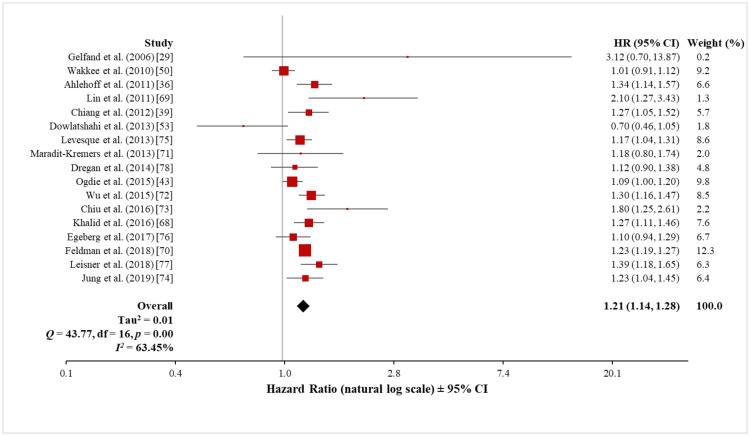
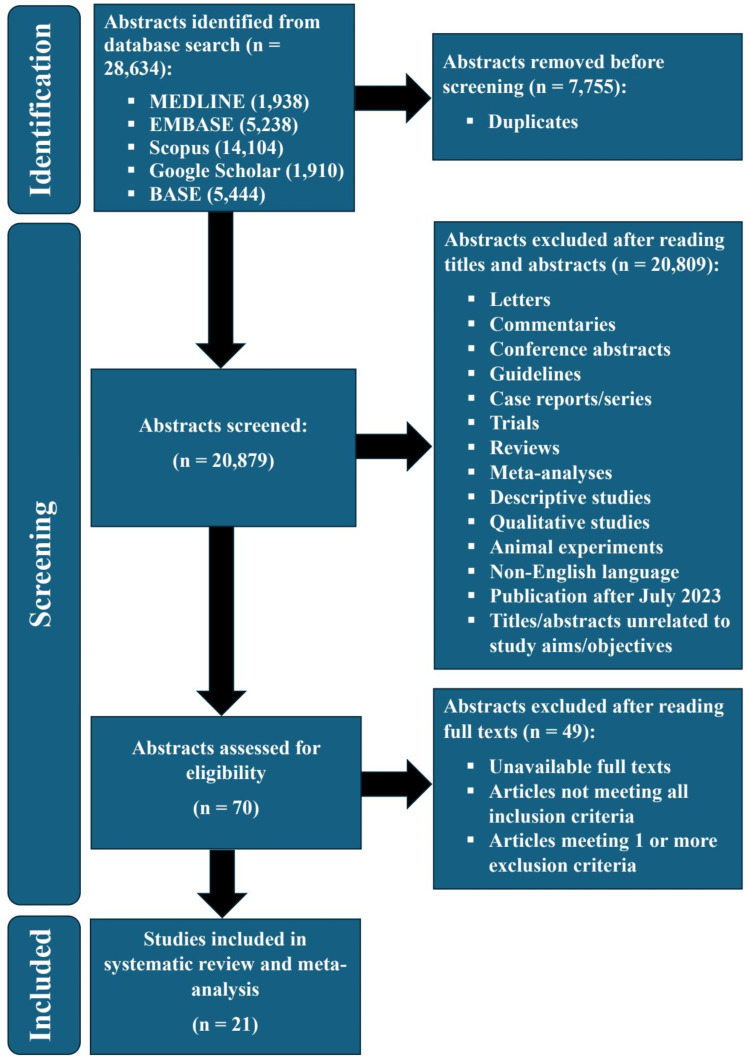
Psoriasis is a chronic immune-mediated disease affecting the skin, nails, and/or joints. It is associated with systemic inflammation and may also be linked to an increased risk of atherosclerotic cardiovascular disease (ASCVD). The objectives of this study were to determine the overall risk of ASCVD in patients with psoriasis and to evaluate the risk according to ASCVD type and the severity of psoriasis. This was a systematic review and meta-analysis of observational studies reporting the association between psoriasis and one or more of the clinical types of ASCVD. We searched Medical Literature Analysis and Retrieval System Online (MEDLINE) via PubMed, Excerpta Medica Database (EMBASE), Scopus, Bielefeld Academic Search Engine (BASE), and Google Scholar for relevant studies in the English language from the beginning of their records to July 2023. Study selection and data extraction were conducted by four independent reviewers. A total of 21 observational studies (three cross-sectional, one case-control, and 17 cohort) were included in this review, representing a total of 778,049 patients with psoriasis and 16,881,765 control subjects without psoriasis. The included studies had varying degrees of covariate adjustment, and thus, their findings may have been subject to residual confounding. All the meta-analyses used the adjusted effect sizes and were based on the random-effects model. However, the cohort studies were analysed separately from the non-cohort studies (the case-control and cross-sectional studies). There was a significant association between psoriasis and ASCVD (cohort studies: hazard ratio (HR), 1.21; 95% confidence interval (CI), 1.14 to 1.28; I = 63%; p < 0.001; non-cohort studies: odds ratio (OR), 1.60; 95% CI, 1.34 to 1.92; I = 31%; p = 0.23). Psoriasis was also significantly associated with myocardial infarction (cohort studies: HR, 1.20; 95% CI, 1.10 to 1.31; I = 60%; p < 0.001; non-cohort studies: OR, 1.57; 95% CI, 1.15 to 2.15; I = 74%; p = 0.05), coronary artery disease (cohort studies: HR, 1.20; 95% CI, 1.13 to 1.28; I = 67%; p < 0.001; non-cohort studies: OR, 1.60; 95% CI, 1.34 to 1.92; I = 31%; p = 0.23), aortic aneurysm (HR, 1.45; 95% CI, 1.04 to 2.02; I = 67%; p = 0.08) but not with ischaemic stroke (HR, 1.14; 95% CI, 0.96 to 1.36; I = 44%; p = 0.17). Pooled analysis in terms of the severity of psoriasis showed that both mild (cohort studies: HR, 1.17; 95% CI, 1.08 to 1.26; I = 74%; p < 0.001; non-cohort studies: OR, 1.54; 95% CI, 1.25 to 1.90; I = 0%; p = 0.50) and severe (cohort studies: HR, 1.43; 95% CI, 1.23 to 1.65; I = 65%; p < 0.001; non-cohort studies: OR, 1.65; 95% CI, 1.29 to 2.12; I = 25%; p = 0.26) psoriasis were significantly associated with ASCVD. Psoriasis (including mild and severe disease) is associated with an increased risk of ASCVD, including coronary artery disease (CAD) and aortic aneurysm (AA). ASCVD risk assessment and prevention should be prioritised in all adult psoriasis patients. Future observational studies investigating the association between psoriasis and ASCVD should conduct a more comprehensive adjustment of covariates.
银屑病是一种慢性免疫介导性疾病,可累及皮肤、指甲和/或关节。它与全身炎症相关,还可能与动脉粥样硬化性心血管疾病(ASCVD)风险增加有关。本研究的目的是确定银屑病患者发生ASCVD的总体风险,并根据ASCVD类型和银屑病严重程度评估风险。这是一项对观察性研究的系统评价和荟萃分析,这些研究报告了银屑病与一种或多种ASCVD临床类型之间的关联。我们通过PubMed检索医学文献分析与联机检索系统(MEDLINE)、医学文摘数据库(EMBASE)、Scopus、比勒费尔德学术搜索引擎(BASE)和谷歌学术,查找从其记录开始至2023年7月的英文相关研究。研究选择和数据提取由四名独立评审员进行。本评价共纳入21项观察性研究(3项横断面研究、1项病例对照研究和17项队列研究),共涉及778,049例银屑病患者和16,881,765例无银屑病的对照受试者。纳入的研究有不同程度的协变量调整,因此,其研究结果可能存在残余混杂因素。所有荟萃分析均使用调整后的效应量,并基于随机效应模型。然而,队列研究与非队列研究(病例对照研究和横断面研究)分开分析。银屑病与ASCVD之间存在显著关联(队列研究:风险比(HR)为1.21;95%置信区间(CI)为1.14至1.28;I² = 63%;p < 0.001;非队列研究:优势比(OR)为1.60;95%CI为1.34至1.92;I² = 31%;p = 0.23)。银屑病与心肌梗死也显著相关(队列研究:HR为1.20;95%CI为1.10至1.31;I² = 60%;p < 0.001;非队列研究:OR为1.57;95%CI为1.15至2.15;I² = 74%;p = 0.05)、冠状动脉疾病(队列研究:HR为1.20;95%CI为1.13至1.28;I² = 67%;p < 0.001;非队列研究:OR为1.60;95%CI为1.34至1.9,2;I² = 31%;p = 0.23)、主动脉瘤(HR为1.45;95%CI为1.04至2.02;I² = 67%;p = 0.08),但与缺血性卒中无关(HR为1.14;95%CI为0.96至1.36;I² = 44%;p = 0.17)。根据银屑病严重程度进行的汇总分析表明,轻度(队列研究:HR为1.17;95%CI为1.08至1.26;I² = 74%;p < 0.001;非队列研究:OR为1.54;95%CI为1.25至1.90;I² = 0%;p = 0.50)和重度(队列研究:HR为1.43;95%CI为1.23至1.65;I² = 65%;p < 0.001;非队列研究:OR为1.65;95%CI为1.29至2.12;I² = 25%;p = 0.26)银屑病均与ASCVD显著相关。银屑病(包括轻度和重度疾病)与ASCVD风险增加相关,包括冠状动脉疾病(CAD)和主动脉瘤(AA)。所有成年银屑病患者均应优先进行ASCVD风险评估和预防。未来调查银屑病与ASCVD之间关联的观察性研究应更全面地调整协变量。