Rossi Antonio, Zipfel Jonas, Maity Indrajit, Lorenzon Monica, Dandu Medha, Barré Elyse, Francaviglia Luca, Regan Emma C, Zhang Zuocheng, Nie Jacob H, Barnard Edward S, Watanabe Kenji, Taniguchi Takashi, Rotenberg Eli, Wang Feng, Lischner Johannes, Raja Archana, Weber-Bargioni Alexander
The Molecular Foundry, Lawrence Berkeley National Laboratory, Berkeley, California 94720, United States.
Advanced Light Source, Lawrence Berkeley National Laboratory, Berkeley, California 94720, United States.
ACS Nano. 2024 Jul 16;18(28):18202-18210. doi: 10.1021/acsnano.4c00015. Epub 2024 Jul 1.
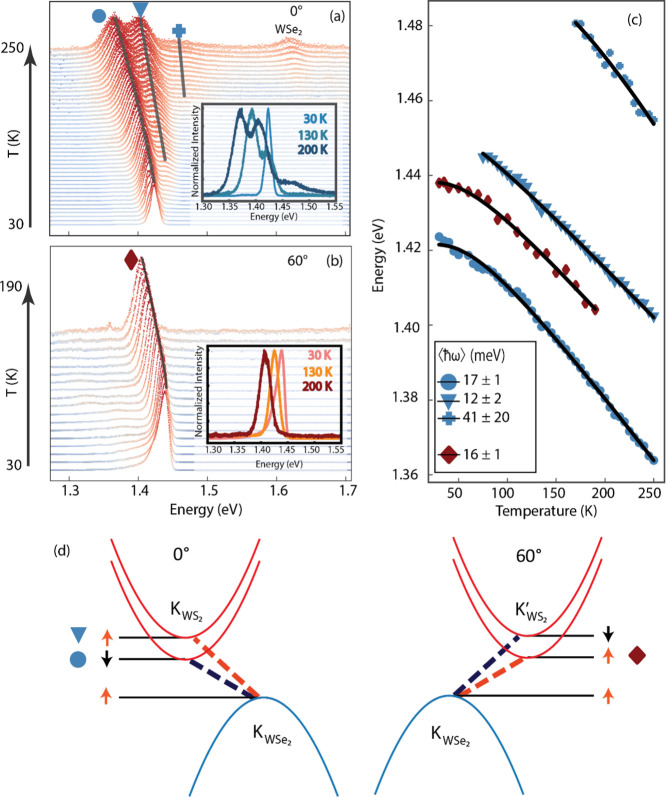
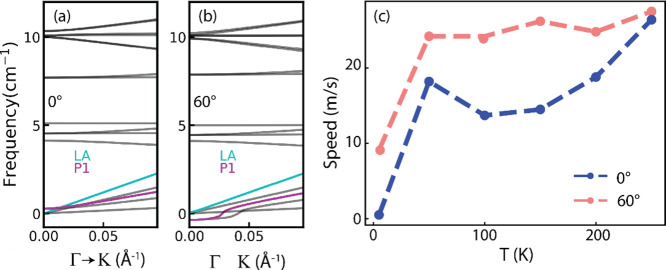
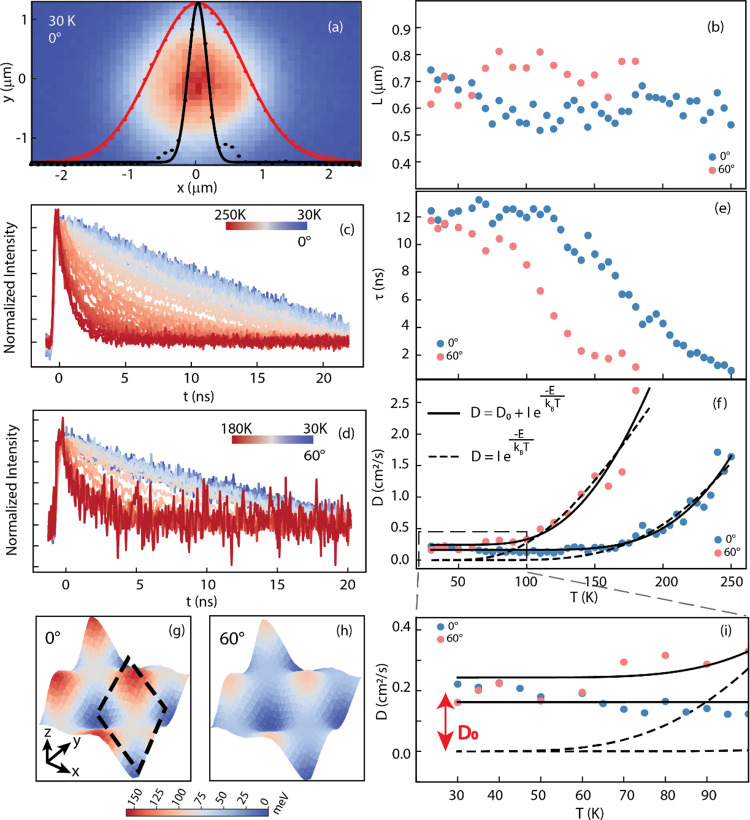
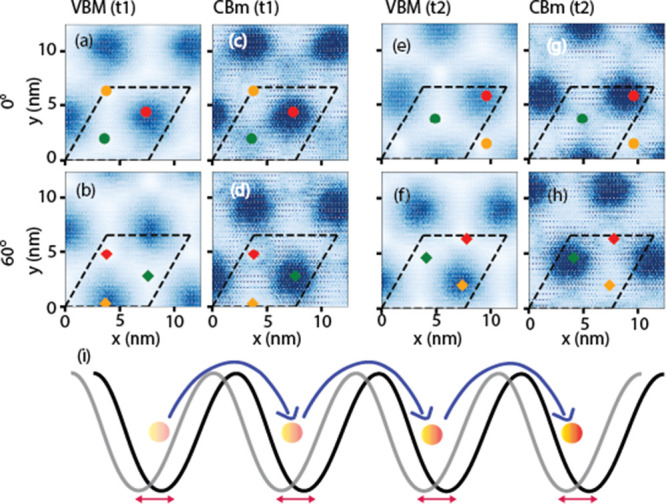
Stacking van der Waals crystals allows for the on-demand creation of a periodic potential landscape to tailor the transport of quasiparticle excitations. We investigate the diffusion of photoexcited electron-hole pairs, or excitons, at the interface of WS/WSe van der Waals heterostructure over a wide range of temperatures. We observe the appearance of distinct interlayer excitons for parallel and antiparallel stacking and track their diffusion through spatially and temporally resolved photoluminescence spectroscopy from 30 to 250 K. While the measured exciton diffusivity decreases with temperature, it surprisingly plateaus below 90 K. Our observations cannot be explained by classical models like hopping in the moiré potential. A combination of ab initio theory and molecular dynamics simulations suggests that low-energy phonons arising from the mismatched lattices of moiré heterostructures, also known as phasons, play a key role in describing and understanding this anomalous behavior of exciton diffusion. Our observations indicate that the moiré potential landscape is dynamic down to very low temperatures and that the phason modes can enable efficient transport of energy in the form of excitons.
堆叠范德华晶体能够按需创建周期性势场,以调控准粒子激发的输运。我们研究了在很宽的温度范围内,光激发的电子 - 空穴对(即激子)在WS/WSe范德华异质结构界面处的扩散。我们观察到了平行和反平行堆叠时不同层间激子的出现,并通过空间和时间分辨光致发光光谱追踪了它们在30至250 K温度范围内的扩散。虽然测得的激子扩散率随温度降低,但令人惊讶的是,在90 K以下它趋于平稳。我们的观察结果无法用诸如在莫尔势中跳跃等经典模型来解释。从头算理论和分子动力学模拟相结合表明,莫尔异质结构晶格失配产生的低能声子(也称为相位子)在描述和理解激子扩散的这种异常行为中起着关键作用。我们的观察结果表明,莫尔势场在极低温度下都是动态的,并且相位子模式能够以激子的形式实现能量的高效输运。