Tůmová Michala, Jílková Veronika, Macek Petr, Devetter Miloslav
Faculty of Science University of South Bohemia České Budějovice Czech Republic.
Institute of Soil Biology and Biogeochemistry Biology Centre, Czech Academy of Sciences České Budějovice Czech Republic.
Ecol Evol. 2024 Jul 3;14(7):e11386. doi: 10.1002/ece3.11386. eCollection 2024 Jul.
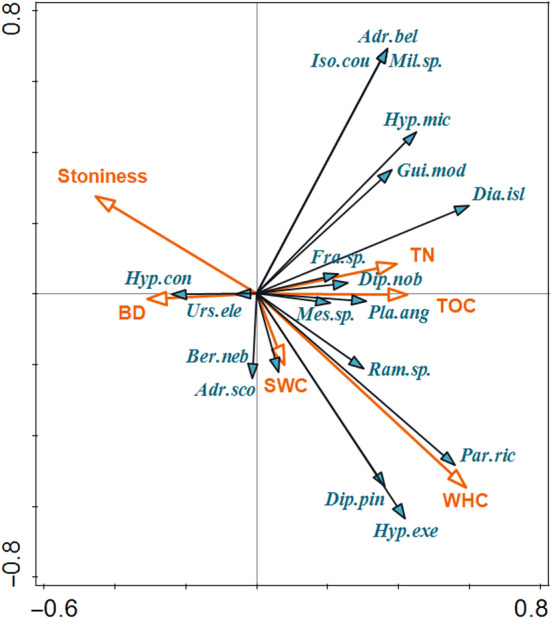
Tardigrades are omnipresent microfauna with scarce record on their ecology in soils. Here, we investigated soil inhabiting tardigrade communities in five contrasting polar habitats, evaluating their abundance, diversity, species richness, and species composition. Moreover, we measured selected soil physico-chemical properties to find the drivers of tardigrade distribution among these habitats. In spite of reported tardigrade viability in extreme conditions, glacier forelands represented a habitat almost devoid of tardigrades. Even dry and wet tundra with soil developing for over more than 10 000 years held low abundances compared to usual numbers of tardigrades in temperate habitats. Polar habitats also differ in species composition, with being typical species for dry and for wet tundra. Overall, tardigrade abundance was affected by the content of nutrients as well as physical properties of soil, i.e. content of total nitrogen (TN), total organic carbon (TOC), stoniness, soil texture and the water holding capacity (WHC). While diversity and species composition were significantly related to soil physical properties such as the bulk density (BD), soil texture, stoniness, and WHC. Physical structure of environment was, therefore, an important predictor of tardigrade distribution in polar habitats. Since many studies failed to identify significant determinants of tardigrade distribution, we encourage scientists to include physical properties of tardigrade habitats as explanatory variables in their studies.
缓步动物是无处不在的微型动物,但关于它们在土壤中的生态学记录却很少。在这里,我们调查了五个不同极地栖息地中栖息在土壤中的缓步动物群落,评估了它们的丰度、多样性、物种丰富度和物种组成。此外,我们测量了选定的土壤理化性质,以找出这些栖息地中缓步动物分布的驱动因素。尽管有报道称缓步动物在极端条件下具有生存能力,但冰川前沿却是一个几乎没有缓步动物的栖息地。与温带栖息地中通常数量的缓步动物相比,即使是有超过10000年土壤发育历史的干湿苔原,其缓步动物数量也很低。极地栖息地的物种组成也有所不同, 是干旱苔原的典型物种, 是潮湿苔原的典型物种。总体而言,缓步动物的丰度受到土壤养分含量以及物理性质的影响,即总氮(TN)、总有机碳(TOC)含量、含石量、土壤质地和持水量(WHC)。而多样性和物种组成与土壤物理性质如容重(BD)、土壤质地、含石量和持水量显著相关。因此,环境的物理结构是极地栖息地缓步动物分布的重要预测指标。由于许多研究未能确定缓步动物分布的重要决定因素,我们鼓励科学家在研究中将缓步动物栖息地的物理性质作为解释变量。